
Recursos
Exploren una amplia gama de recursos valiosos en GCED para profundizar su comprensión y promover su búsqueda, incidencia, enseñanza y aprendizaje.
134 resultados encontrados
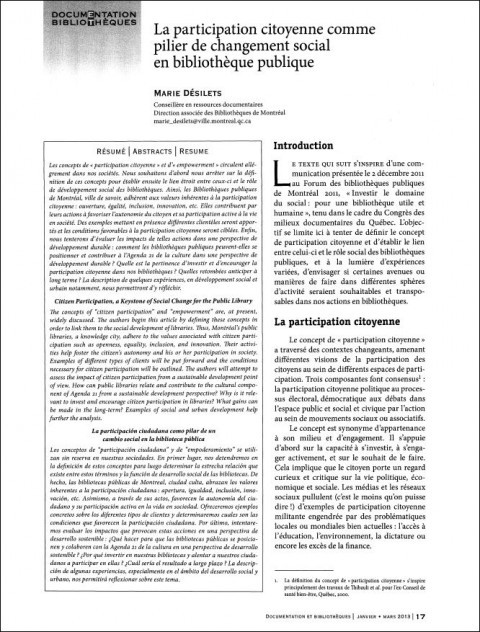 Citizen Participation, a Keystone of Social Change for the Public Library Año de publicación: 2013 Autor: Marie Désilets Autor corporativo: Revue Documentation et bibliothèques The concepts of "citizen participation" and "empowerment" are, at present, widely discussed. The authors begin this article by defining these concepts in order to link them to the social development of libraries. Thus, Montréal's public libraries, a knowledge city, adhere to the values associated with citizen participation such as openness, equality, inclusion, and innovation. Their activities help foster the citizen's autonomy and his or her participation in society. Examples of different types of clients will be put forward and the conditions necessary for citizen participation will be outlined. The authors will attempt to assess the impact of citizen participation from a sustainable development point of view. How can public libraries relate and contribute to the cultural component of Agenda 21 from a sustainable development perspective? Why is it relevant to invest and encourage citizen participation in libraries? What gains can be made in the long-term? Examples of social and urban development help further the analysis.
 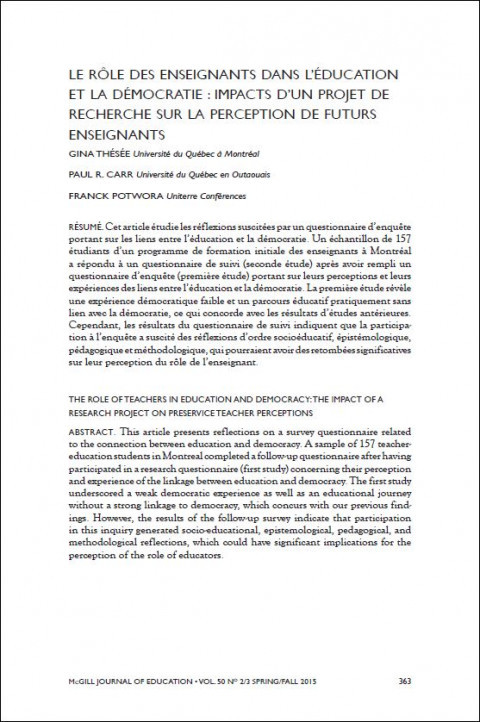 The Role of Teachers in Education and Democracy: The Impact of a Research Project on Preservice Teacher Perceptions Año de publicación: 2015 Autor: Gina Thésée | Paul R. Carr | Franck Potwora Autor corporativo: McGill University. Faculty of Education This article presents reflections on a survey questionnaire related to the connection between education and democracy. A sample of 157 teacher-education students in Montreal completed a follow-up questionnaire after having participated in a research questionnaire (first study) concerning their perception and experience of the linkage between education and democracy. The first study underscored a weak democratic experience as well as an educational journey without a strong linkage to democracy, which concurs with our previous findings. However, the results of the follow-up survey indicate that participation in this inquiry generated socio-educational, epistemological, pedagogical, and methodological reflections, which could have significant implications for the perception of the role of educators. La participación ciudadana como pilar de un cambio social en la biblioteca pública Año de publicación: 2013 Autor: Marie Désilets Autor corporativo: Revue Documentation et bibliothèques Los conceptos de "participación ciudadana" y de "empoderamiento" se utilizan sin reserva en nuestras sociedades. En primer lugar, nos detendremos en la definición de estos conceptos para luego determinar la estrecha relación que existe entre estos términos y la función de desarrollo social de las bibliotecas. De hecho, las bibliotecas públicas de Montreal, ciudad culta, abrazan los valores inherentes a la participación ciudadana: apertura, igualdad, inclusión, innovación, etc. Asimismo, a través de sus actos, favorecen la autonomía del ciudadano y su participación activa en la vida en sociedad. Ofreceremos ejemplos concretos sobre los diferentes tipos de clientes y determinaremos cuales son las condiciones que favorecen la participación ciudadana. Por último, intentaremos evaluar los impactos que provocan estas acciones en una perspectiva de desarrollo sostenible: ¿Qué hacer para que las bibliotecas públicas se posicionen y colaboren con la Agenda 21 de la cultura en una perspectiva de desarrollo sostenible? ¿Por qué invertir en nuestras bibliotecas y alentar a nuestros ciudadanos a participar en ellas? ¿Cuál sería el resultado a largo plazo? La descripción de algunas experiencias, especialmente en el ámbito del desarrollo social y urbano, nos permitirá reflexionar sobre este tema. La participation citoyenne comme pilier de changement social en bibliothèque publique Año de publicación: 2013 Autor: Marie Désilets Autor corporativo: Revue Documentation et bibliothèques Les concepts de « participation citoyenne » et d’« empowerment » circulent allègrement dans nos sociétés. Nous souhaitons d’abord nous arrêter sur la définition de ces concepts pour établir ensuite le lien étroit entre ceux-ci et le rôle de développement social des bibliothèques. Ainsi, les Bibliothèques publiques de Montréal, ville de savoir, adhèrent aux valeurs inhérentes à la participation citoyenne : ouverture, égalité, inclusion, innovation, etc. Elles contribuent par leurs actions à favoriser l’autonomie du citoyen et sa participation active à la vie en société. Des exemples mettant en présence différentes clientèles seront apportés et les conditions favorables à la participation citoyenne seront ciblées. Enfin, nous tenterons d’évaluer les impacts de telles actions dans une perspective de développement durable : comment les bibliothèques publiques peuvent-elles se positionner et contribuer à l’Agenda 21 de la culture dans une perspective de développement durable ? Quelle est la pertinence d’investir et d’encourager la participation citoyenne dans nos bibliothèques ? Quelles retombées anticiper à long terme ? La description de quelques expériences, en développement social et urbain notamment, nous permettront d’y réfléchir.
 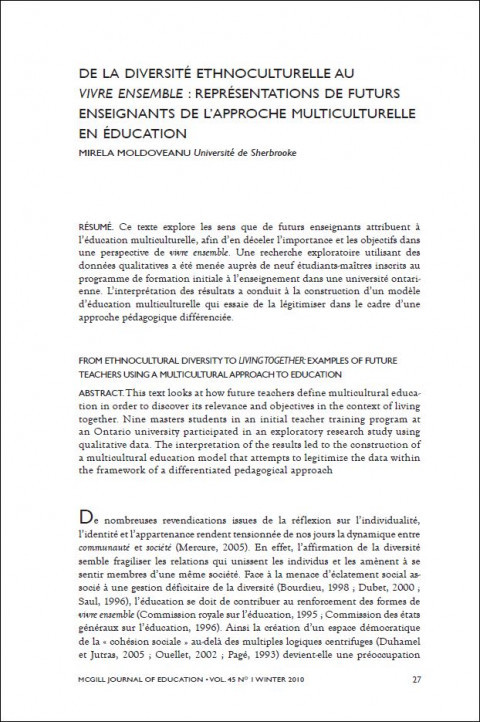 From Ethnocultural Diversity to Living Together: Examples of Future Teachers Using a Multicultural Approach to Education Año de publicación: 2010 Autor: Mirela Moldoveanu Autor corporativo: McGill University. Faculty of Education This text looks at how future teachers define multicultural education in order to discover its relevance and objectives in the context of living together. Nine masters students in an initial teacher training program at an Ontario university participated in an exploratory research study using qualitative data. The interpretation of the results led to the construction of a multicultural education model that attempts to legitimize the data within the framework of a differentiated pedagogical approach.
  MODÈLES DE RECHERCHE: Démocratie, citoyenneté mondiale et éducation transformatoire Año de publicación: 2018 Autor: Paul R. Carr | Gina Thésée Autor corporativo: Chaire UNESCO Démocratie, citoyenneté mondiale et éducation transformatoire (DCMÉT) Les modèles conceptuels et théoriques présentés dans ce document ont été élaborés sur une période d’environ douze ans, commençant en 2005, par le titulaire (Paul R. Carr, Université du Québec en Outaouais) et la co-titulaire (Gina Thésée, Université du Québec à Montréal) de la Chaire UNESCO. Ces modèles ont été publiés dans diverses revues académiques, en anglais ou en français et ont été traduits et adaptés ici pour produire une représentation mise à jour et bilingue de la recherche sur l’éducation pour la démocratie que Carr et Thésée ont réalisée. Certains de ces modèles ont été affinés (et améliorés) avec le temps et sont des moyens qui aident à élucider, interroger et mettre en évidence le sens des trois thèmes qui sous-tendent la Chaire UNESCO DCMÉT. Research Models Laying the Foundation for the Unesco Chair: Democracy, Global Citizenship and Transformative Education (DCMÉT) Año de publicación: 2018 Autor: Paul R. Carr | Gina Thésée Autor corporativo: Chaire UNESCO Démocratie, citoyenneté mondiale et éducation transformatoire (DCMÉT) The conceptual and theoretical models presented in this document were developed over a roughly twelve-year period, starting in 2005, by the Chair (Paul R. Carr, Université du Québec en Outaouais) and Co-Chair (Gina Thésée, Université du Québec à Montréal) of the UNESCO Chair DCMÉT. These models have been published in diverse academic journals in either English or French, and have been translated and adapted herein to produce an updated and bilingual representation of the Education for Democracy research that Carr and Thésée have produced. In some cases, the models have been refined (and improved) over time, and they are presented as a means of attempting to elucidate, interrogate and highlight the meaning of the three themes that underpin the UNESCO Chair DCMÉT.
  Between Colonial Heritage and Political Autonomy. Comparing the Experience of Australian, American and Canadian Aboriginal Peoples in the Turmoil of Welfare State Reform Año de publicación: 2016 Autor: Martin Papillon Autor corporativo: Lien social et Politiques Long excluded, then victims of forced assimilation, aboriginal peoples are now evaluating the conditions of their belonging to and participation in citizenship regimes in these three former colonies. The processes of welfare state restructuring may influence the dynamic of identity claims of aboriginal peoples, by modifying the parameters of social citizenship and the relations that aboriginal peoples have with the state. These reforms lean, on the one hand, towards integrated policy with targeted programmes and, on the other hand, towards greater local autonomy in programme management. The post-war citizenship regime in contrast favoured a uniform relationship between citizens and the state, thereby setting up a contradiction between the terms of the citizenship regime and maintenance of a distinct legal regime for aboriginal peoples. The current model seems less likely to constitute a block to recognition of multiplicity and differentiation. Entre l’héritage colonial et la recherche d’autonomie politique: les peuples autochtones dans la tourmente des réformes de l’État-providence. Une comparaison de l’expérience australienne, américaine et canadienne Año de publicación: 2016 Autor: Martin Papillon Autor corporativo: Lien social et Politiques Longtemps exclus, puis victimes de politiques d’assimilation forcée, les peuples autochtones remettent aujourd’hui en question les conditions de leur appartenance et de leur participation au régime de citoyenneté des États issus de la colonisation européenne. Le processus de restructuration de l’État-providence pourrait influencer la dynamique des revendications identitaires autochtones, en modifiant les paramètres de la citoyenneté sociale et la relation des peuples autochtones avec l’État. On tend aujourd’hui, d’une part, à l’intégration programmatique accompagnée de mesures ciblées et, d’autre part, à une plus grande autonomie locale dans la gestion de ces programmes. Le régime de citoyenneté d’après-guerre favorisait plutôt une uniformisation du rapport entre les citoyens et l’État, et donc posait en contradiction l’intégration à ce régime et le maintien d’un régime statutaire distinct pour les autochtones. Le modèle actuel peut ainsi paraître moins réfractaire à la multiplicité et à la différenciation.
  L’enseignement de l’histoire au Québec instrumentalisé par l’éducation à la citoyenneté ? Año de publicación: 2013 Autor: FélixBouvier | PhilippeChamberland | Marie-Line Belleville Autor corporativo: Bulletin d'histoire politique Cet article permet d’identifi er des similitudes et des différences quant aux choix pris par diverses grandes démocraties relativement à l’enseignement de l’histoire et de l’éducation à la citoyenneté en contexte pluraliste. D’abord, la France, l’Angleterre, l’Australie et le Québec mettent tous l’accent sur la pensée critique dans l’enseignement et encouragent les débats et les discussions en classe afi n de préparer les jeunes à devenir des citoyens actifs. Ces démocraties reconnaissent que, pour parvenir à dispenser une éducation à la citoyenneté de qualité, les enseignants doivent être formés en ce sens et ont besoin de soutien. Finalement, elles soulignent le rôle important de la communauté scolaire, microsociété responsable de favoriser le développement de valeurs démocratiques et d’habiletés so-Association québécoise d’histoire politique 129 ciales chez l’élève, notamment en lui offrant de bons exemples de vivreensemble.