
Recursos
Exploren una amplia gama de recursos valiosos en GCED para profundizar su comprensión y promover su búsqueda, incidencia, enseñanza y aprendizaje.
3,385 resultados encontrados
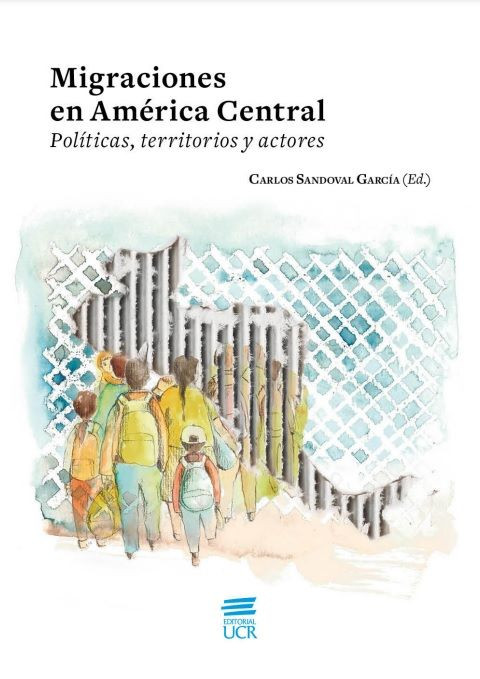 Migrations in Central America: Policies, Territories and Actors. Año de publicación: 2016 Autor: Carlos Sandival García Autor corporativo: Editorial Universidad de Costa Rica Migrations in Central America. Policies, Territories, and Actors seeks to offer an approach to the various dimensions of the migratory experience in Central America. Four starting points characterize this book: the public nature of the call, the collective dimension of the work, the regional perspective that is nourished by the contrast and comparison of cases and, fourthly, the call that gives rise to this book. This has allowed us to have a concrete task to shape the expectations of public, collective and regional work. Migraciones en América Central: Politicas, territorios y actores. Año de publicación: 2016 Autor: Carlos Sandival García Autor corporativo: Editorial Universidad de Costa Rica Migraciones en América Central. Políticas, territorios y actores procura ofrecer un acercamiento a las diversas dimensiones de la experiencia migratoria en Centroamérica. Cuatro puntos de partida caracterizan este libro: el carácter público de la convocatoria, la dimensión colectiva del trabajo, la perspectiva regional que se nutre del contraste y comparación de casos y, en cuarto lugar, la convocatoria que da origen a este libro. Lo anterior ha permitido contar con una tarea concreta para darle forma a las expectativas del trabajo público, colectivo y regional.
 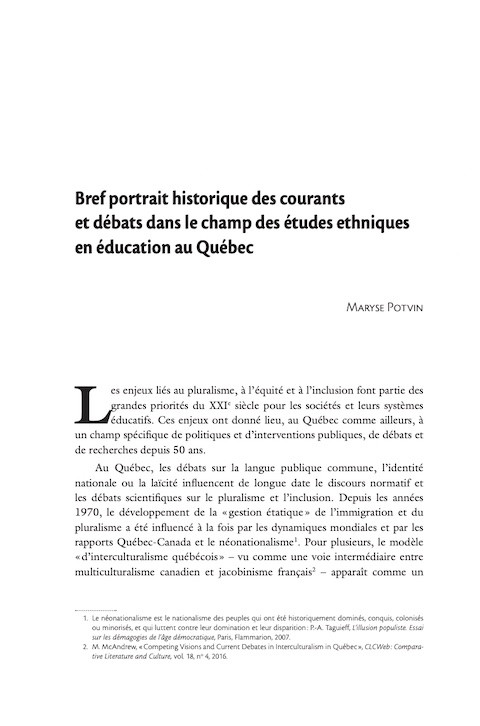 A Brief History of Currents and Debates in the Field of Ethnic Studies in Education in the Quebec Society (Cahiers de recherche sociologique; no. 64) Año de publicación: 2018 Autor: Maryse Potvin Autor corporativo: Athéna éditions The issues of pluralism, equity and inclusion are among the top priorities of the 21st century for education systems. These issues have given rise, in Quebec as elsewhere, to a specific field of public policies and interventions, debates and research for 50 years. This article traces the relatively "successive" appearance of currents - multicultural or intercultural, anti-racist, civic and rights-based, inclusive, still present in the sociology of education today - and shows how they marked (and predominated in) the normative discourses and the field of ethnic studies in education in Quebec during three different periods : the years 1970-1980, 1990-2000, 2010 to the present day. This article outlines the main "currents of ideas" and debates in this field of education during these three periods, and situates these debates in their links, both with the main social issues or significant events in the Quebec context and with the evolution of public policies in this field. Bref portrait historique des courants et débats dans le champ des études ethniques en éducation au Québec (Cahiers de recherche sociologique; no. 64) Año de publicación: 2018 Autor: Maryse Potvin Autor corporativo: Athéna éditions Les enjeux liés au pluralisme, à l’équité et à l’inclusion font partie des grandes priorités du XXIe siècle pour les systèmes éducatifs. Ces enjeux ont donné lieu, au Québec comme ailleurs, à un champ spécifique de politiques et d’interventions publiques, de débats et de recherches depuis 50 ans. Cet article retrace l’apparition relativement « successive » de courants - multiculturel ou interculturel, antiraciste, à la citoyenneté et aux droits, inclusif, encore tous présents dans la sociologie de l’éducation aujourd’hui – et montre comment ils ont marqué (et prédominé davantage dans) les discours normatifs et le champ des études ethniques en éducation au Québec au cours de trois périodes différentes : les années 1970-1980, 1990-2000, 2010 à nos jours. Cet article esquisse donc à grands traits les principaux « courants d’idées » et débats dans le champ en éducation au Québec au cours de ces trois périodes, et resitue ces débats dans leurs liens à la fois avec les principaux enjeux de société ou événements marquants du contexte québécois et avec l’évolution des politiques publiques dans ce champ.
 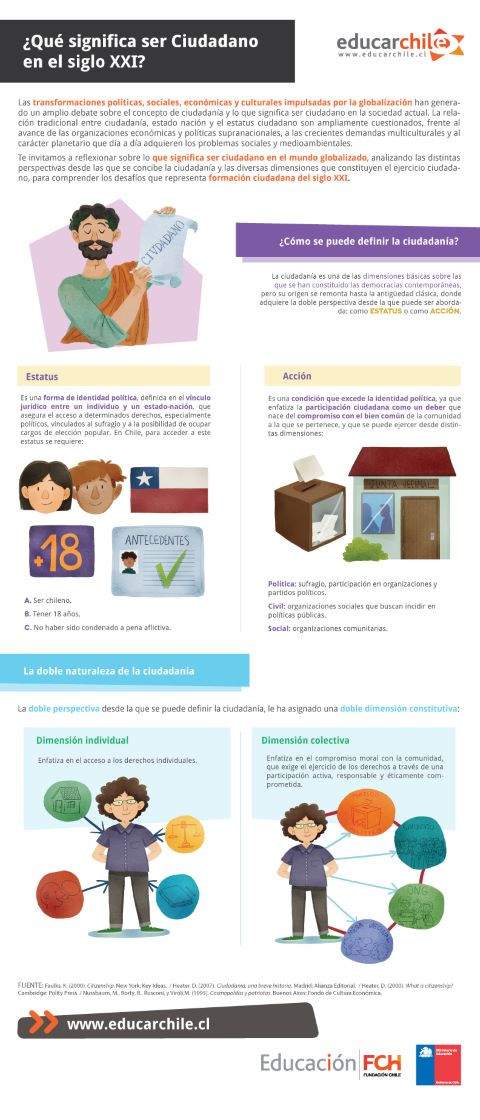 What Does it Mean to Be a Citizen in the 21st Century? (Part1) Autor corporativo: Educar Chile | Chile Foundation The political, social, economic and cultural transformations driven by globalization have generated a wide debate on the concept of citizenship and what it means to be a citizen in today's society. The traditional relationship between citizenship, nation state and citizen status are widely questioned, in the face of the advance of supranational economic and political organizations, the growing multicultural demands and the planetary character that social and environmental problems acquire day by day. ¿Qué significa ser ciudadano en el siglo XXI? (parte1) Autor corporativo: Educar Chile | Chile Foundation Las transformaciones políticas, sociales, económicas y culturales impulsadas por la globalización han generado un amplio debate sobre el concepto de ciudadanía y lo que significa ser ciudadano en la sociedad actual. La relación tradicional entre ciudadanía, estado nación y el estatus ciudadano son ampliamente cuestionados, frente al avance de las organizaciones económicas y políticas supranacionales, a las crecientes demandas multiculturales y al carácter planetario que día a día adquieren los problemas sociales y medioambientales.
 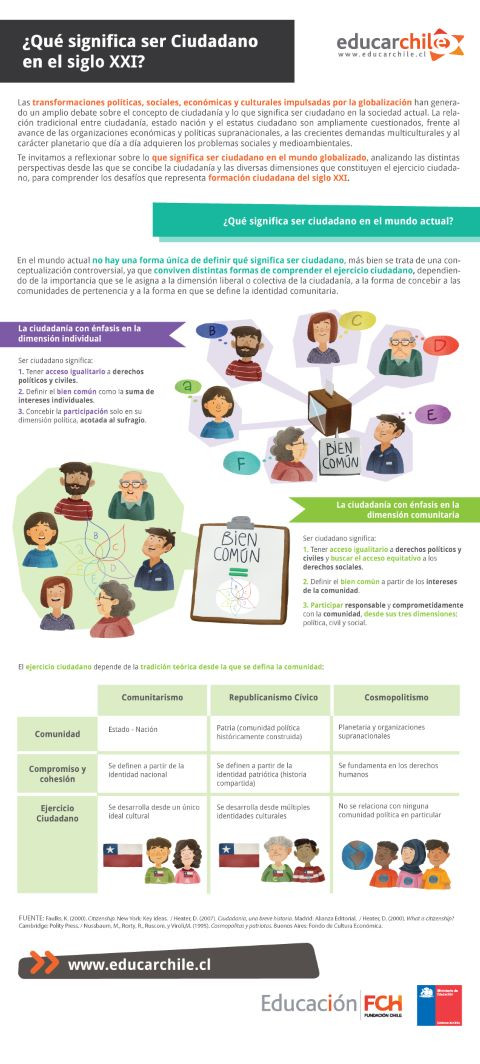 What Does it Mean to Be a Citizen in the 21st Century? (Part2) Autor corporativo: Educar Chile | Chile Foundation It is invited to reflect on what it means to be a citizen in the globalized world, analyzing the different perspectives from which citizenship is conceived and the various dimensions that constitute the exercise of citizenship, in order to understand the challenges that citizen training represents in the 21st century. ¿Qué significa ser ciudadano en el siglo XXI? (parte2) Autor corporativo: Educar Chile | Chile Foundation Se invita a reflexionar sobre lo que significa ser ciudadano en el mundo globalizado, analizando las distintas perspectivas desde las que se concibe la ciudadanía y las diversas dimensiones que constituyen el ejercicio ciudadano, para comprender los desafíos que representa formación ciudadana del siglo XXI.
 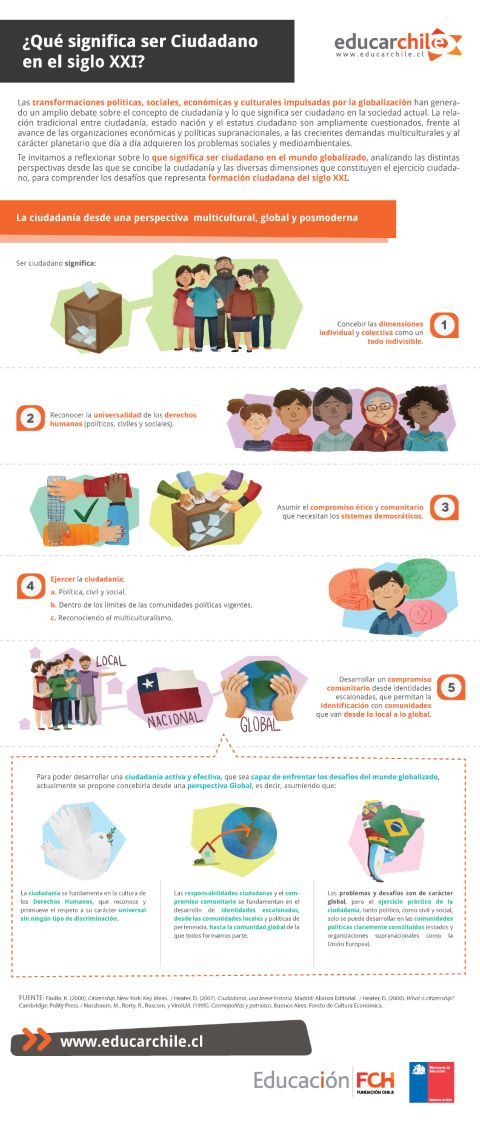 What Does it Mean to Be a Citizen in the 21st Century? (Part3) Autor corporativo: Educar Chile | Chile Foundation It explores citizenship from a multicultural, global and postmodern perspective, inviting reflection on the meaning of being a citizen in the 21st century, in order to understand the challenges from the various dimensions. ¿Qué significa ser ciudadano en el siglo XXI? (parte3) Autor corporativo: Educar Chile | Chile Foundation Explora la ciudadanía desde una perspectiva multicultural, global y posmoderna, invitando a la reflexión sobre el significado de ser ciudadano en el siglo XXI, para poder comprender los desafios desde las diversas dimensiones.