
Recursos
Exploren una amplia gama de recursos valiosos en GCED para profundizar su comprensión y promover su búsqueda, incidencia, enseñanza y aprendizaje.
1,182 resultados encontrados
 다문화가정 대상국가와의 교육교류사업 2022년도 사업: 최종보고서 Año de publicación: 2022 Autor corporativo: 유네스코 아시아태평양 국제이해교육원 | Korea R. Ministry of Education 2012년부터 시작되어 2022년에 11년 차를 맞이한 「다문화가정 대상국가와의 교육교류사업」 은, 2020년도 팬데믹으로 인해 물리적 교류가 불가능한 상황에서 비대면 온라인 교육교류의 형태로 진행되었다. 2022년도 교육교류 추진 실적 및 결과, 교육활동 결과물 등이 수록되어있다.
  Иcпользование живого наследия в учебном процессе в азиатскотихоокеанском регионе: комплект методических материалов Año de publicación: 2022 Autor corporativo: UNESCO Bangkok | Азиатско-Тихоокеанский центр образования для международного понимания (APCEIU) | International Information and Networking Centre for Intangible Cultural Heritage in the Asia-Pacific Region (ICHCAP) Использование концепций и практики живого наследия в учебном процессе может повысить качество образования, способствовать оживлению учебного процесса для учащихся и учителей и способствовать сохранению такого наследия для нынешнего и будущих поколений. Кроме того, как показала продолжающаяся пандемия COVID-19, живое наследие может играть важную роль в обеспечении благополучия и жизнеспособности человеческих сообществ. ЮНЕСКО призывает страны сохранять живое наследие посредством формального и неформального образования. С конца 2019 по начало 2022 года ЮНЕСКО совместно со своими партнёрами реализовала пилотный проект «Преподавание и обучение с использованием элементов живого наследия в школах» в шести странах Азиатско-Тихоокеанского региона — Камбодже, Казахстане, Кыргызстане, Непале, Южной Корее и Таиланде. Более 1900 учащихся из 21 школы получили возможность принять участие в этих инновационных занятиях. В ходе этого проекта 86 учителей, из которых более двух третей — женщины, разработали и опробовали 101 план уроков и мероприятий. Данный комплект методических материалов содержит пошаговое руководство и основные сведения, позволяющие понять важность и научиться интегрировать концепции и практику живого наследия в учебные и внеклассные мероприятия в школах. Кем бы вы ни были — сотрудником директивных органов, директором школы, учителем, учеником, родителем, практикующим носителем живого наследия — вам предстоит сыграть жизненно важную роль в этом процессе.
  ACER-APCEIU 세계시민교육 모니터링 가이드: 교사, 학교 관리자, 교육행정가를 위한 안내서 Año de publicación: 2025 Autor: Rachel Parker | Amy Berry | Payal Goundar | Karena Menzie-Ballantyne Autor corporativo: 호주교육연구위원회 | 유네스코 아시아태평양 국제이해교육원 『ACER-APCEIU 세계시민교육 모니터링 가이드: 교사, 학교 관리자, 교육행정가를 위한 안내서』는 APCEIU와 ACER가 2022년부터 2024년까지 3년에 걸쳐 호주, 라오스, 필리핀, 한국의 파트너들과 함께 수행한 공동연구의 결과물인 『ACER-APCEIU Global Citizenship Education Monitoring Toolkit for Teachers, Schools and System Leaders』를 한국의 맥락에 맞게 번역한 국문판이다.이 가이드는 다양한 수준의 교육 이해관계자가 세계시민교육에서 자신의 위치를 진단하고 목표와 계획을 수립하며, 실행과 평가를 지속적으로 이어가도록 설계된 탐구 순환 모형을 제시하며, 이를 각자의 맥락에 맞게 실천할 수 있도록 구체적인 지침과 방법을 안내한다.이 가이드의 주요 활용자는 정책 입안자, 교육부 및 교육청 등 유관 기관의 교육행정가, 학교장과 학교감 등 교육 리더십을 가진 이들뿐 아니라 정규·비정규 교육 전반에서 세계시민교육을 실천하는 모든 교사를 포함한다.
  2023 Asia-Pacific Training Workshop on EIU: Mentorship Programme Final Report Año de publicación: 2023 Autor corporativo: APCEIU Asia-Pacific Training Workshop on EIU/GCED (APTW) is APCEIU's flagship Training of Trainers (TOT) programme for educators and teacher trainers in the Asia-Pacific region. Over the last 23 years, APCEIU benefitted more than 650 educators through the workshop. Especially, since 2021, the workshop has been carried out online training workshops, mentorship, and local project implementation to further support the participants to bring positive and sustainable changes in their local communities. In 2023, the 22nd APTW was virtually held from 30 May to 8 June with the theme of 'GCED as a Common Vision for Change.' 56 enthusiastic educators from 16 UNESCO member states in the Asia-Pacific region joined the programme. The workshop provided a venue to learn and discuss how GCED could contribute to transforming current education. This report summarizes 14 GCED projects implemented in the Asia-Pacific region by the 22nd APTW alumni who participated in the mentorship programme.
  Global Capacity-Building Workshop on GCED 2023: Follow-Up Activity Report Año de publicación: 2023 Autor corporativo: APCEIU This report summarizes 15 GCED projects implemented by the selected mentees/grantees of APCElU's 8th Global Capacity-Building Workshop on GCED on 13-21 July 2023. The projects include teacher training workshops, curriculum development, school-based activities, and community development projects, undertaken by educators, teachers, and practitioners in Asia, Europe, Africa, Latin America, and the Caribbean. The mentees/grantees first participated in the 8th Global Capacity-Building Workshop on GCED in August 2023. After completing the Workshop, graduates submitted GCED proposals to be selected as grantees/mentees. The selected 15 mentees/grantees were matched with expert mentors who guided them in their project development and implementation. This report describes the summary of 15 projects held in different corners of the world along with their outputs.
  ACER-APCEIU Global Citizenship Education Monitoring Toolkit: For Teachers, Schools and System Leaders Año de publicación: 2024 Autor: Rachel Parker | Amy Berry | Payal Goundar | Karena Menzie-Ballantyne Autor corporativo: Australian Council for Educational Research (ACER) | APCEIU The APCEIU-ACER GCED Monitoring Toolkit was developed and informed by research conducted from 2022-2024 in collaboration with partners in Australia, Lao PDR, Philippines, and South Korea. The toolkit aims to assist education stakeholders to embed GCED within policy and practice in alignment with local, regional, and international frameworks. Target users of this toolkit include policy makers, education department and ministry personnel, leaders, and educators at all levels in both formal and non-formal education sectors.The toolkit explores effective GCED including how to conceptualise and define, plan, enact and monitor implementation, and how to measure success. By guiding educators and leaders to align their enactment and monitoring efforts to international guidance, research, theory and practice, this toolkit supports a robust and evidence-informed process for enacting GCED in ways that nurture learners as proactive and empowered global citizens.Phase I Report (Link): https://www.unescoapceiu.org/post/4995Phase II Report (Link): https://www.unescoapceiu.org/post/5184
  7th Meeting of UNESCO Category 2 Centres in Education: Meeting Report Año de publicación: 2023 Autor corporativo: APCEIU This meeting report provides the summary of the 7th Meeting of UNESCO Category 2 Centres in Education held on 7 November 2023 in Paris, France. It offers an overview of the presentations delivered by Category 2 Centres in Education, outlining their programmes and activities for the upcoming years, specifically for 2024.
  팬데믹 시대, 변혁적 교수법을 활용한 세계시민교육: 교사용 가이드 (초등·중등) Año de publicación: 2020 Autor: 김화선 | 박재준 | 하승천 [초등 편] | 양철진 | 최인선 | 최윤경 [중등 편] Autor corporativo: 유네스코 아시아태평양 국제이해교육원 본 교사용 가이드는 팬데믹과 관련된 다양한 세계시민교육 주제를 선정하여, 유네스코가 권장하는 변혁적 교수학습법(Transformative pedagogy)을 수업에 적용하여 실천해볼 수 있도록 구성하였다. 초등과 중등 수준에 맞춰 다양한 주제의 수업활동을 위한 교사용 팁과 교수학습자료도 포함하였다.
 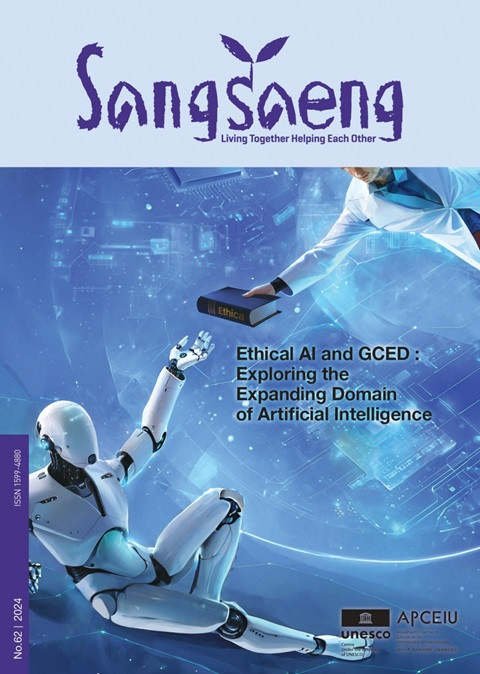 Ethical AI and GCED: Exploring the Expanding Domain of Artificial Intelligence (SangSaeng; No. 62, 2024) Año de publicación: 2024 Autor corporativo: APCEIU The 62nd issue of SangSaeng has been published with the theme of “Ethical AI and GCED: Exploring the Expanding Domain of Artificial Intelligence.” AI has never been as pervasive and influential as it is in today’s rapidly changing world. Despite the convenience and cutting-edge technology AI has offered us, it has the potential to pose a threat to humanity. This is where ethics for AI should come forward. In this regard, this issue will lead readers to the alarming side of AI as well as its future developments, focusing on the importance of GCED and AI ethics in tackling any potential problems. Contents03 Editor's Note 04 Special ColumnEmbracing Change to Cultivate Success — Integrating Global Citizenship Education into Tertiary Education / Dendev Badarch 08 FOCUS: Ethical AI and GCED: Exploring the Expanding Domain of Artificial IntelligenceRole of Ethics in the Era of AI — Protecting and Guiding AI Processes for Humanity to Flourish / Emma Ruttkamp-BloemPaying Attention to AI Ethics — An Avenue for a New Competitive Edge in Business / Myoungshin KimDriving Innovative Education — Balancing Future Possibilities and Ethical Concerns: How GCED Can be Used to Address AI Issues / Angelique Southern 20 Special ReportEmpowering a Climate Generation — From Classrooms to Climate Frontlines: The Transformative Role of Education highlighted at COP28 / Djian Sadadou 22 Best PracticesNavigating an AI Future — Ethical AI and the Importance of Critical Thought / Hannah GrantGLACE Brings the World to a City — Empowering Youth as Global Citizens: Lessons from Navotas City’s Project GLAC / Marco D. MedurandaLowering Eco-Anxiety — Teaching Climate Change Through Media and Information Literacy / Laetitia Legrand 33 GCED YOUTH NETWORK New Wave of Youth Advocacy — Role of AI in Youth Advocacy and its Ethical Implications to Global Citizenship / Oshan M. Gunathilake and Diego Manrique 36 Understanding the Asia Pacific RegionDiscovering Auroville — Where Boundaries Fade, Nature Thrives, and Global Minds Unite / Akanksha Arya 39 Peace in My MemoryHappiness without Violence — Mindanao Peace ForumCelebrates Building a Culture of Peace / Ludivina Borja-DekitPeace Scholar Passes Away Amidst Turbulent Times / Kwang-Hyun KIM 45 Story TimeThe Right Footing — My Life Has Purpose Thanks to Football / Hajar Abulfazl 48 LetterShared Challenges of Global Citizens / Natsuki Nagata 50 APCEIU in Action
 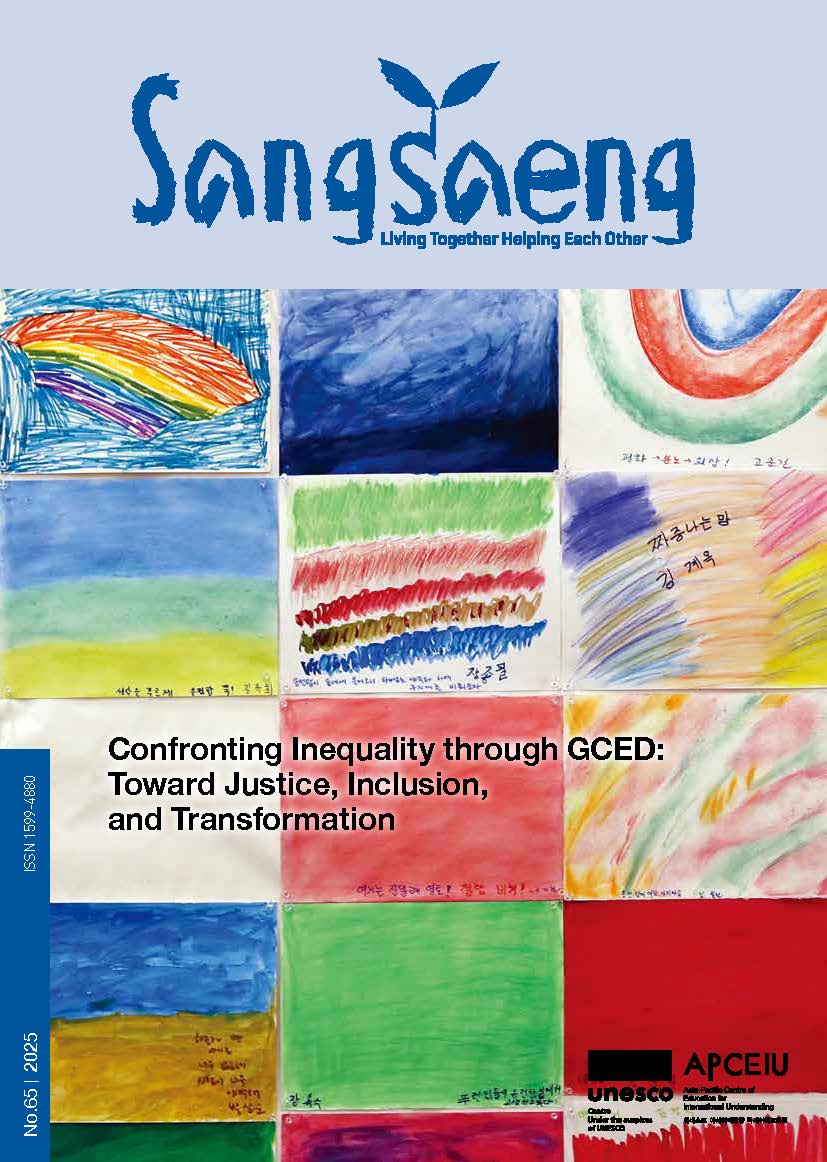 Confronting Inequality through GCED: Toward Justice, Inclusion, and Transformation (SangSaeng; No.65, 2025) Año de publicación: 2025 Autor corporativo: APCEIU The 62nd issue of SangSaeng has been published with the theme of “Ethical AI and GCED: Exploring the Expanding Domain of Artificial Intelligence.”AI has never been as pervasive and influential as it is in today’s rapidly changing world. Despite the convenience and cutting-edge technology AI has offered us, it has the potential to pose a threat to humanity. This is where ethics for AI should come forward. In this regard, this issue will lead readers to the alarming side of AI as well as its future developments, focusing on the importance of GCED and AI ethics in tackling any potential problems.Contents03 Editor's Note 04 Special ColumnEmbracing Change to Cultivate Success — Integrating Global Citizenship Education into Tertiary Education / Dendev Badarch08 FOCUS Ethical AI and GCED: Exploring the Expanding Domain of Artificial IntelligenceRole of Ethics in the Era of AI — Protecting and Guiding AI Processes for Humanity to Flourish / Emma Ruttkamp-BloemPayingAttention to AI Ethics — An Avenue for a New Competitive Edge in Business / Myoungshin KimDriving Innovative Education — Balancing Future Possibilities and Ethical Concerns: How GCED Can be Used to Address AI Issues / Angelique Southern 20 Special ReportEmpowering a Climate Generation — From Classrooms to Climate Frontlines : The Transformative Role of Education highlighted at COP28 / Djian Sadadou 22 Best PracticesNavigating an AI Future — Ethical AI and the Importance of Critical Thought / Hannah GrantGLACE Brings the World to a City — Empowering Youth as Global Citizens: Lessons from Navotas City’s Project GLAC / Marco D. MedurandaLowering Eco-Anxiety — Teaching Climate Change Through Media and Information Literacy / Laetitia Legrand 33 GCED YOUTH NETWORKNew Wave of Youth Advocacy — Role of AI in Youth Advocacy and its Ethical Implications to Global Citizenship / Oshan M. Gunathilake and Diego Manrique36 Understanding the Asia Pacific RegionDiscovering Auroville — Where Boundaries Fade, Nature Thrives, and Global Minds Unite / Akanksha Arya 39 Peace in My MemoryHappiness without Violence — Mindanao Peace Forum Celebrates Building a Culture of Peace / Ludivina Borja-DekitPeace Scholar Passes Away Amidst Turbulent Times / Kwang-Hyun KIM 45 Story TimeThe Right Footing — My Life Has Purpose Thanks to Football / Hajar Abulfazl 48 LetterShared Challenges of Global Citizens / Natsuki Nagata 50 APCEIU in Action