
Empowering Teachers and Youth to Prevent Violent Extremism
Critical inquiry, mindfulness, empathy and compassion: these are the four competencies that the UNESCO Mahatma Gandhi Institute of Education for Peace and Sustainable Development in New Delhi, India has identified as the key to empower youth to address 21st century challenges, including violent extremism, based on recent advances in brain research.
Empowering educators and teachers to build these competencies and prevent violent extremism through education brought together participants from 10 countries for a three-day workshop organized by MGIEP in New Delhi.
Addressing the closing session of the event, Director-General Irina Bokova higlighted the leading role of MGIEP in building the capacity for educators across the globe, online and offline. Drawing on existing research in neuroscience, MGIEP has started work with pilot schools to integrate socio-emotional skills, empathy training and values-based education into curricula.
“I believe what you are doing here in fostering a culture of tolerance and non-violence, expresses the core mission of UNESCO, to build peace in the minds of men and women,” said the Director-General.
“Violent extremism seeks to destroy the foundation of humanity,” continued Irina Bokova. “’Hard power’ is not enough to counter a threat that draws on exclusive visions of the world and builds on false interpretations of faith, hatred and intolerance, we need ‘soft power’ to win this battle. We need to educate a new generation of peace fighters […] with the skills and knowledge they need to respond to those who distort history, culture and religion.”
In this context, the Director-General called for new political will, new partnerships, new policies and concrete pedagogical tools to take this forward.
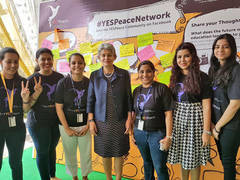
On the same day, the Director-General participated in a “Talking Across Generations” dialogue, organized by MGIEP and India’s YESPeace Network which focused on ‘Harnessing the Indian youth demographic bulge for a true dividend: Vision to Action for 21st Century’.
Both through social media and on site, students exchanged with the Director-General and Dr Karan Singh, Chair of the MGIEP Board, on skills to navigate rapid change driven by technology and create more just, peaceful and sustainable societies.
“We need a broad perspective, an integral education encompassing body, mind and emotions,” said Dr Karan Singh. Recalling his participation in the Delors Commission on Education for the 21st Century, he emphasized “learning to live together” as the bedrock of human and social development.
The Director-General discussed evolving approaches to education promoted by UNESCO, centred on changing mindsets and developing new skills not only for jobs in growth areas, from cultural industries to the green economy, but also for intercultural dialogue, tolerance and understanding. This calls for sustained investment in teachers, in relevant online content, and in broad community and social mobilization to make education a priority. She praised the youth present for championing peace and for their sensitivity to advancing social justice and education for all.