
UNESCO supports countries to crack the code, advance gender equality in STEM education worldwide
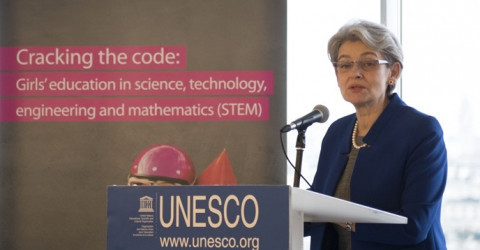
“Girls and women are key actors in crafting solutions to improve lives and generate inclusive, green growth that benefits us all,” said UNESCO’s Director-General Irina Bokova in her opening remarks. But she noted that “far too few girls are in school, and far too few of them pursue studies in STEM subjects. Even fewer go on to lead STEM careers.” Still today, girls and women around the world face steep challenges hindering their education opportunities. This is of particular concern in the fields of STEM, where girls and women are significantly under-represented. To support Member States in their efforts to advance gender equality in education, the event shared UNESCO’s latest findings on girls’ and women’s participation, achievement and continuation in STEM education.
UNESCO’s cutting-edge report Cracking the code: girls’ and women’s education in STEM finds that only 35% of all students enrolled in STEM-related fields at higher education are female. In mathematics and engineering in particular, girls’ represent only 5% and 8% of all students, respectively. The report goes deeper. It finds that the potential contributions and talent of millions of women are put aside due to a variety of factors from girls’ own perceptions of their abilities to systemic and educational biases. To respond to these hindering factors, the report offers targeted actions on four levels (learner, parents and peers, school and society) to increase girls’ and women’s participation and engagement in STEM disciplines.
“Listening to different perspectives and approaches was helpful in the way that we look at the scope of business,” said Executive Vice President of the CJ Group, Heekyung Jo Min, highlighting her inspiring experience from the three-day UNESCO International Symposium and Policy Forum held in August 2017 in Bangkok, Thailand. She further stated, “we need more of us in the private sector to engage on this issue, and to help girls’ and women’s take their righteous place in tech or engineering companies and in laboratories.” The Symposium explored gender inequalities in STEM education and shared innovative solutions empowering girls and women that could be replicated worldwide. Watch the outcomes video of the Symposium (link is external).
“Only 50% of capacities are utilized. We need to utilize 100% of the talent available from women and men,” shared Amandine Clerc, student from the Associated Schools network (ASPnet). Inspired by the Symposium, Clerc is now thinking of re-orienting her studies to science fields and has founded a STEM club in her school.
Looking at the way forward, participants discussed the importance of continued cooperation across all sectors to further momentum on this topic during a moderated discussion bringing together experts and partners. Relevant tools and initiatives, such as the TeachHer partnership and the UNESCO-L’Oréal for Women in Science (link is external) were highlighted for their key role in promoting girls and women in STEM education and careers. Teachers have a strong role in engaging girls in STEM fields. Farah Ouechtati, member of the panel and UNESCO-L'Oréal International Fellow, shared that she was inspired and encouraged to continue in sciences by her biology teacher, a woman.
UNESCO promotes gender equality in and through education systems from early childhood to higher education, in formal, non-formal and informal settings and in all intervention areas from planning infrastructure to training teachers.