
At UNESCO, a call to regulate digital platforms in the face of online disinformation and hate
23 February 2023
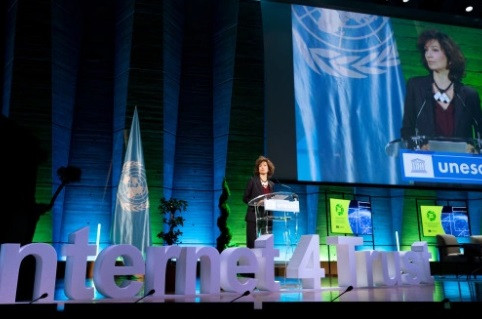
UNESCO’s Internet For Trust Conference has brought together 4,300 participants to discuss regulatory solutions to the ongoing crisis of online information – the first ever such global conference. Speakers from UNESCO Director-General Audrey Azoulay, to the Brazilian President Luiz Inácio Lula da Silva and 2021 Nobel Peace Prize winner Maria Ressa underlined the urgent need for common global guidelines to improve the reliability of information while protecting human rights.
"The blurring of boundaries between true and false, the highly-organized denial of scientific facts, the amplification of disinformation and conspiracies – these did not originate on social networks. But, in the absence of regulation, they flourish there much better than the truth. Only by taking the full measure of this technological revolution can we ensure it does not sacrifice human rights, freedom of expression and democracy. For information to remain a common good, we must reflect and act now, together."
- Audrey Azoulay, UNESCO's Director-General -
The Internet For Trust Conference serves as a high point in a global dialogue launched by UNESCO to develop first global guidelines for the regulation of social media to improve the reliability of information and promote human rights online. The Organization involved all stakeholders: governments, independent regulators, digital companies, academia and civil society. The guidelines will be launched by UNESCO in September 2023.
“Without facts, you can’t have truth”
"Lies spread faster than facts. For some reason, facts are really boring. Lies – especially when laced with fear, with anger, with hate, with tribalism – us against them. They spread. It’s like throwing a lit match into kindling."
- Marie Ressa, Novel Peace prize-winning journalist -
She went on to caution that if we continue to tolerate social media algorithms which reward lies, future generations will inherit a world in which truth has been dangerously devalued. “Without facts, you can’t have truth, without truth, you can’t have trust, and we have no shared reality”.
In his message to the Conference, the President of Brazil, Luiz Inácio Lula da Silva recalled the violent attacks on democratic institutions in Brazil on January 8.
"What happened that day was the culmination of a campaign, initiated much earlier, and that used lies and disinformation as ammunition. To a large extent, this campaign was nurtured, organized, and disseminated through digital platforms and messaging apps. This is the same method used to generate acts of violence elsewhere in the world. It must stop."
- Luiz Inácio Lula da Silva, President of Brazil -
Regulation coordinated and anchored in human rights
The Director-General of UNESCO pointed out the proliferation of regulatory initiatives - at least 55 countries are working on these. But she advocated a coherent, global approach, based on human rights. “If these regulatory initiatives are developed in isolation, with each country working in their own corner, they are doomed to fail. Information disruption is by definition a global problem, so our reflections must take place at the global scale,” she said.
"Discussions, such as the ones we are having now in Paris, are immensely important. It’s important to figure out a common set of guidelines on how to regulate this digital space. Technology cannot be misused to suppress people, to surveil or harass, or to shut down the internet."
- Katrín Jakobsdóttir, Prime Minister of Iceland -
YouTube influencer Felipe Neto shared his own experiences with extremist content pushed by algorithms, as one of the world’s most-subscribed content creators.
"Of course we don’t want to shut down the platforms – we don’t want to fight them. It’s about accountability, stopping impunity, bringing them to the table and saying ‘you need to be responsible for the mistakes you’ve made and that you’re going to make'."
- Felipe Neto, Brazilian YouTube influencer -
The Director-General closed by urging all countries to join UNESCO’s efforts to transform the internet into a tool which is truly at the service of the public and that helps assure the right to freedom of expression; a right which includes the right to seek and receive information.