
Science-led Governance of AI can Help Power Sustainable Development: Guterres
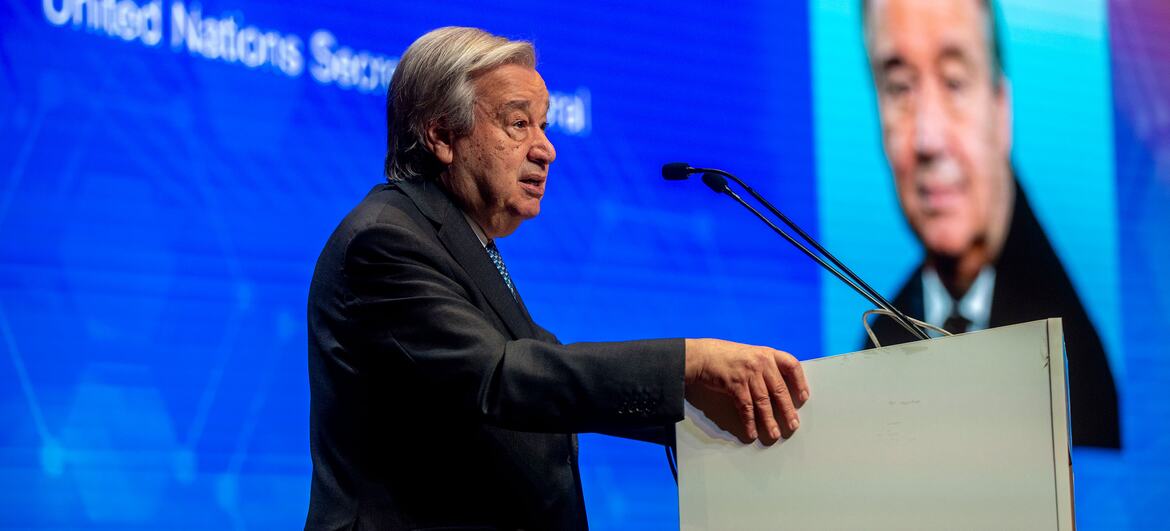
© United Nations/Ishan Tankha
UN Secretary-General António Guterres highlighted the key role science has in international governance of artificial intelligence during an event on Friday held on the margins of the AI Impact Summit in New Delhi, India.
“Guided by science, we can transform AI from a source of uncertainty into a reliable engine for the Sustainable Development Goals (SDGs),” he said.
He urged the international community to build a future “where policy is as smart as the technology it seeks to guide.”
New expert panel
The Secretary-General noted that “AI innovation is moving at the speed of light, outpacing our collective ability to fully understand it, let alone govern it.”
He stressed that “if we want AI to serve humanity, policy cannot be built on guesswork,” underscoring the need for “facts we can trust – and share – across countries and across sectors.”
For this reason, the UN is developing mechanisms that put science at the centre of international cooperation on AI, starting with a recently appointed body that brings together 40 leading experts in the field.
The Independent International Scientific Panel on Artificial Intelligence aims to help close “the AI knowledge gap” and assess the real impacts these new technologies have across economies and societies so that countries can act with the same clarity regardless of their level of AI capacity.
Accelerating progress, anticipating risks
“The Panel will provide a shared baseline of analysis – helping Member States move from philosophical debates to technical coordination; and anchor choices in evidence,” he said.
The UN chief was adamant that science-led governance of AI “is not a brake on progress” but rather “an accelerator for solutions.”
It will help countries to identify where AI “can do the most good, the fastest,” he said, and provide “a way to make progress safer, fairer, and more widely shared.”
Furthermore, the international community will be able to anticipate AI impacts early – such as risks for children or labour markets. That way “countries can prepare, protect and invest in people.”
Dangers of fragmentation
He noted that international cooperation is difficult today amid strained trust and growing technological rivalry.
“Without a common baseline, fragmentation wins – with different regions operating under incompatible policies and technical standards,” he said, which will only “raise costs, weaken safety, and widen divides.”
The Secretary-General said countries can align their “technical baselines”, guided by the Independent Panel and another UN initiative, the Global Dialogue on AI Governance to be held in Geneva in May.
Meaningful human oversight
Before concluding, he upheld that while “science informs,” human control of AI must be “a technical reality – not a slogan.”
This requires “meaningful human oversight in every high-stakes decision – in justice, healthcare, credit” as well as “clear accountability – so responsibility is never outsourced to an algorithm” he said.
“People must understand how decisions are made, challenge them – and get answers.”