
Open Exchange on Educating Against Extremism with Tony Blair
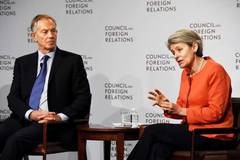
In an open dialogue hosted by the Council on Foreign Relations in New York on 22 September 2016, former British Prime Minister Tony Blair and UNESCO Director-General Irina Bokova exchanged on the theme of “Extremism, Education and Global Leadership.”
Mr Blair commended UNESCO’s approach to global citizenship that he described as “extremely relevant and the most beneficial in the UN system.”
The need to rethink education in a globalized world ran through the discussion. Mr Blair stressed the need for changing education systems so that they do not lead to “closed minded views of the world.” He shared his ambition to rally political leaders around a global commitment on education to “weed out religious prejudice and promote religious tolerance”.
New skills must be nurtured to build resilience and global competences, including for employment: “intercultural skills, critical thinking, knowledge of human rights, of heritage and history have been far too neglected,” said the Director-General. This is beginning to change, she said, as governments see the transformative power of education, citing the cases of Iraq where UNESCO will be reviewing national curricula to Afghanistan where a new fund for culture will also have an explicit educational dimension, through the promotion of culture, heritage and history as forces for identity, reconciliation and resilience.
“All this is about changing the narrative,” said Ms Bokova. ”There is not one path towards radicalization and not one response. Critical thinking is key, to evaluate information, relate and share with other.” Both noted the role of critical thinking in relationship to social media, and urged for support to encourage youth civic engagement. “We need to give this issue a far greater profile otherwise we will always be dealing with the symptoms rather than the causes,” said Mr Blair.
The former British Prime Minister founded the Tony Blair Faith Foundation in 2008. It develops projects and tools to prevent religious extremism through building the capacity of educators and enhancing collaboration between communities.