
Safe and ethical cyberspace in the focus of a world conference co-organized by IFAP
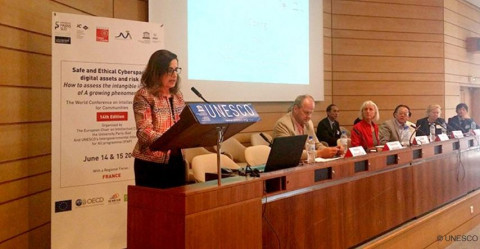
© UNESCO
The World Conference on “Intellectual Capital for Communities”, organized by the European Chair on Intellectual Capital of the University Paris-Sud and UNESCO’s intergovernmental Information for All Programme (IFAP), took place at UNESCO Headquarters in Paris on 14 and 15 June 2018 under the theme: “Safe and Ethical Cyberspace, digital assets and risk: How to assess the intangible impacts of a growing phenomenon?”. About 100 participants followed the sessions.
The growing importance of cyber-security in knowledge-based economies has generated concerns about the risks of data integrity, data confidentiality and data accessibility. Moreover, cyber-security is also related to the well-functioning of the infrastructure, which is integrated to the Internet. The 14th Edition of the World Intellectual Capital conference focused on the junction between cybersecurity, digital assess and risks.
In the opening session on “Digital transformation, ethical cyberspace and the policy agenda”, moderated by Boyan Radoykov, from UNESCO’s Knowledge Societies Division, the IFAP Chair and Deputy Permanent Delegate of Grenada Ms Haddad introduced the priorities and projects of the Information for All Programme.
“Following its five year Strategic Plan outlined till 2021, IFAP will address emerging challenges, which are inherent to technological development such as the Internet of things, algorithmic decision-making and Artificial Intelligence (AI), including the risks associated with increased surveillance, profiling and data privacy, with the uncertain impact of huge data and continued digitalization of communication, employment, equality and empowerment,” said Ms Haddad.
According to Prof. Ahmed Bounfour, Holder of the European Chair on Intangibles, the economic loss of a cyber-security is difficult to measure when it is mainly related to the intangibles. A recent joint research project (Hermeneut) on cyber-security led by the University of Paris-Sud within the European Chair on Intangibles, attempts to quantify the tangible and intangible losses generated by cyber-attacks. “At the macro level, scenario-specific parameters suggest the presence of cascading effects of cyber-attacks resulting from sectors dysfunction. The most critical sectors affected by cyber-attacks are the ICT sector itself, the motion picture, video and television programme production and the legal and accounting activities sector,” said Prof. Bounfour.
Guillaume Poupard, Director General of ANSSI, the French National Agency on protection of information systems, informed that cybercrime assessment is below of reality as victims, including SMEs, are “ashamed and try to forget”. Steeling digital material is growing by mafia groups and states and reaches in public domain, administration and private sector historically high levels.
The moderator, Mr Radoykov, recalled UNESCO’s first-ever conference on information ethics organized in Monaco, in 1995. The risks were seen in the visionary approach, and so was the massive need for awareness raising of Member States about the challenges at stake. He also mentioned the IFAP Code of Ethics for the Knowledge Societies that was an important contribution to the global efforts aiming at addressing the info-ethical dimensions of the emerging knowledge societies and their social implications. “We need to further promote the basic values and principles that are to be convincingly enshrined in the knowledge societies such as peace and democracy, free flow of information in the public domain, tolerance, cultural and linguistic diversity, solidarity, etc.” He ended by emphasizing that “It is our role, it is our task and it is our utmost responsibility to ensure the progress of civilization in cyberspace”.
Mr Ferrara, DG Connect of the European Union, informed via videoconference on “Building Cybersecurity for EU Resilience, Deterrence and Defence”. The proposal of DG connect is a voluntary European cybersecurity certification framework with Recommendation for a coordinated response to large-scale cybersecurity attacks.
In his keynote address on cyber risks, Mr Indrajit Banerjee, Director of Knowledge Society Division of UNESCO’s Communication and Information Sector underlined that UNESCO acknowledges the potential of the Internet for fostering sustainable human development and building more democratic societies, and for enhancing the free flow of information and ideas throughout the world. UNESCO has actively contributed to the international debates on Internet governance in particular through its participation in the Internet Governance Forum (IGF). The mandate of the IGF is to discuss the development of open, transparent and inclusive Internet policy. IGF 2018 will be hosted in November by UNESCO.
URL: