
Republic of Korea highlights the transformative power of girls’ education
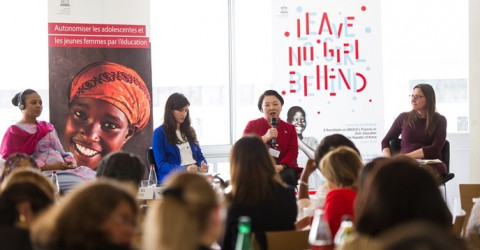
© UNESCO
Young girls now tell me that they are not too young to lead, they are not too young to be part of change’, said Bonita Sharma, UNESCO Female Champion from Nepal, during an event entitled Leave No Girl Behind held at UNESCO on girls’ education with the support of the Ministry of Foreign Affairs of the Republic of Korea and the Korean National Commission for UNESCO.
While much progress has been achieved to reach gender parity in education, the journey to school still remains fraught for girls in many settings. This is particularly the case for adolescent girls who face challenges that significantly affect their educational opportunities, including early and forced marriage, exposure to violence, and lack of sanitation facilities in schools to address menstrual hygiene.
The event highlighted the importance of investing in girls’ education from various angles, including through cross-sectoral action, community-level and youth engagement, policy formulation and partnerships.
‘We are focusing our efforts in favour of better policy, better data and more empowerment for girls and women through education’, said Stefania Giannini, UNESCO’s Assistant Director-General for Education, sharing UNESCO’s vision to accelerate its commitment to girls’ and women’s education.
Lalla El Oumrany, representative of the Ministry of National Education in Mali, emphasized the importance of cross-sectoral action in addressing challenges faced by adolescent girls. This is a core component of UNESCO’s work in Mali – bringing together the education, health, gender, youth and employment sectors to facilitate the healthy transition of girls into adulthood through quality education.
‘While adolescent years are important, it is important to recognize that the socialisation process of girls and boys start in their early years of education and this influences the dreams and futures they envision for themselves’, said Justine Sass of UNESCO.
‘Girls’ education should become a national priority rather than an educational priority’, said Pauline Rose, professor at the University of Cambridge. She urged to invest in gender-responsive approaches in the early years of education, especially as, according to research, the poorest girls do not receive more than 5 years of education.
The Republic of Korea (ROK) is conscious of the transformative power of education, especially for girls, having achieved fast economic growth after the Korean War through the quick reconstruction of its education system. ‘The Korean government reaffirms its strong commitment to gender equality in education so that no girls are left behind’, said Seok-in Hong of the Ministry of Foreign Affairs of the ROK.
‘Girls’ education is a very important issue for us’, shared Heekyung Jo Min of CJ CheilJedang. ‘We strive to best utilize our platforms to raise awareness among our clientele composed mostly of girls and women.’ As a long-standing partner of UNESCO, CJ reached as much as 2.2 billion people through just one concert last year alone, and many more through its entertainment and media platforms.
Held on the sidelines of the 206th session of the Executive Board, the roundtable brought together 150 stakeholders, including partners, donors, civil society organizations, private sector, government representatives and Bonita, a young woman and change-maker from a UNESCO project in Nepal. This event was particularly timely, given the planned launch in July of UNESCO’s revised vision for its commitment to girls’ education.
ROK has been a continuous partner of UNESCO, in particular supporting projects on girls’ education across the Asia-Pacific and Africa regions. Contributions also include those made by CJ to the UNESCO Malala Fund for Girls’ Right to Education and by the Korea International Cooperation Agency to the Joint Programme on Empowering Adolescent Girls and young Women through Education.
URL:
https://en.unesco.org/news/republic-korea-highlights-transformative-power-girls-education