
Boys and girls make menstrual pads at their school’s gender club in Ethiopia
Tenaye Ashenafi’s first experience with menstruation did not go very well. She ran back home after being ridiculed by her peers at school, and showed her blood-stained clothes to her mother.
Her mother gave her pieces of “gabi”, a traditional cotton blanket to use during her menstruation period. “Even my mother did not know about sanitary pads”, Tenaye says.
Many girls like Tenaye are forced to miss school during their menstruation. Talking about menstruation is considered a taboo and girls often face stigma and discrimination during this time. This prevents girls from receiving adequate guidance to support them through the challenges of puberty. In Ethiopia, only 54% of girls complete primary school, many dropping out because of cramps or embarrassing mishaps during their period according to a 2017 UNICEF report.
Gender club
Simret Getaneh joined Tenaye’s school as a mathematics teacher in 2015. She was one of the participants of the Gender-Responsive Pedagogy (GRP) training organized in the school as part of a UNESCO project in Ethiopia. The training built teachers’ competencies, with a focus on how to include gender considerations into lessons and learning activities in the classroom and co-curricular activities.
Soon after, Simret took over the leadership of the gender club, which had been inactive. “Most of the students here are from low-income families,” says Simret. “They cannot afford to buy sanitary pads.” Sanitary pads and other sanitary products and materials were provided to the school as part of the project.
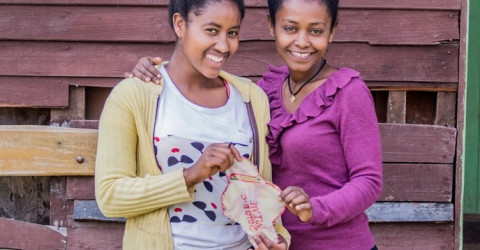
The next time Tenaye’s clothes were stained, she went to speak to Simret who encouraged her to join the gender club to learn about menstruation and sanitary pads. Simret taught the members of the gender club how to use sanitary pads and make reusable ones by using pieces of cloth and other materials. Girls choose the color of their cloth, cut them into shape and sew them together. Some even sew their names on their pads.
Engaging boys
Simret encouraged boys to join the club. She had learned at the training that for a school environment to be gender-responsive it must involve both girls and boys. Much has changed at the school: boys used to sit separately in class, but now they are helping girls make reusable sanitary pads at the gender club.
Merid, aged 17, is a member of the gender club. He attended a life skills training organized as part of the project where he learned about gender equality, including the role of boys and men. “I like to work with girls and help them to minimize the cost for their menstrual pads, as they do not have to worry about this and can focus instead on being successful in their studies”, says Merid.
Creating teacher-mentors
In Ras Desta Primary School, girls are often forced to drop out of school due to early or arranged marriage. Simret has provided continuous mentorship to girls – speaking to them about early marriage and the importance of completing their education. “Dropouts due to early marriage have decreased with the activities of the gender club’, shared Simret. ‘Many girls choose to continue their education.”
All 117 teachers, including 56 women, at Ras Desta Primary School were trained on GRP. Simret is one of many teachers making a significant impact on girls and their education, according to Merinda Teklu, the school Director. “Most of the girls used to miss class during menstruation because they could not afford sanitary pads, but now they have learned to make sanitary pads and have good mentors at the school.”
Tenaye, Simret and Merid’s school is one of the participating schools under the project, and it is showing promising results. More girls are successfully passing their national primary school examinations. The rate of girls completing their primary education has increased by close to 10% within a year, from the 2016-17 to the 2017-18 academic year. Out of these, three girls received a scholarship, a benefit only conferred to boys previously.
The UNESCO-HNA Funds-In-Trust project in Ethiopia aims to enhance the quality and relevance of education for adolescent girls, and ensure that all girls have access to and transition through the full education cycle successfully, so that they can lead better lives.
The project is implemented by the UNESCO Liaison Office in Ethiopia, under the UNESCO-HNA Partnership for Girls’ and Women’s Education. The UNESCO International Institute for Capacity Building in Africa (IICBA) is providing technical backstopping in institutional capacity-building for gender mainstreaming in education, GRP and teacher training.
- Watch: Meet Eden, Blen and Hareg: three Ethiopian girls who value their education
- Read: Two girls speak about gender equality at their school in Ethiopia
URL:
https://en.unesco.org/news/boys-and-girls-make-menstrual-pads-their-schools-gender-club-ethiopia