
UNESCO at the 2019 Geneva Peace Week
© UNESCO
The 2019 Geneva Peace Week took place at the Palais des Nations (the United Nations Office in Geneva) and the Graduate Institute in Geneva from 4 to 8 November 2019. UNESCO, whose mission is to build peace in the minds of men and women, participated in the weeklong event, bringing the photo exhibition Les Mains de la Paix (The Hands of Peace) and the workshop Intercultural Competencies + Youth = Peace to Geneva, otherwise known as the Capital of Peace.
The exhibition Les Mains de la Paix by Séverine Desmarest (on display until 14 November at the Passerelle, Palais des Nations) presents a series of portraits of famous or anonymous personalities, who work assiduously in favour of peace. The diversity of the range of their action illustrates the vastness of the territories yet to chart in order to establish UNESCO’s mission: “Since wars begin in the minds of men and women, it is in the minds of men and women that the defenses of peace must be constructed.” Fighting poverty, conflict prevention, sustainable development, equal opportunities, advocating for women’s rights, education and childhood protection, represent some of the struggles towards a new humanism.
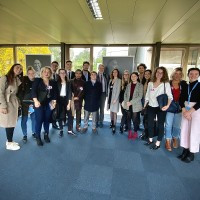
Mr. Vincent Defourny, Director of the Geneva Liaison Office, sat together with a group of students from University of Geneva who visited the exhibition to engage in a conversation on UNESCO’s role in building peace. Mr. Defourny highlighted that UNESCO’s scope of work extends well beyond cultural heritage sites, which is usually people’s immediate association with the Organization. Just like UNESCO’s Man and the Biosphere Program, the nature is in equilibrium when there is diversity in the ecosystem, so is peace achieved when there is cultural diversity in the world. Furthermore, UNESCO firmly believes that knowledge and information equality contribute to peace. The General African History program addresses the imbalance of knowledge on the history of the African continent by assembling African researchers and scholars to publish a complete collection of eight volumes for open access.
The promotion of intercultural competencies is another essential component in peacebuilding—for conflict prevention and reconciliation—to increase the resilience of individuals and communities and to promote a culture of peace. One of UNESCO's approaches to peacebuilding among the youth is the dissemination of knowledge about cultural diversity and the evolving notion of cultures and their interdependence.
Ms. Amina Hamshari, Program Specialist in Intercultural Dialogue at UNESCO, led a workshop named Intercultural Competencies + Youth = Peace to highlight the importance of promoting dialogue and fostering mutual respect. She presented a UNESCO publication Writing Peace to the audience, who were intrigued by the idea that learning how to write “peace” in different languages can open doors to better cross-cultural understanding. Peace is not simply the absence of conflict, it is also the harmonious coexistence among peoples of different backgrounds and this concept should be taught to the youth, who are the next generation of peacemakers. UNESCO’s Global Citizenship Education program, for example, is a response from the Organization to the world’s most lingering obstacles to peace: human rights violations, inequality and poverty.
Geneva Peace Week offers an opportunity to connect and highlight the work of different stakeholders and to expand the space for building peace and resolving conflict through dialogue and negotiation; it also emphasizes that every person, actor and institution has a role to play in building peace and resolving conflict.
URL: