
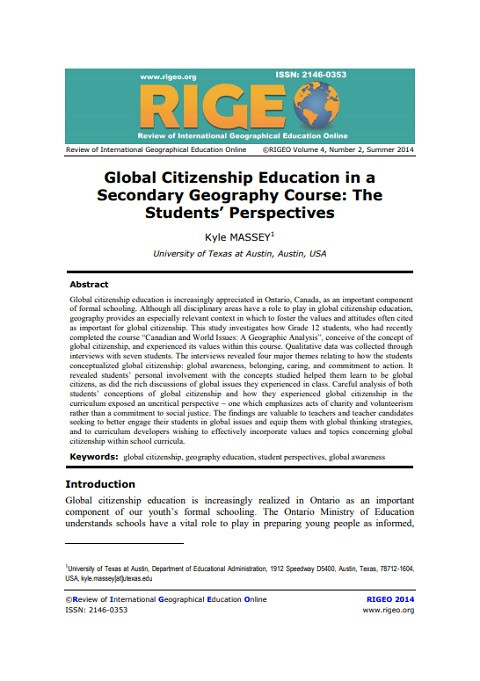
Global Citizenship Education in a Secondary Geography Course: The Students’ Perspectives (Review of International Geographical Education Online; Vol. 4, No. 2)
Global citizenship education is increasingly appreciated in Ontario, Canada, as an important component of formal schooling. Although all disciplinary areas have a role to play in global citizenship education, geography provides an especially relevant context in which to foster the values and attitudes often cited as important for global citizenship. This study investigates how Grade 12 students, who had recently completed the course “Canadian and World Issues: A Geographic Analysis”, conceive of the concept of global citizenship, and experienced its values within this course. Qualitative data was collected through interviews with seven students. The interviews revealed four major themes relating to how the students conceptualized global citizenship: global awareness, belonging, caring, and commitment to action. It revealed students’ personal involvement with the concepts studied helped them learn to be global citizens, as did the rich discussions of global issues they experienced in class. Careful analysis of both students’ conceptions of global citizenship and how they experienced global citizenship in the curriculum exposed an uncritical perspective – one which emphasizes acts of charity and volunteerism rather than a commitment to social justice. The findings are valuable to teachers and teacher candidates seeking to better engage their students in global issues and equip them with global thinking strategies, and to curriculum developers wishing to effectively incorporate values and topics concerning global citizenship within school curricula.
관련 자료
-
 Voices Against Violence: Middle Years
 -
 Study on the Historical Impact of the 1974 Recommendation concerning Education for International Understanding, Cooperation and Peace and Education relating to Human Rights and Fundamental Freedoms
 -
 IIEP-UNESCO 12th Medium-Term Strategy: 2026–2029
 -
 More than Welcome: Intercultural Integration of Migrants in and Through Higher Education