UNESCO CLEARINGHOUSE ON
GLOBAL CITIZENSHIP EDUCATION
HOSTED BY APCEIU
English
Français
Español
Русский
العربية
中文
한국어
소개
세계시민교육
세계시민교육 클리어링하우스
자료
이벤트
뉴스
English
Français
Español
Русский
العربية
中文
한국어
Search
Advanced Search
소개
세계시민교육
세계시민교육 클리어링하우스
자료
이벤트
뉴스
자료
세계시민교육에 대한 이해를 넓히고 연구, 옹호 활동, 교수, 학습 등을 향상시킬 수 있는 다양하고 유용한 자료를 찾아보세요.
검색
Searching...
고급 검색
© APCEIU
1
건의 결과가 검색되었습니다
관련도순
최신순
연도순
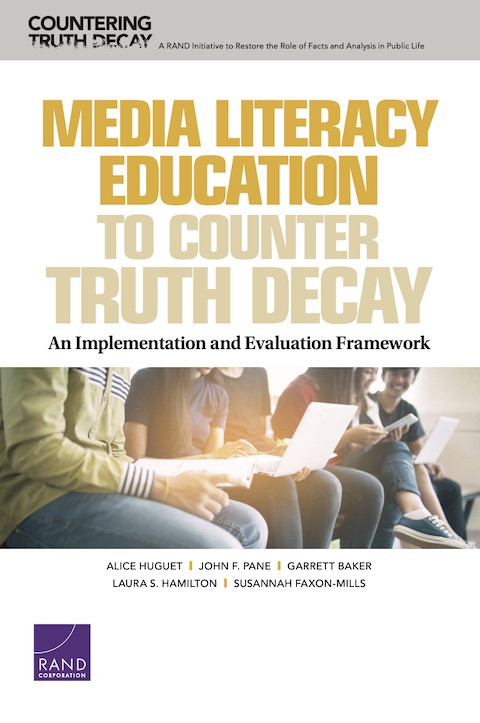
Media Literacy Education to Counter Truth Decay: An Implementation and Evaluation Framework
발행 연도:
2021
저자:
Alice Huguet
|
John F. Pane
|
Garrett Baker
|
Laura S. Hamilton
|
Susannah Faxon-Mills
단체 저자:
RAND Corporation
Media literacy (ML) education has emerged as a promising approach to slowing the spread of Truth Decay, described as the diminishing role that facts, data, and analysis play in political and civil discourse. Several factors contribute to Truth Decay, including a rapidly evolving information ecosystem and overburdened educational institutions. Many teachers believe their students lack the complex skills that are necessary to navigate today’s information- saturated world. This gap—between students’ existing competencies and those required to engage responsibly in a fast-paced media environment— could lead to negative consequences for individuals and society writ large.However, teachers report a lack of guidance around promoting ML education in their practice, and rigorous research about what kinds of ML educationwork best, and in what conditions, remains limited. This report presents a framework for implementing and evaluating ML educational efforts. Following an introduction to the framework, the authors discuss six steps of ML implementation and evaluation: setting ML learning expectations; identifying conditions that can influence ML instructional efforts; exploring instructional resources; identifying measures of ML competencies; monitoring progress; and finally, measuring the summative impacts of ML education on student learning. By bringing this information together for implementors—such as district decisionmakers and teachers—as well as evaluators, the authors emphasize the important connections between these too often separate groups.
본 사이트는 사용자 경험을 향상시키기 위해 쿠키를 사용합니다. 자세한 내용은 아래의 쿠키 정책을 확인하시기 바랍니다.
쿠키정책
.