
자료
세계시민교육에 대한 이해를 넓히고 연구, 옹호 활동, 교수, 학습 등을 향상시킬 수 있는 다양하고 유용한 자료를 찾아보세요.
5 건의 결과가 검색되었습니다
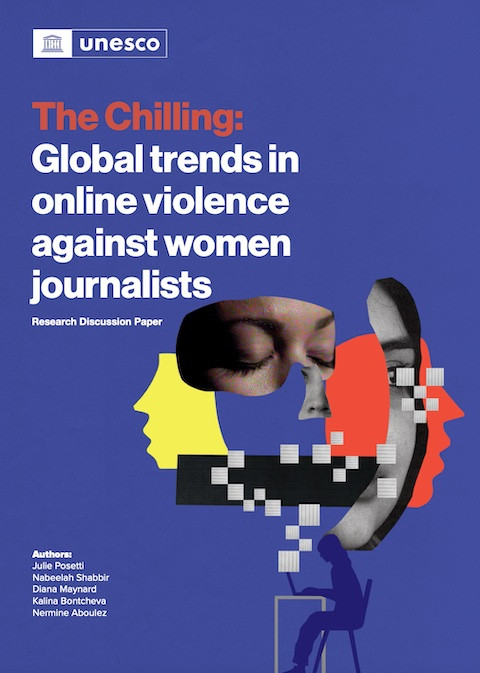 The Chilling: Global Trends in Online Violence Against Women Journalists; Research Discussion Paper 발행 연도: 2021 저자: Julie Posetti | Nabeelah Shabbir | Diana Maynard | Kalina Bontcheva | Nermine Aboulez 단체 저자: UNESCO This report demonstrates that online violence against women journalists is a global phenomenon, albeit one with uneven impacts that are heightened at various intersectional points, including racism, religious bigotry, sectarianism, homophobia and disinformation. There is a climate of impunity surrounding online attacks on women journalists which must be more urgently and effectively addressed because impunity emboldens the perpetrators, demoralises the victim, erodes the foundations of journalism, and undermines freedom of expression. For too long, the emphasis has been on making women journalists responsible for their own defence and protection, rather than making the perpetrators and instigators, the platform enablers, and law enforcement and media employers accountable.These methods of attack are growing more sophisticated, and they are evolving with technology. They are also increasingly networked and fuelled by political actors. This points to the need for responses to online violence to grow equally in technological sophistication and collaborative coordination. Another point highlighted by this research: most women journalists do not report or make public the online attacks they experience, in line with low levels of reporting when it comes to violence against women more broadly. Many media employers still appear reluctant to take online violence seriously. This aligns with the evident failure of the internet communications companies - whose social networks, messaging and search services facilitate much of the harassment, intimidation, abuse and threats targeting women journalists - to take effective action to address this freedom of expression and gender equality crisis.
  Balancing Act: Countering Digital Disinformation While Respecting Freedom of Expression 발행 연도: 2020 저자: Kalina Bontcheva | Julie Posetti 단체 저자: UNESCO | Broadband Commission for Sustainable Development. Working Group on AI Capacity Building | International Telecommunication Union (ITU) This report provides stakeholders with a rich suite of sector-specific recommendations, as well as a helpful 23-point framework that can be used for assessing any particular response to disinformation in the context of freedom of expression challenges. This research will help the widest range of key actors to better understand this phenomenon, and especially the way the world is responding to it, and where the gaps are.At the heart of this knowledge product is the need to balance responses to disinformation with respect for freedom of expression. The research shows us that this can be done.
  Disinfodemic: Deciphering COVID-19 Disinformation (Policy Brief; 1) 발행 연도: 2020 저자: Julie Posetti | Kalina Bontcheva 단체 저자: UNESCO The purpose of this brief is to provide a structure for understanding the COVID-19 disinfodemic and the responses to it, highlighting practices which have a bearing on the UN Sustainable Development Goals (SDGs), the right to health and the right to freedom of expression. SDG 16.10 calls for “public access to information and fundamental freedoms”. Desinfodemia: Descifrando la desinformación sobre el COVID-19 (Policy Brief; 1) 발행 연도: 2020 저자: Julie Posetti | Kalina Bontcheva 단체 저자: UNESCO El propósito de este resumen es presentar una estructura para comprender la ‘desinfodemia’ del COVID-19 y las respuestas respectivas, resaltando las prácticas pertinentes a los Objetivos de Desarrollo Sostenible de la ONU, al derecho a la salud y al derecho a la libertad de expresión. EL ODS16.10 subraya la necesidad de “acceso público a la información y libertades fundamentales”. Désinfodémie: Déchiffrer la désinformation sur le COVID-19 (Note d’orientation; 1) 발행 연도: 2020 저자: Julie Posetti | Kalina Bontcheva 단체 저자: UNESCO Le but de cette note d’orientation est de présenter une structure pour comprendre la désinfodémie sur le COVID-19 et les réponses possibles, en mettant en évidence les pratiques liées aux Objectifs de développement durable (ODD) des Nations Unies, le droit à la santé et le droit à la liberté d’expression. L’ODD 16.10 appelle à « un accès public à l’information et aux libertés fondamentales ».