UNESCO CLEARINGHOUSE ON
GLOBAL CITIZENSHIP EDUCATION
HOSTED BY APCEIU
English
Français
Español
Русский
العربية
中文
한국어
소개
세계시민교육
세계시민교육 클리어링하우스
자료
이벤트
뉴스
English
Français
Español
Русский
العربية
中文
한국어
Search
Advanced Search
소개
세계시민교육
세계시민교육 클리어링하우스
자료
이벤트
뉴스
자료
세계시민교육에 대한 이해를 넓히고 연구, 옹호 활동, 교수, 학습 등을 향상시킬 수 있는 다양하고 유용한 자료를 찾아보세요.
검색
Searching...
고급 검색
© APCEIU
1
건의 결과가 검색되었습니다
관련도순
최신순
연도순
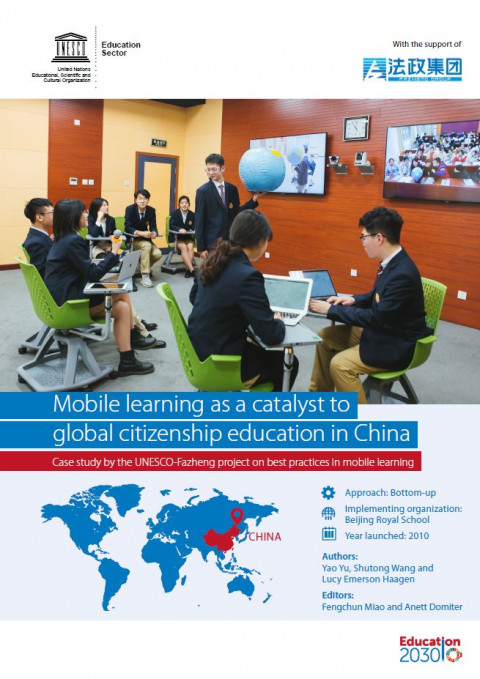
Mobile Learning as a Catalyst to Global Citizenship Education in China: Case Study by the UNESCO-Fazheng Project on Best Practices in Mobile Learning
발행 연도:
2019
저자:
Yao Yu
|
Shutong Wang
|
Lucy Emerson Haagen
단체 저자:
UNESCO
The Beijing Royal School was one of the pioneer schools in China in incorporating mobile learning into pedagogical transformation. Its mobile learning programme started in 2010. Stemming from the school’s orientation towards global citizenship education, the Beijing Royal School recognizes mobile learning as both driver and enabler for supporting the development of students’ cognitive, socio-emotionaland behavioural dimensions, organized around knowledge acquisition, understanding and respect for difference and diversity, and responsible engagement with global issues. It takes advantage of a variety of mobile apps to support students’ multilingual education, and uses open educational resources (OER) to support multicultural education, taking advantage of the up-to-date worldwide data and information available on the web. It also engages with students from other countries in projects and courses that help the students to widen their understanding of diverse cultures and social contexts. Overall, this case study illustrates how to use mobile technologies to support the implementation of a well-defined and clearly structured educational vision by embedding the use of mobile technologies in students’ daily learning lives.
본 사이트는 사용자 경험을 향상시키기 위해 쿠키를 사용합니다. 자세한 내용은 아래의 쿠키 정책을 확인하시기 바랍니다.
쿠키정책
.