UNESCO CLEARINGHOUSE ON
GLOBAL CITIZENSHIP EDUCATION
HOSTED BY APCEIU
English
Français
Español
Русский
العربية
中文
한국어
소개
세계시민교육
세계시민교육 클리어링하우스
자료
이벤트
뉴스
English
Français
Español
Русский
العربية
中文
한국어
Search
Advanced Search
소개
세계시민교육
세계시민교육 클리어링하우스
자료
이벤트
뉴스
자료
세계시민교육에 대한 이해를 넓히고 연구, 옹호 활동, 교수, 학습 등을 향상시킬 수 있는 다양하고 유용한 자료를 찾아보세요.
검색
Searching...
고급 검색
© APCEIU
1
건의 결과가 검색되었습니다
관련도순
최신순
연도순
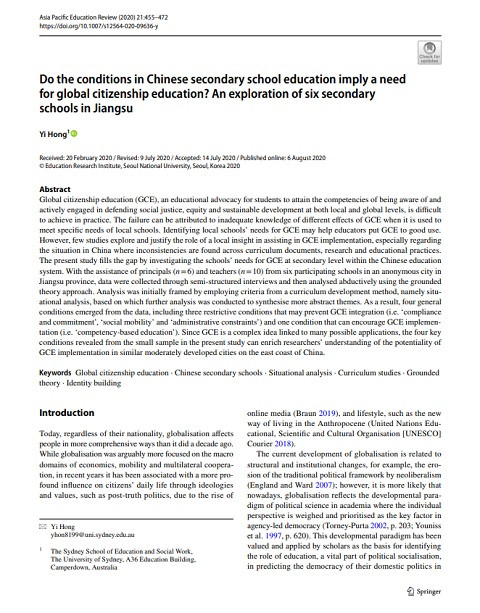
Do the Conditions in Chinese Secondary School Education Imply a Need for Global Citizenship Education? an Exploration of Six Secondary Schools in Jiangsu (Asia Pacifc Education Review; Rev. 21)
발행 연도:
2020
저자:
Yi Hong
단체 저자:
Seoul National University. Education Research Institute
Global citizenship education (GCE), an educational advocacy for students to attain the competencies of being aware of and actively engaged in defending social justice, equity and sustainable development at both local and global levels, is difficult to achieve in practice. The failure can be attributed to inadequate knowledge of different effects of GCE when it is used to meet specific needs of local schools. Identifying local schools’ needs for GCE may help educators put GCE to good use. However, few studies explore and justify the role of a local insight in assisting in GCE implementation, especially regarding the situation in China where inconsistencies are found across curriculum documents, research and educational practices. The present study fills the gap by investigating the schools’ needs for GCE at secondary level within the Chinese education system. With the assistance of principals (n = 6) and teachers (n = 10) from six participating schools in an anonymous city in Jiangsu province, data were collected through semi-structured interviews and then analysed abductively using the grounded theory approach. Analysis was initially framed by employing criteria from a curriculum development method, namely situational analysis, based on which further analysis was conducted to synthesise more abstract themes. As a result, four general conditions emerged from the data, including three restrictive conditions that may prevent GCE integration (i.e. ‘compliance and commitment’, ‘social mobility’ and ‘administrative constraints’) and one condition that can encourage GCE implementation (i.e. ‘competency-based education’). Since GCE is a complex idea linked to many possible applications, the four key conditions revealed from the small sample in the present study can enrich researchers’ understanding of the potentiality of GCE implementation in similar moderately developed cities on the east coast of China.
본 사이트는 사용자 경험을 향상시키기 위해 쿠키를 사용합니다. 자세한 내용은 아래의 쿠키 정책을 확인하시기 바랍니다.
쿠키정책
.