
자료
세계시민교육에 대한 이해를 넓히고 연구, 옹호 활동, 교수, 학습 등을 향상시킬 수 있는 다양하고 유용한 자료를 찾아보세요.
190 건의 결과가 검색되었습니다
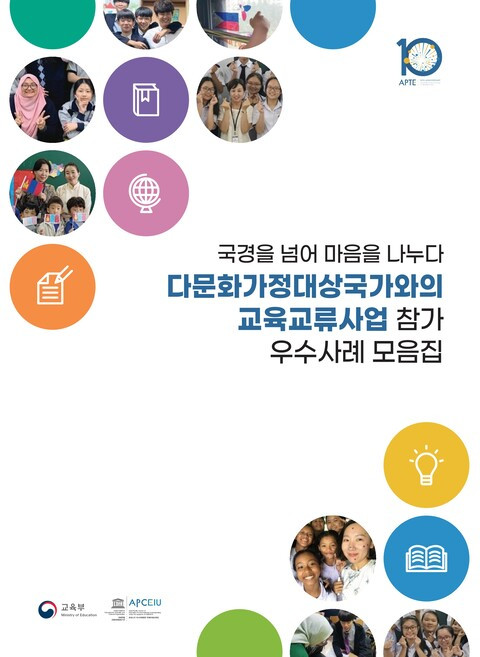 다문화가정대상국가와의 교육교류사업 참가 우수사례 모음집 발행 연도: 2023 단체 저자: APCEIU A carefully curated collection of best practices is presented as part of the 10th-anniversary celebrations of the Asia Pacific Teacher Exchange for Global Education (APTE). Over 30 teachers share their honest and vivid experiences, as well as outstanding follow-up activities. Each story aims to inspire teachers who are interested in the APTE Programme, and to serve as a valuable resource for future participants.
  2022 SSAEM Conference: Final Report 발행 연도: 2023 단체 저자: APCEIU | Korea R. Ministry of Education The 2022 SSAEM (Sharing Stories of Asia-Pacific Education Movements) Conference is a space for examining and sharing the educational outcomes of the participating teachers and schools of the programme. This conference, which has been held annually since 2014, aims to provide an excellent opportunity for the participants and stakeholders to showcase the impact of the programme and to explore methods for strengthening cooperation for further development of the programme. The main programme included the panel discussion of the Ministry representatives of the 8 countries, the presentation of 2022 programme participants, etc.
  Asia-Pacific Teacher Exchange for Global Education 2022: Final Report 발행 연도: 2022 단체 저자: APCEIU | Korea R. Ministry of Education The Asia-Pacific Teacher Exchange for Global Education (APTE), which has been in place since 2012, marks its 10th anniversary this year. APTE had been conducted according to the existing programme execution system and flow chart until 2019. However, the Office of International Teacher Exchange (ITE) focused on online exchange due to the pandemic crisis. This year’s APTE programme followed last year’s online formula and presented a new direction for utilization even post-pandemic. These efforts are expected to enhance global educational competencies for a more sustainable Global Citizenship Education.
  2022 Youth Leaders’ Mentorship & Local GCED Projects: Activity Report 발행 연도: 2022 단체 저자: APCEIU This report summarizes 15 GCED projects implemented in different parts of the world by the alumni of APCEIU’s Youth Leadership Workshop on GCED in 2022. Ranging from community advocacy for global citizenship to girls’ empowerment projects, 15 GCED initiatives have been taken by the team of 15 young leaders in their own communities in Asia, Europe, Africa, Latin America, and the Caribbean. APCEIU offers GCED training programmes targeting youth leaders around the globe to encourage them to achieve the SDGs through global citizenship and GCED. Since 2015, the Youth Leadership Workshop on GCED has been held every year in the Republic of Korea, inviting 50 young global leaders to take part in an intensive training programme where they share their actions, deepen their knowledge on global/local issues, enhance their motivation to take actions for a change, and establish the young leaders’ network on GCED. Since 2021, it has been shifted to a comprehensive training programme composed of online training workshops, mentorship, and local project implementation.
  Asia-Pacific Teacher Exchange for Global Education: 2020 Final Report 발행 연도: 2020 단체 저자: APCEIU | Korea R. Ministry of Education The Asia-Pacific Teacher Exchange for Global Education (APTE) has been conducted since 2012 and marks its 9th anniversary this year. This report looks back over the past 9 years and the achievements of the programme for 2020.This year, due to the pandemic effects, the Office of International Teacher Exchange (ITE) focused on expanding the foundation for online exchange and developing content to strengthen the sustainability of educational exchange and ensure the internal stability of the programme.
  2020 Online SSAEM Conference: Teaching Across Borders; Final Report (November 24-30, 2020) 발행 연도: 2020 단체 저자: APCEIU | Korea R. Ministry of Education 2020 Online SSAEM (Sharing Stories of Asia-Pacific Education Movements) Conference is a space for examining and sharing the educational outcomes of the participating teachers and schools of the Programme. This Conference, which has been held annually since 2014, aims to provide an excellent opportunity for the Programme participants and stakeholders to showcase the impact of the Programme and to explore methods on strengthening cooperation for further development of the Programme. Main Programme included the Panel Discussion of the Ministry representatives of the 8 countries, the Presentation and Live Talk show of 2012-2019 programme alumni, and the exhibition of various educational materials etc. More than 450 teachers participated and their educational network has strengthened. Table of Contents PrologueWhat is 「Asia-Pacific Teacher Exchange about」?Ⅰ. 2020 Online SSAEM ConferenceBackground and ObjectivesConference OutlineConference ContentsConference OutcomesⅡ. Presentations by Exchange TeachersDay 1Day 2Day 3
 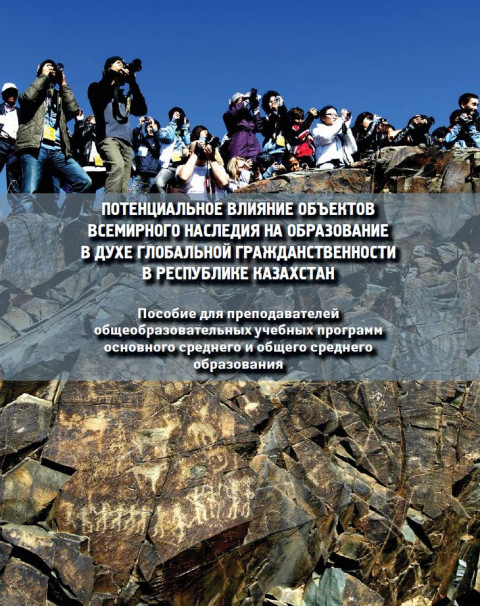 Potential Influence of World Heritage Sites over the Global Citizenship Education in the Republic of Kazakhstan: Manual for Teachers of General Secondary and High school Education Programmes 발행 연도: 2017 저자: Baipakov K.M. | Voyakin D.A. | Massanov M.N. | Sarsenova E.A. | Shaigozova Z.N. 단체 저자: APCEIU | National World Heritage Committee (Kazakhstan) Present publication is a manual for teachers for of general secondary and high school education programmes of the Republic of Kazakhstan and Central Asia. It aims to raise awareness of teachers and students on the issue of local cultural and natural heritage, and Global Citizenship Education Concept, and to introduce World Heritage and Global Citizenship Education topics to the general secondary and high school education programmes of Kazakhstan. For Kazakhstan and Central Asian, it is a first attempt to understand the potential contribution of UNESCO World Heritage Sites to the Global Citizenship Education.This publication can be separated in three parts. First part presents general description of UNESCO and its cooperation with the Republic of Kazakhstan. It pays particular attention to each Kazakhstan’s site from the UNESCO World Heritage list. Second part covers Global Citizenship Education concept, and main international trends in field of school education in the world. Third part of this publication provides practical guide on the ways that Kazakhstan’s teachers of general secondary and high school education programmes can use World and Intangible Heritage for promotion of global citizenship concept among their students. All three examples of education courses were made as much different from each other as possible in order to provide to Kazakhstan’s teachers a wider choice for preparation of their own classes dedicated to the World Heritage sites and Global Citizenship Education.
 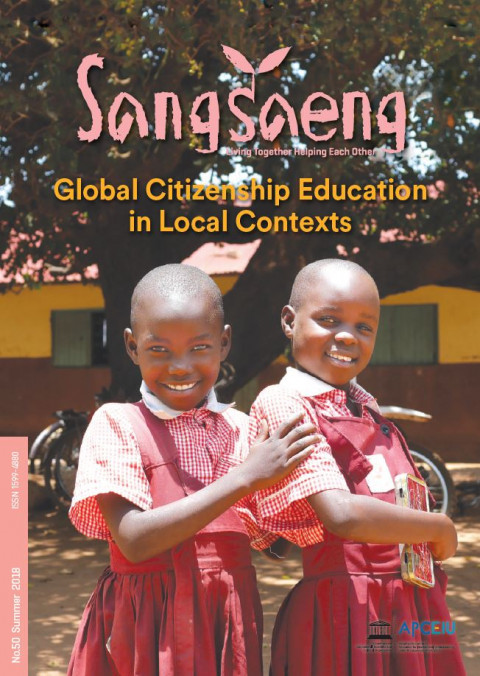 Global Citizenship Education in Local Contexts (SangSaeng no. 50 summer 2018) 발행 연도: 2018 단체 저자: APCEIU The 50th issue of SangSaeng has been published with the theme “Global Citizenship Education in Local Contexts.” This edition reviews the divergent efforts to implement Global Citizenship Education(GCED) in the indigenous context of each region. Readers are invited to explore the fields of GCED from national and regional perspectives, as well as in formal, non-formal and informal education. 3 Director’s Message4 Special ColumnEngaging Learners’ Hearts and Minds8 Focus : Global Citizenship Education in Local Context8 Embracing Global Citizenship Education in a Tough Place12 Teaching Teachers to Teach GCED15 GCED Shapes New Cambodian History Curriculum19 Constructing Defences of Peace in the Minds of Future Leaders 22 Special ReportWhy [Use] Comics in School?26 Best Practices26 Beyond Zombie Apocalypse30 Transforming Space into Meaningful Learning Place34 InterviewThrough the Lens, Out of Africa, into Our Hearts and Minds38 LetterTowards a Green, Peaceful and Just World through GCED 40 Youth NetworkYouth for Learning, Exchanging, Growing and Taking Action43 Peace in my MemoryUnwanted Nation Living in Own Land47 Understanding the Asia-Pacific RegionTatau: A Pacific Journey50 APCEIU in Action
  [Video] What is Global Citizenship Education? 발행 연도: 2019 단체 저자: APCEIU Here we introduce a fast, fun, and friendly way of learning GCED.The series of bite-sized animation will take you on a journey to GCED in minutes!
  APCEIU-MNUAC Joint Research on Establishing the Foundation for Promoting Global Citizenship Education in Higher Education Institutions in Mongolia 발행 연도: 2025 저자: Daehoon Jho | Jihyang Lee | Odsuren Dagmid | Mandukhai Baldandorj | Tumennast Dashtsenden | Amartuvshin Myagmarsuren | Delgertsetseg Choijilsuren | Punsaldulam Binderiya 단체 저자: APCEIU | Mongolia National University of Arts and Culture (MNUAC) This report reviews the integration of global citizenship education (GCED) in higher education and examines various approaches to establishing a foundation for promoting GCED in Mongolian HEIs. To this end, the study conducted a situational analysis on the current status of GCED at MNUAC. Based on this analysis, the report proposes a GCED integration roadmap for MNAUC, outlining a sequenced pathway that begins with achievable initiatives while also offering insights for other HEIs in Mongolia. The report is available in both English and Mongolian.