
자료
세계시민교육에 대한 이해를 넓히고 연구, 옹호 활동, 교수, 학습 등을 향상시킬 수 있는 다양하고 유용한 자료를 찾아보세요.
190 건의 결과가 검색되었습니다
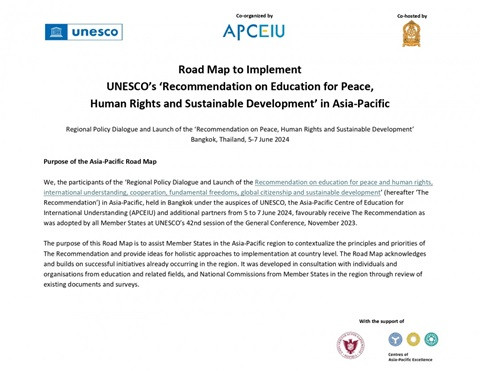 Road Map to Implement UNESCO’s ‘Recommendation on Education for Peace, Human Rights and Sustainable Development’ in Asia-Pacific 발행 연도: 2024 단체 저자: UNESCO Bangkok | APCEIU The Road Map is a product of the Regional Policy Dialogue and the Launch of the Recommendation on Education for Peace, Human Rights, and Sustainable Development (hereafter referred to as the 2023 Recommendation), held in Bangkok in June 2024. This document aims to promote the regional implementation of the 2023 Recommendation and outlines the challenges and priorities within the Asia-Pacific educational landscape, making it a valuable resource for policymakers, researchers, and practitioners.
 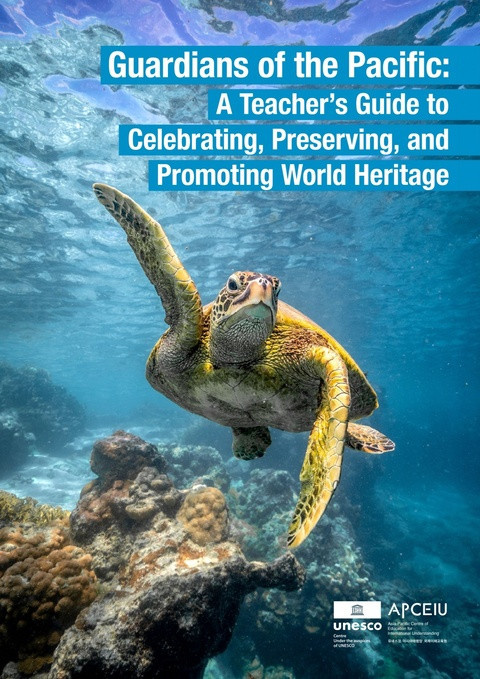 Guardians of the Pacific: A Teacher’s Guide to Celebrating, Preserving, and Promoting World Heritage 발행 연도: 2024 저자: Karena Menzie-Ballantyne | Nanise J. Young Okotai | Adi Meretui Tuvou Ratunabuabua 단체 저자: APCEIU Guardians of the Pacific: A Teacher’s Guide to Celebrating, Preserving, and Promoting World Heritage is an APCEIU initiative dedicated to advancing Global Citizenship Education (GCED) worldwide. Anchored in the principles of the Sustainable Development Goals (SDGs) and UNESCO World Heritage, the guide places a special emphasis on the rich and diverse heritage of the Pacific region. This Guide reflects GCED’s integrative approach, which encompasses three interconnected dimensions of learning: cognitive, socio-emotional, and behavioral. It encourages critical thinking about heritage and sustainability, fosters empathy by deepening understanding of the Pacific's unique cultural and natural environments, and inspires meaningful actions to protect and preserve local heritage. Tailored for educators working with students in upper primary (grades 4–6) and lower secondary (grades 7–9), the Guide provides step-by-step instructions and practical resources for incorporating Pacific World Heritage into classroom lessons and extracurricular activities. It is a valuable tool for nurturing awareness, appreciation, and stewardship of the Pacific region’s irreplaceable heritage in schools worldwide. <Table of Contents>ForewordHow to Use This GuideSection 1. Learning Framework Rationale Section 2. What Makes a Place Special?Section 3. The 2030 Agenda, Five Pillars and SDGsSection 4. Protecting People: Levuka Historical Port Town (Cultural Site)Section 5. Preserving the Planet: Phoenix Islands Protected Area (Natural Site)Section 6. Ensuring Prosperity: Rock Islands Southern Lagoon (Mixed Site)Section 7. Promoting Peace: Bikini Atoll Nuclear Test Site (Cultural Site)Section 8. Partnerships to Protect the Environment: East Rennell (Natural Site)Section 9. Taking Action to Promote and Protect a Special PlaceReferences WorksheetsPhoto Cards
  Confronting Inequality through GCED: Toward Justice, Inclusion, and Transformation (SangSaeng; No.65, 2025) 발행 연도: 2025 단체 저자: APCEIU The 62nd issue of SangSaeng has been published with the theme of “Ethical AI and GCED: Exploring the Expanding Domain of Artificial Intelligence.”AI has never been as pervasive and influential as it is in today’s rapidly changing world. Despite the convenience and cutting-edge technology AI has offered us, it has the potential to pose a threat to humanity. This is where ethics for AI should come forward. In this regard, this issue will lead readers to the alarming side of AI as well as its future developments, focusing on the importance of GCED and AI ethics in tackling any potential problems.Contents03 Editor's Note 04 Special ColumnEmbracing Change to Cultivate Success — Integrating Global Citizenship Education into Tertiary Education / Dendev Badarch08 FOCUS Ethical AI and GCED: Exploring the Expanding Domain of Artificial IntelligenceRole of Ethics in the Era of AI — Protecting and Guiding AI Processes for Humanity to Flourish / Emma Ruttkamp-BloemPayingAttention to AI Ethics — An Avenue for a New Competitive Edge in Business / Myoungshin KimDriving Innovative Education — Balancing Future Possibilities and Ethical Concerns: How GCED Can be Used to Address AI Issues / Angelique Southern 20 Special ReportEmpowering a Climate Generation — From Classrooms to Climate Frontlines : The Transformative Role of Education highlighted at COP28 / Djian Sadadou 22 Best PracticesNavigating an AI Future — Ethical AI and the Importance of Critical Thought / Hannah GrantGLACE Brings the World to a City — Empowering Youth as Global Citizens: Lessons from Navotas City’s Project GLAC / Marco D. MedurandaLowering Eco-Anxiety — Teaching Climate Change Through Media and Information Literacy / Laetitia Legrand 33 GCED YOUTH NETWORKNew Wave of Youth Advocacy — Role of AI in Youth Advocacy and its Ethical Implications to Global Citizenship / Oshan M. Gunathilake and Diego Manrique36 Understanding the Asia Pacific RegionDiscovering Auroville — Where Boundaries Fade, Nature Thrives, and Global Minds Unite / Akanksha Arya 39 Peace in My MemoryHappiness without Violence — Mindanao Peace Forum Celebrates Building a Culture of Peace / Ludivina Borja-DekitPeace Scholar Passes Away Amidst Turbulent Times / Kwang-Hyun KIM 45 Story TimeThe Right Footing — My Life Has Purpose Thanks to Football / Hajar Abulfazl 48 LetterShared Challenges of Global Citizens / Natsuki Nagata 50 APCEIU in Action
  Envisioning the Future of Assessment in Transformative Education: A Synthesis Report of the Expert Meeting on Evaluation and Assessment for Transformative Education: Towards and Beyond 2030 발행 연도: 2025 저자: Esther Care 단체 저자: APCEIU Transformative education calls for learning that nurtures not only knowledge, but also the values, attitudes, and behaviours essential for inclusive, just, and sustainable societies. Recent global discussions, including UNESCO’s Reimagining Our Futures Together: A New Social Contract for Education and the Recommendation on Education for Peace and Human Rights, International Understanding, Cooperation, Fundamental Freedoms, Global Citizenship and Sustainable Development, emphasise learning that fosters critical thinking, empathy, cooperation, and action-oriented engagement. Within this vision, assessment needs to evolve from primarily measuring achievement to supporting a process of learning that actively enables and evidences learners’ reflection, growth, and empowerment. Traditional approaches, which prioritise standardisation and summative outcomes, are insufficient for capturing the complex competencies at the heart of transformative education, such as socio-emotional development, critical reflection, ethical reasoning, and responsible action. These limitations raise fundamental questions about not only how transformative learning outcomes can be assessed across diverse systems and contexts, but also what purposes assessment should serve.To examine these issues, APCEIU convened the Expert Meeting on Evaluation and Assessment for Transformative Education: Towards and Beyond 2030, held in Seoul, Republic of Korea, on 2–3 July 2025. The meeting brought together global experts, researchers, and policymakers to discuss current challenges, share emerging practices, and consider strategic directions for reimagining assessment in support of transformative education.Building on these rich discussions, this report synthesises the key reflections and forward-looking perspectives shared during the meeting. Part I presents analytical insights and strategic considerations for advancing assessment in transformative education, while Part II documents the meeting proceedings, including presentations and collaborative discussions.
  Addressing Global Citizenship Education in Adult Learning and Education; Summary Report 발행 연도: 2019 저자: Christiana Nikolitsa-Winter | Werner Mauch | Philippe Maalouf 단체 저자: UNESCO Institute for Lifelong Learning (UIL) | APCEIU The Asia-Pacific Centre of Education for International Understanding (APCEIU) has published the summary report on Addressing Global Citizenship Education in Adult Learning and Education (ALE) in partnership with UNESCO Institute for Lifelong Learning (UIL). In regard to GCED in ALE the publication looks at the developments, gaps and challenges in Finland, Mauritania, the Republic of Korea, South Africa, and Uruguay and highlights a number of good practices in the field. As the role of ALE and GCED has been emphasized in realizing the 2030 Sustainable Development Agenda, it aims to raise awareness of the significance of GCED in ALE and to inspire various stakeholders to develop and strengthen this field of education. ForewordIntroduction Part I: Thematic Studies Global citizenship education(GCED): Conceptual considerationsRealizing the 2030 Sustainable Development Agenda: The role of GCED in ALEALE’s contribution to fostering GCED - ALE as GCEDLiteracy: The foundation of ALE and GCED - Contribution of adult literacy programmes to GCED outcomes - GCED in ALE: Global trends and outcomesProfessionalization of adult educators in GCED - Competency framework for adult educators in GCED - Curriculum framework for adult educators in GCED - Examples of curricula for adult educatorsConclusion on the thematic studies Part II: Case Studies GCED in ALE: Case studies from the five UNESCO regions - State of the art of ALE in the five countries - Legal frameworks and discourse - Selected ALE programmes and mechanisms that touch on GCED in the case studies - Professionalizing ALE educators as a means of fostering GCED in ALE: examples - Key outcomes of the country case studies - Addendum: GCED in ALE as a response to acute need - The BEF Alpha programme Conclusion and way forwardBibliography
  5th UNESCO Forum on Transformative Education for Sustainable Development, Global Citizenship, Health and Well-being (Strand 3) 발행 연도: 2021 저자: Carmel Cefai | Dy Samsideth | Mieke van Ingelghem | Kiichi Oyasu 단체 저자: UNESCO | El Centro Asia Pacífico de Educación para el Entendimiento Internacional (APCEIU) Strand 3– What does progress in transformative education look like – the crucial role of teachers Plenary session 3Based on the findings of two global studies conducted by UNESCO and its partners, this session discussed what can be done to support teachers to feel more confident in their role and to effectively facilitate transformative education. Moderators: Ms Antonia Wulff, Director of Policy, Advocacy and Research, Education International, Mr Christophe Cornu, Senior Project Officer, Section of Education for Health and Well-being, UNESCOMr William Gaudelli, Dean, College of Education & Vice Provost for innovation in education, Lehigh University, USAMr Carmel Cefai, Professor, Department of Psychology, University of Malta, MaltaPanelists:Mr Anil Ramdewor, Ministry of Education, MauritiusMr Souphap Khounvixay, Advisor, Cabinet Office of the Minister for Education and Sports, Lao People's Democratic RepublicMs Miri Yemini, Professor, Department of Educational Policy and Administration, the Jaime and Joan Constantiner School of Education, Tel Aviv University, IsraelMr Bert Tuga, President, Philippines Normal University, PhilippinesMs Anh Duong Phuong, Teacher and youth activist for gender equality and girls’ rights, Viet NamMr Renato Jiménez Cabrera, teacher trainer, the Benemérita Escuela Nacional de Maestros, Mexico Concurrent sessions 3The session addressed key action areas in view of advancing the role and building the capacities of teachers to deliver ESD, GCED and education for health and well-being. Session 3.1 – Teacher preparednessModerator: Dr Jim Taylor, Research Associate, University of KwaZulu-Natal, South AfricaSpeakers:Dr Dy Samsideth, Deputy Director General for Education, Ministry of Education, Youth and Sport, CambodiaDr Mieke van Ingelghem, Lecturer, UC Leuven Limburg Teacher Education (UNESCO Associated Schools Network member), Belgium Session 3.2 – Teaching and learning resources and materialsModerator: Ms Yumiko Yokozeki, Director, UNESCO International Institute for Capacity Building in Africa (IICBA)Speakers:Mr Dennis Sinyolo, Director, Education International’s African Regional OfficeMs Mary Sichangi, Head of Department, Partnerships & Linkages, Centre for Mathematics, Science and Technology Education in Africa (CEMASTEA)Mr Temechegn Engida, Program Officer, UNESCO International Institute for Capacity Building in Africa (IICBA) Session 3.3 – School and community supportModerator: Mr Carlos Vargas, Chief of Section of Teacher Development, UNESCOMr Carlos Enrique Rodoriguez Rivas, Head, National Teacher Training Institute, Ministry of Education, El SalvadorDr James Williams, Professor, School of Education and Human Development at George Washington University, USAMr Kiichi Oyasu, Director, Education Cooperation Department of Asia-Pacific Cultural Centre for UNESCO (ACCU), Japan Links to Strand 1 / Strand 2 & Special Session / Strand 4
  5th UNESCO Forum on Transformative Education for Sustainable Development, Global Citizenship, Health and Well-being (Strand 4) 발행 연도: 2021 저자: Alexander Leicht | Nilantha Gunasekara | Aaron Benavot | Umair Mushtaq | Elena Diryugina | Libby Giles | Mónika Réti | Le Anh Vinh 단체 저자: 유네스코 | 유네스코 아시아태평양 국제이해교육원 Strand 4 – What does progress in transformative education look like – conclusions and next steps Plenary session 4The Strand assessed how to best capture progress including possible benchmarks and success indicators in addressing different aspects of transformative education and discussed the way forward.Moderator: Ms Vibeke Jensen, Director, Division of Peace and Sustainable Development, UNESCOPresentation of the key ideas for recommendation:Mr Alexander Leicht, Chief of Section of Education for Sustainable Development, UNESCODiscussants:Mr Nilantha Gunasekara, Deputy Director, School Health and Nutrition Branch, Ministry of Education, Sri LankaMs Chandrika Bahadur, Director, SDG AcademyMs Katarina Popovic, Professor, Department of Andragogy, University of Belgrade, Serbia & Secretary General, the International Council for Adult Education (ICAE)Mr Hyun Mook Lim, Director, APCEIUMr Aaron Benavot, Professor, University of Albany, USA Concurrent sessions 4In the concurrent sessions, concrete policy recommendations on advancing transformative education and creating enabling conditions were formulated by policymakers, practitioners and monitoring experts. Session 4.1 – Policy makersModerator: Mr Sam Loni, Programme Director, UN Sustainable Development Solutions Network, USASpeakers:Ms Catherine Matara, Assistant Director of Education, Ministry of Education, KenyaMs Sandra Allison Soria Mendoza, Head of the Environmental Education Unit and Environmental Education Specialist, Ministry of Education of PeruMs Saher Baig, Representative, Youth4Climate Session 4.2 – PractitionersModerator: Ms Monica Froehler, CEO, Ban Ki-moon Centre for Global CitizensSpeakers:Mr Umair Mushtaq, Project Manager, The Little Art, PakistanMs Elena Diryugina, Head of methodology and evaluation department, Investment to the Future, Russian FederationMs Libby Giles, Head of Global Citizenship, St Cuthbert’s College, Director, New Zealand Centre for Global Studies, New Zealand Session 4.3 – Monitoring experts on measurement frameworks, M&E, and dataModerator: Mr Ralph Carstens, Senior Research Advisor, International Association for the Evaluation of Educational Achievement (IEA)Speakers:Ms Mónika Réti, Representative of Hungary, UNECE working group on monitoring of the ESD strategyMr Le Anh Vinh, Deputy Director General, Viet Nam Institute of Educational Sciences (VNIES)Mr Hilaire Hounkpodoté, Coordinator of the Programme for the Analysis of Education Systems (PASEC), CONFEMENMr Guy-Roger Kaba, Coordinator of the Observatory on the Quality of Education, CONFEMEN Links to Strand 1 / Strand 2 & Special Session / Strand 3
  5th UNESCO Forum on Transformative Education for Sustainable Development, Global Citizenship, Health and Well-being (Strand 1) 발행 연도: 2021 저자: Shadreck Majwabe | Thomas Greiner | Taka Horio | Niveen Jouhar | Arjen Wals | Lynndina Essack | Didier Jourdan | James O’Higgins Norman | Bolorchimeg Dagva 단체 저자: UNESCO | APCEIU Plenary session 1In this first plenary, countries shared their vision, practice and progress underpinning their understanding of “transformative education”. The impact of current practices related to learners’ behavior and the educational system was discussed, highlighting success indicators.Moderator: Ms Krista Pikkat, Director, UNESCO Almaty OfficeMr Shadreck Majwabe, Director of the Department of Curriculum Development and Evaluation, Ministry of Basic Education, BotswanaMr Thomas Greiner, Head of Subdivision, Lifelong Learning, Federal Ministry of Education and Research, GermanyMs Taka Horio, Assistant Secretary-General, the Japanese National Commission for UNESCO & ASP National Coordinator, Ministry of Education, Culture, Sports, Science and Technology, JapanMs Niveen Jouhar, Member of Directorate of Curricula, Ministry of Education, Jordan Concurrent sessions 1Following the plenary session, the concurrent sessions discussed the different components that need to be transformed in the education system, and how to bring about these changes and further advance. Session 1.1 – PolicyModerator: Ms Akpezi Ogbuigwe, Founder, Anpez Centre for Environment and Development, Nigeria Mr Arjen Wals, UNESCO Chair, Social Learning and Sustainable Development, University of Wageningen, Netherlands Ms Anna-Karin Johansson, Swedish National Commission for UNESCO, Ministry of Education, Sweden Mr Felipe de Souza Costa, São Paulo Municipal Secretariat of Education, Brazil Mr El Hadji Gueye, Founder, Banlieu UP, Senegal Session 1.2 – Curricula, pedagogy and assessmentModerator: Mr Yao Ydo, Director, UNESCO International Bureau of Education (IBE)Dr Esther Care, Professor, University of Melbourne, AustraliaMs Lynndina Essack, Senior Education Officer, Department of Education Services, Ministry of Education, SeychellesMr Daehoon Jho, Professor, Sungshin Women's University, Republic of KoreaDr Jinan Karameh Chaya, Principal, Al Manar Modern School (UNESCO Associated Schools Network member), Lebanon Session 1.3 – Learning environmentModerator: Mr Chris Castle, Chief of Section of Education for Health and Well-being, UNESCOProf Didier Jourdan, UNESCO Chair and Head of the World Health Organization (WHO) Collaborating Center "Global Health & Education"Prof James O’Higgins Norman, Director of the National Anti-Bullying Centre, the Dublin City University, Ireland & UNESCO Chair on Tackling Bullying in Schools and CyberspaceMs Bolorchimeg Dagva, Adolescents and HIV Specialist, UNICEF, Mongolia Links to Strand 2 & Special session / Strand 3 / Strand 4
  5th UNESCO Forum on Transformative Education for Sustainable Development, Global Citizenship, Health and Well-being (Strand 2 & Special Session) 발행 연도: 2021 저자: Miho Taguma | Leanne Riley | Valeria Damiani | Nandini Chatterjee | Valerie Shapiro | Pablo Pincheira | Nicolas Jonas | Denis Barrett | Doug McCall | Antoine Marivin | Cheoljin Yang | Sunkyung Lee 단체 저자: UNESCO | APCEIU Strand 2 – What does progress in transformative education look like – a look at recent global and regional data Plenary session 2Building upon Strand 1, this session examined transformative education through the lens of regional and global comparative data in relation to SDG Target 4.7. The discussion identified the progress made, and remaining gaps in existing monitoring and assessment frameworks.Moderator: Mr Sobhi Tawil, Director, Future of Learning and Innovation, UNESCOMs Miho Taguma, Senior Policy Analyst on OECD Learning Compass 2030 and SDG 4.7Ms Leanne Riley, Unit Head, Surveillance, Monitoring and Reporting, Department of Noncommunicable Diseases (NCDs), World Health OrganizationMs Valeria Damiani, Associate Professor, La Libera Università Maria SS. Assunta (LUMSA) University, ItalyMr Carlos Henríquez Calderon, Coordinator of the Latin American Laboratory for Assessment of the Quality Education (LLECE), Regional Bureau for Education in Latin America and the Caribbean (OREALC), UNESCO Santiago Office Concurrent sessions 2The concurrent sessions engaged in an in-depth discussion on three selected major gaps in transformative education, identified opportunities and made suggestions on the way forward. Session 2.1 – How to address social and emotional dimensions of learning in assessment?The increasing integration of social and emotional learning (SEL) into curricula has raised questions regarding feedback and assessment. Drawing on research, policy and practice, this session examined possibilities and gaps in SEL.Moderator: Ms Cecilia Barbieri, Chief, Section of Education for Global Citizenship & Peace, UNESCOMs Nandini Chatterjee, Senior National Project Officer, UNESCO Mahatma Gandhi Institute of Education for Peace and Sustainable Development (MGIEP)Ms Valerie Shapiro, Associate Professor, University of California Berkeley, USAMr Pablo Pincheira, Training Director, Forja Chile, Chile Session 2.2 – Making adult learning and education visible within lifelong learning: strengthening non-formal education for individual, social and system level transformationThis session presented local initiatives that have embedded ESD and GCED into lifelong learning systems through policy/strategy development and project implementation, as well as progress made in building learning cities. Moderator: Mr Jose Roberto Guevara, President, International Council for Adult EducationSpeakers:Mr Nicolas Jonas, Programme Specialist, UNESCO Institute for Lifelong Learning (UIL)Ms Mo Winnie Wang, Programme Specialist, UNESCO Institute for Lifelong Learning (UIL)Mr Denis Barrett, Coordinator of Cork Learning City, Ireland Session 2.3 – What do we need to monitor/measure/assess in transformative education - gaps and opportunities?The session focused on promising practices and remaining gaps in capturing the transformation of individuals, societies and education. The key question addressed was how quality teaching and learning can be guided based on the evidence available.Moderator: Dr Marcia McKenzie, Director, MEECE Project and SEPN, and Professor, the University of Melbourne, AustraliaMr Doug McCall, Executive Director, International School Health NetworkMr Antoine Marivin, Project Manager, UNICEF-East Asia and Pacific Regional Office (EAPRO)Dr Julia Kim, Programme Director, the Gross National Happiness Centre, Bhutan Special Session by the Host Country (Plenary) – Experiences from the Republic of Korea and Beyond: Progress, Challenges and New VisionsThe Special Session discussed the Korean experience on SDG Target 4.7, at the domestic and international level. Good practices, emerging trends and lessons learnt were shared, suggesting key agendas, challenges, and visions towards 2030 and transformative education.Moderator: Mr Soon-yong Pak, Professor, Yonsei University, Republic of KoreaSpeakers:Mr Hwanbo Park, Professor, Chungnam University, Republic of KoreaMr Cheol-Jin Yang, Teacher at Songwoo Middle School & Co-Founder/Director of Neuroo, Republic of KoreaDiscussants:Ms Sun-Kyung Lee, Professor, Cheongju National University of Education, Republic of KoreaMr Aaron Benavot, Professor, University of Albany, USA Links to Strand 1 / Strand 3 / Strand 4
  [Summary] First Meeting of UNESCO Chairs Relating to Global Citizenship Education 발행 연도: 2022 단체 저자: 联合国教科文组织 (UNESCO) | 亚太地区促进国际理解教育中心 (APCEIU) This report shares the overview of the First Meeting of UNESCO Chairs Relating to Global Citizenship Education held on Friday, 30 September 2022. The event was co-organized by UNESCO and APCEIU with the main objective of gathering UNESCO Chairs from GCED-related fields to discuss the need for a platform for information sharing and knowledge exchanges and share ideas of how UNESCO Chairs could collaborate through joint projects.As UNESCO is in the process of revising the 1974 UNESCO Recommendation concerning Education for International Understanding, Co-operation and Peace and Education relating to Human Rights and Fundamental Freedoms, the report also shared the summary of the discussion over the meeting regarding the current status of the revision process and UNESCO Chairs' thoughts and suggestions on the revised Recommendation.