
자료
세계시민교육에 대한 이해를 넓히고 연구, 옹호 활동, 교수, 학습 등을 향상시킬 수 있는 다양하고 유용한 자료를 찾아보세요.
248 건의 결과가 검색되었습니다
 Second Annual Meeting of the Global Citizenship Education Actors’ Platform: Meeting Report 발행 연도: 2020 단체 저자: APCEIU This meeting report provides readers with an overview of discussion points during the “Second Annual Meeting of the GCED Actors’ Platform” held on 19 November 2020. The Meeting was aimed at: Reviewing and updating the status of regional priorities and progress for GCED in the light of the COVID-19 pandemic. Sharing initiatives and on-going projects undertaken at the regional level, especially in the field of GCED Research. Discussing future directions of the global and inter-regional GCED partnership.
  International Understanding and Cooperation in Education in the Post-Corona World 발행 연도: 2020 저자: Dongjoon Jo | Edward Vickers | Dina Kiwan | Fei Yan | Kyujoo Seol | Kyoko Nakayama 단체 저자: APCEIU This report aims to figure out the role of education in the post-pandemic world. It includes research studies from 6 experts to give insightful views on the direction for international understanding and cooperation in the education sector in the post-pandemic years.
  EIU Best Practices Series No. 16: A Korean Agricultural Village's Communal Movement for Education for Sustainable Development 발행 연도: 2009 저자: Seungkwan Jung 단체 저자: APCEIU This monograph is one of APCEIU's EIU Best Practices Series, which aims to encourage educators, scholars, and activists to implement and share local initiatives on EIU. The Series No.16 introduces the Poolmoo School, which turns surrounding economy, ecology, culture into educational learning material, and endeavor to create a school culture with emphasis on sustainable development. Students of Poolmoo School learn about organic farming, ecological village, and agricultural sustainability, essentially raising awareness of environmental preservation for the next generation.
  Supporting Change in Practice: Case Studies on the Use of the ACER-APCEIU Global Citizenship Education Monitoring Toolkit; Country Case-Australia 발행 연도: 2025 저자: Rachel Parker | Karena Menzie-Ballantyne 단체 저자: APCEIU APCEIU published Supporting Change in Practice: Case Studies on the Use of the ACER-APCEIU Global Citizenship Education Monitoring Toolkit, which shares key findings from the research conducted in Australia and the Republic of Korea. The two reports, based on case studies from two countries, build upon the three-phase Asia-Pacific GCED Monitoring Project (2022–2024) jointly undertaken by ACER and APCEIU to strengthen monitoring and evaluation of GCED and support progress toward SDG 4.7 across the region. The three phases of the initiative identified enabling conditions for GCED, validated the regional GCED Monitoring Framework, and developed the ACER-APCEIU GCED Monitoring Toolkit. The reports for each phase can be found here: Phase I, Phase II, and Phase III.The reports move the project forward by examining how the Toolkit can be practically applied in real educational settings. The study aimed to examine how the Toolkit could be used to support collaboration among key education stakeholders—teachers, school leaders, and education supervisors—in 1) goal setting, 2) planning, 3) implementing, and 4) reflecting on GCED practices. Through this process, the research sought to understand how the Toolkit could help strengthen the connection between policy commitments and everyday educational practice, supporting teachers, school leaders, and system leaders to embed GCED more systematically and sustainably within their existing framework. Both studies conducted in Australia and the Republic of Korea have been guided by the following research questions: How does the GCED Monitoring Toolkit support key stakeholder groups to collaboratively embed GCED in policy and practice? a. What aspects of the Toolkit enable or challenge stakeholders to achieve their GCED goals and objectives? b. How do key stakeholders perceive its usefulness?Are there any aspects of the Toolkit that stakeholders would change to improve its usefulness in supporting the implementation and contextualisation of GCED in policy and practice?The reports demonstrate how a GCED Monitoring Toolkit can be translated into actionable processes within real educational settings. It offers valuable insights for policymakers, school leaders, teachers, and researchers aiming to monitor and strengthen GCED implementation and systematically embed GCED within their educational ecosystems.
  EIU Best Practices Series No. 19: Culture-Based Education Programme for Indigenous Children & Youth in the Philippines 발행 연도: 2010 저자: Benjamin David Abadiano 단체 저자: APCEIU This monograph is one of APCEIU's EIU Best Practices Series, which aims to encourage educators, scholars, and activists to implement and share local initiatives on EIU. The Series No.19 introduces the Pumulaan program, a successful culture-based education programme for indigenous children and youth in the Philippines. The program is similar to that of Tugdaan, a widely recognized education program that promote learning for the Indigenous people. The Pumulaan program focuses on providing culturally sensitive, appropriate, and relevant education to students in Mangyan Tribe in Mindoro and the Matigsalog Tribe in Mindanao, incorporating values of peace, harmony, and diversity within the education programs.
  3rd Youth Leadership Workshop on GCED: Final Report 발행 연도: 2017 단체 저자: APCEIU This report provides an overview of the activities carried out during the 3rd Youth Leadership Workshop on Global Citizenship Education (GCED) held in Jeju, Republic of Korea, from 28 May - 3 June 2017. This programme invited 50 youth activists from 43 countries around the world to exchange their ideas and identify GCED leadership strategies in order to mobilize young people for GCED in local and national contexts and advance the agenda globally. This report also aims to convey the voice of the youth represented by GCED Youth Network: their thoughts and reflections on GCED and its priority areas. The workshop was organized by APCEIU and in partnership with GCED Youth Network, Jeju Forum for Peace and Prosperity, Jaejudo Joa and Global Inner Peace; it was sponsored by Ministry of Education of the Republic of Korea and Jeju Special Self-Governing Province.For more information, please contact APCEIU's Office of Education and Training at ent@unescoapceiu.org. 제3차 세계시민교육 청년리더십 워크숍: 최종보고서 발행 연도: 2017 단체 저자: APCEIU 본 보고서는 2017년 5월 28일부터 6월 3일까지 제주에서 열린 ‘제3차 세계시민교육 청년리더십 워크숍(3rd Youth Leadership Workshop on GCED)’에서 이루어진 활동 개요를 제공한다. 이 워크숍은 유네스코 아태교육원 주최, 세계시민교육 청년네트워크, 평화와 번영을 위한 제주포럼, 재주도좋아, 글로벌 이너피스가 파트너로 참여하였으며, 대한민국 교육부 및 제주특별자치도청이 후원하였다. 이 프로그램에는 전세계 43개국 50명의 청년활동가들이 참가하여 세계시민교육에 대한 아이디어를 교환하며, 세계시민교육을 전 세계적으로 확산하고 지역·국가적 차원의 청년활동을 증진하기 위한 리더십 전략을 논의하였다. 본 보고서는 7일간의 워크숍 활동들에 대한 기록과 더불어 세계시민교육의 주체인 청년들을 대표하여 세계시민교육 청년 네트워크가 생각하는 세계시민교육의 의미와 우선 과제들에 대한 목소리를 담고자 했다. 문의: 유네스코 아태교육원 교육연수실(ent@unescoapceiu.org)
 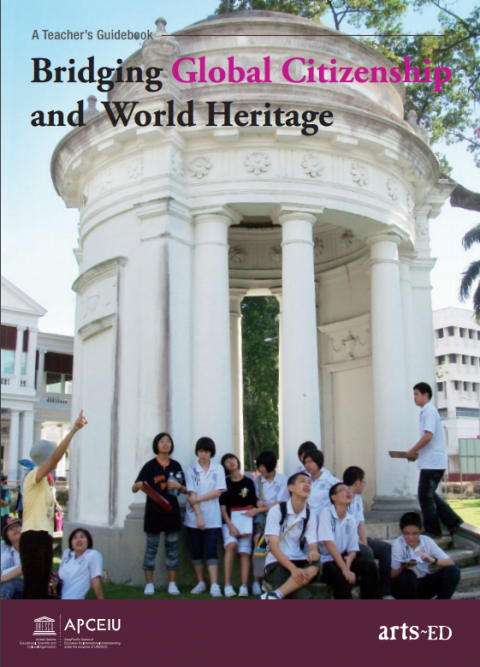 GCED Teacher's Guidebook Bridging Global Citizenship and World Heritage 발행 연도: 2016 단체 저자: APCEIU APCEIU, in collaboration with Arts-ED Penang, a non-profit organisation for art and culture education, has published a Global Citizenship Education(GCED) Teacher’s Guidebook Bridging Global Citizenship and World Heritage. This guidebook was developed as a project of GCED Material Development on World Heritage, in order to promote awareness of cultural diversity as well as mutual understanding. This Teacher’s guidebook not only provides literature on both World Heritage in Malaysia and GCED but also gives case examples and lesson plans to provide teachers with practical assistance in designing and conducting GCED class utilizing World Heritage. <Contents>ForewordList of Figures and ImagesChapter 1. Introduction to the World Heritage Site of George Town and MelakaChapter 2. Global Citizenship Education: Empowering Citizens to Create a Better World TogetherChapter 3. How to Design Lessons Using Global Citizenship Education and Heritage ResourcesChapter 4. Case Examples and Lesson PlansReferences 세계문화유산 활용 세계시민교육 교사 지침서 발행 연도: 2016 단체 저자: APCEIU 문화다양성과 상호이해 증진을 위한 세계유산 활용 세계시민교육 자료개발 사업의 일환으로 발간된 이 교사 지침서는 말레이시아의 세계문화유산을 활용해 진행했던 실천사례와 수업예시 등을 담고 있어 일선 교사들이 향후 세계시민교육 수업을 구성하고 진행하는데 실질적인 도움을 줄 것으로 기대된다.<목차>발간사도표와 그림1장. 믈라카와 조지타운 세계유산 소개2장. 세계시민교육: 더 나은 세상을 함께 만들기 위한 시민의 역량을 기르다.3장. 세계유산과 세계시민교육을 활용한 수업 구성하기4장. 실천 사례 및 수업 교안참고자료
 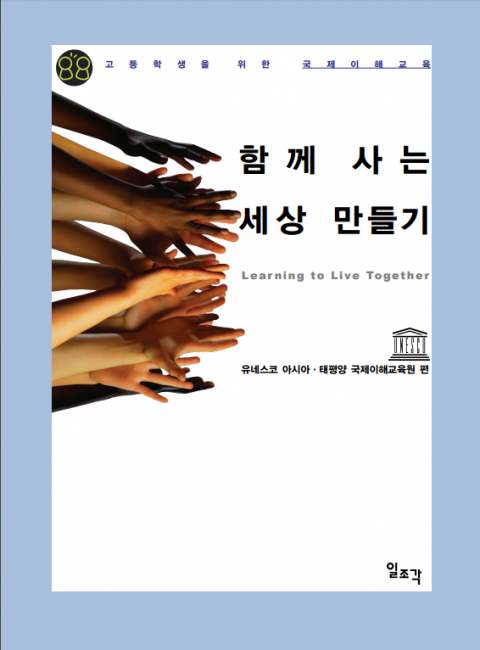 함께 사는 세상 만들기 발행 연도: 2004 단체 저자: APCEIU This book, in essence, aims to introduce Education for International Understanding (EIU) to high school students, college students and teachers at all levels as well as the general public. The growing interconnectedness and interdependence compels all of us to understand the world beyond our immediate living space, to critically reflect on issues affecting us and others, and to work together to make our world a more peaceful and sustainable one. It requires values education that is transformative and participatory in nature to arouse genuine interests and passions to learn more and eventually to make positive changes. The book is comprised of five parts, organized by five thematic areas of EIU, namely, intercultural understanding, globalization, human rights, peace and Education for Sustainable Development (ESD). It introduces carefully chosen topics and discussions which may pique readers’ interest in some of the issues at stake, thus, encourage them to critically reflect on the complexities surrounding the issues and motivate them to engage further. Using an interdisciplinary lens, the book also borrows some ideas and approaches commonly practiced in critical anthropology.