
자료
세계시민교육에 대한 이해를 넓히고 연구, 옹호 활동, 교수, 학습 등을 향상시킬 수 있는 다양하고 유용한 자료를 찾아보세요.
248 건의 결과가 검색되었습니다
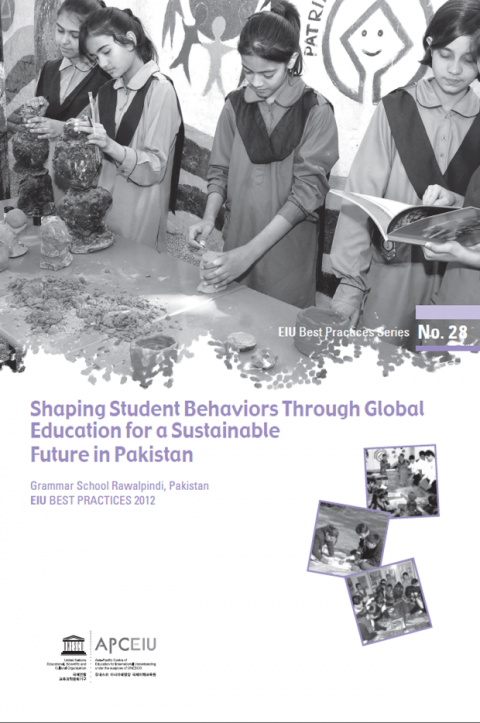 Façonner le comportement des élèves par le biais de l'éducation mondiale pour un avenir durable au Pakistan (ECI Série des Meilleures Pratiques no.28) 발행 연도: 2012 저자: Nasreen Iqbal 단체 저자: APCEIU Question n ° 28 introduit un programme d’Éducation Mondiale avec ses diverses activités de Grammar School Rawalpindi au Pakistan. Il vise à permettre et permettre aux jeunes de devenir des citoyens responsables et humains pour parvenir à un avenir pacifique et durable. Il est destiné à tous les niveaux des élèves, y compris le niveau préscolaire, afin d'accroître leur prise de conscience des valeurs sociales et civiques. Le programme se concentre principalement sur ECI tout aux apprenants des compétences de résolution des conflits, des identités culturelles et nationales et la citoyenneté mondiale. En outre, il intègre des questions telles que les valeurs universelles, les droits de l'homme, la santé, le développement durable, l'égalité, le multiculturalisme, le respect pour les groupes minoritaires, l'identité et l'estime de soi, la tolérance, etc. dans l'ethos et le curriculum de sorte que les étudiants seront en mesure école pour effectuer des changements positifs sur le national et au niveau international.
  Envisioning the Future of Assessment in Transformative Education: A Synthesis Report of the Expert Meeting on Evaluation and Assessment for Transformative Education: Towards and Beyond 2030 발행 연도: 2025 저자: Esther Care 단체 저자: APCEIU Transformative education calls for learning that nurtures not only knowledge, but also the values, attitudes, and behaviours essential for inclusive, just, and sustainable societies. Recent global discussions, including UNESCO’s Reimagining Our Futures Together: A New Social Contract for Education and the Recommendation on Education for Peace and Human Rights, International Understanding, Cooperation, Fundamental Freedoms, Global Citizenship and Sustainable Development, emphasise learning that fosters critical thinking, empathy, cooperation, and action-oriented engagement.Within this vision, assessment needs to evolve from primarily measuring achievement to supporting a process of learning that actively enables and evidences learners’ reflection, growth, and empowerment. Traditional approaches, which prioritise standardisation and summative outcomes, are insufficient for capturing the complex competencies at the heart of transformative education, such as socio-emotional development, critical reflection, ethical reasoning, and responsible action. These limitations raise fundamental questions about not only how transformative learning outcomes can be assessed across diverse systems and contexts, but also what purposes assessment should serve.To examine these issues, APCEIU convened the Expert Meeting on Evaluation and Assessment for Transformative Education: Towards and Beyond 2030, held in Seoul, Republic of Korea, on 2–3 July 2025. The meeting brought together global experts, researchers, and policymakers to discuss current challenges, share emerging practices, and consider strategic directions for reimagining assessment in support of transformative education.Building on these rich discussions, this report synthesises the key reflections and forward-looking perspectives shared during the meeting. Part I presents analytical insights and strategic considerations for advancing assessment in transformative education, while Part II documents the meeting proceedings, including presentations and collaborative discussions.
  2020 온라인 쌤(SSAEM) 컨퍼런스: 최종보고서 발행 연도: 2020 단체 저자: APCEIU | Korea R. Ministry of Education 2020 온라인 SSAEM 컨퍼런스는 교육교류사업 참가교사들의 사업 참가 이후 후속활동 성과를 공유하는 장으로 운영되었다. 2012년도 부터 9년간 교육교류사업에 참가한 약 1,200명의 국내·외 교사들의 다양한 후속활동 결과물을 공유하고, 향후 네트워크 구축을 위한 온라인 소통 공간을 제공하였다.
 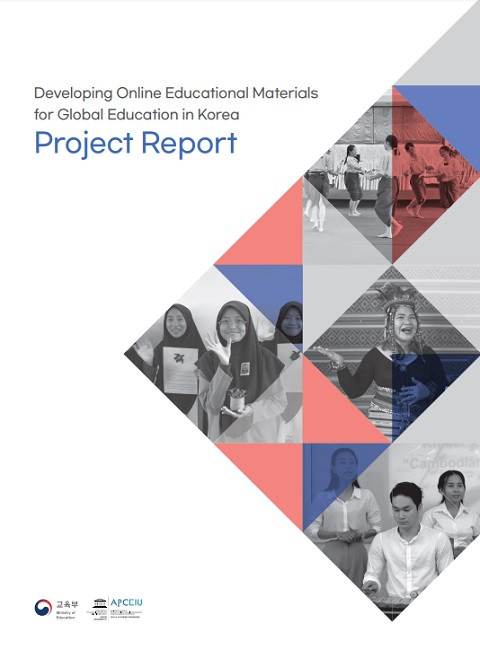 Developing Online Educational Materials for Global Education in Korea: Project Report 발행 연도: 2020 단체 저자: APCEIU | Korea R. Ministry of Education This project aims to enhance the intercultural understanding of Korean teachers and students by utilizing global education and Global Citizenship Education(GCED) materials produced by partner countries’ teachers. Simultaneously, for the teachers from partner countries, the project is expected to enhance their educational competency, global competency, and online teaching competency required in this pandemic era. The project also aims to establish an online teaching and learning model by using online educational materials in Korean classrooms and accumulate and expand educational achievements in response to the spread of online exchange. 초청교사 온라인 교수자료 제작: 최종 보고서 발행 연도: 2020 단체 저자: APCEIU | Korea R. Ministry of Education 본 프로젝트는 대상국 교사가 제작한 글로벌·세계시민교육 자료 활용을 통해, 국내 학교 교원 및 학생의 다문화 감수성을 제고하는 것을 목표로 한다. 동시에 강의자로 참여하는 대상국 교사의 교육 역량과 글로벌 역량, 그리고 언택트 시대에 요구되는 온라인 강의 역량을 향상시키고자 한다. 또한 외국 교사가 제작한 온라인 교수자료를 국내 교육 현장에 활용하여 이를 토대로 온라인 교수-학습 체제를 구축하고, 온라인 교류 확산 추세에 대응하며 교육성과를 축적·확산하고자 한다.
 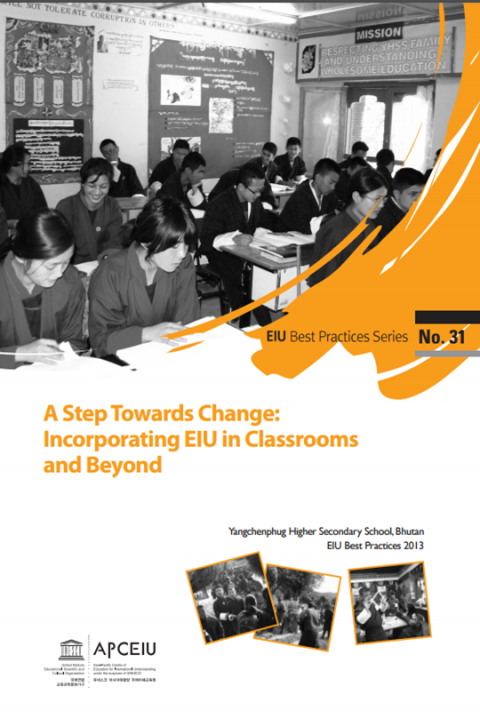 EIU Best Practices Series No.31: A Step towards Change: Incorporating EIU in Classrooms and Beyond 발행 연도: 2013 단체 저자: APCEIU This monograph is one of APCEIU's EIU Best Practices Series, which aims to encourage educators, scholars, and activists to implement and share local initiatives on EIU. The Series No.31 introduces a case study in which Bhutanese school carried out activities and curriculum development to successfully promote EIU and ESD for students and teachers. While the school’s curriculum already embodies a degree of EIU, the school strived to be more creative in upholding the existing content by exploring newer issues of media ethics, human rights, culture, and environmental conservation for fruitful engagement. This in turn allowed the target audience to learn the values of EIU/ESD for a culture of peace.
 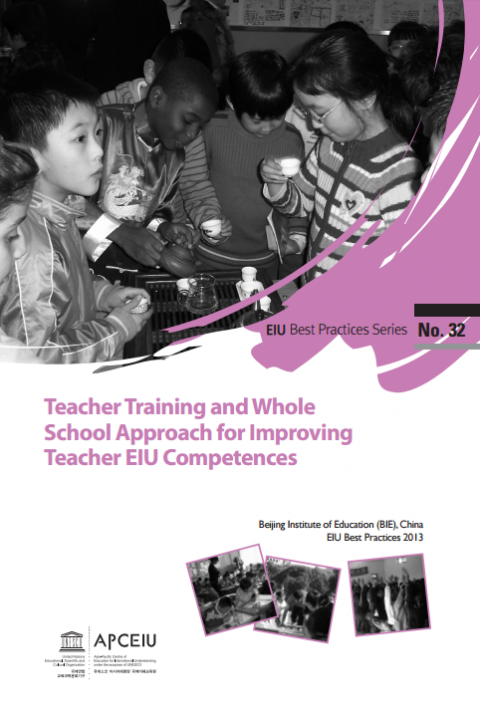 EIU Best Practices Series No.32: Teacher Training and Whole School Approach for Improving Teacher EIU Competences 발행 연도: 2013 단체 저자: APCEIU This monograph is one of APCEIU's EIU Best Practices Series, which aims to encourage educators, scholars, and activists to implement and share local initiatives on EIU. The Series No.32 introduces two cases in which primary and secondary school teachers in Beijing were trained to promote EIU in respective communities. As teachers developed their EIU competence and awareness, students learned to be more open-minded, respectful, and tolerant. The issue highlights the important role educators have in instilling EIU values and shaping perception.
 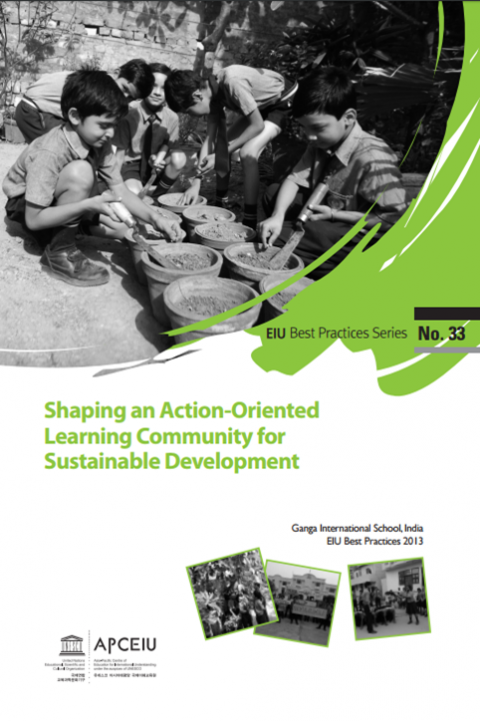 EIU Best Practices Series No.33: Shaping an Action-Oriented Learning Community for Sustainable Development 발행 연도: 2013 단체 저자: APCEIU This monograph is one of APCEIU's EIU Best Practices Series, which aims to encourage educators, scholars, and activists to implement and share local initiatives on EIU. The Series No.33 introduces a program implemented at the Ganga International School in India to promote eco-friendly and multicultural society. Teachers, students, and local community members engaged in awareness raising events such as Recycled Paper Art exhibition, Tree Plantation Drive, and Anti-Malaria Project, allowing everyone to absorb the meaning of EIU and sustainable development. Furthermore, students partook in seed exchange program and video conferences to discuss environmental issues with students of partner schools, which amplified impact at local and global levels.
 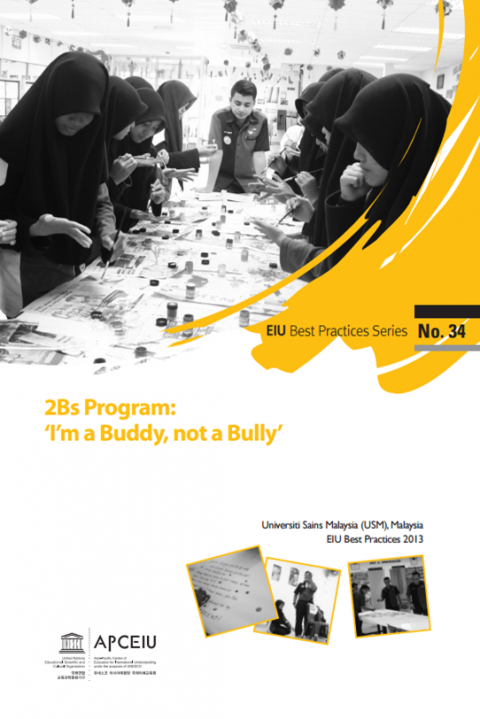 EIU Best Practices Series No.34: 2Bs Program: 'I'm a Buddy, not a Bully' 발행 연도: 2013 단체 저자: APCEIU This issue is one of APCEIU's EIU Best Practices Series, which aims to encourage educators, scholars, and activists to implement and share local initiatives on EIU. The Series No.34 introduces the 2Bs Program implemented in boarding schools in Malaysia, highlighting the importance of education in preventing bullying behavior. The program involves three phases, such as employing creative and fun pedagogy approaches, rehabilitation, and student potential development to effectively raise awareness surrounding the issue and encourage behavior change. Such initiative is exemplary in combatting challenges that arise from cultural differences, and in fostering understanding.
 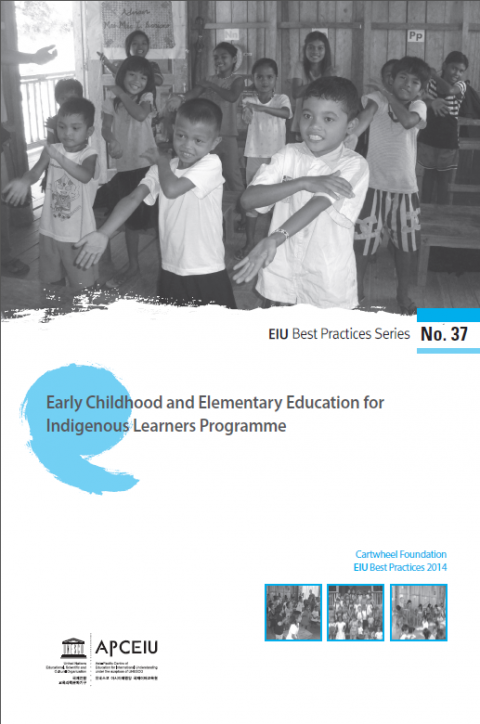 EIU Best Practices Series No.37: Early Childhood and Elementary Education for Indigenous Learners Programme 발행 연도: 2014 단체 저자: APCEIU This monograph is one of APCEIU's EIU Best Practices Series, which aims to encourage educators, scholars, and activists to implement and share local initiatives on EIU. The Series No.37 introduces the Early Childhood and Elementary Education (ECEE) for Indigenous Learners Programme initiated in the Philippines. The indigenous peoples (IP) reside in the mountainous regions, away from basic social services and struggling with poverty, malnutrition, and lack of proper education. The aim of ECEE is to facilitate access to quality and culturally-relevant early childhood and elementary education for the Higaonon indigenous children. To achieve this, activities such as curriculum indigenization and teacher training are provided in collaboration with the community members. As the program creates learning process for all through openness, sharing, and collaboration, this is an exemplary case of EIU/GCED pedagogical approach.