
자료
세계시민교육에 대한 이해를 넓히고 연구, 옹호 활동, 교수, 학습 등을 향상시킬 수 있는 다양하고 유용한 자료를 찾아보세요.
5 건의 결과가 검색되었습니다
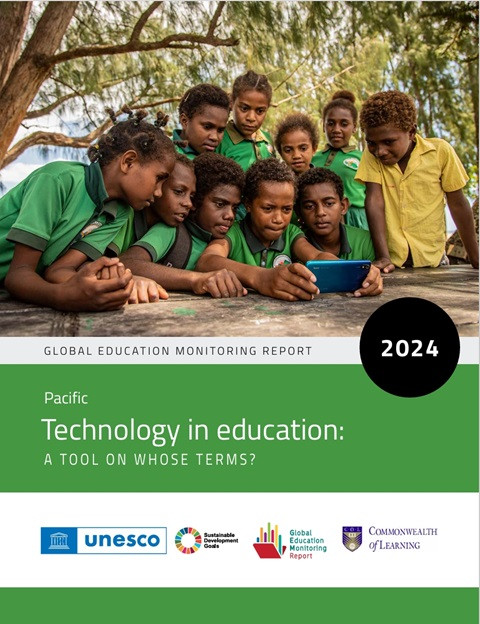 Global Education Monitoring Report 2024, Pacific: Technology in Education; A Tool on Whose Terms? 발행 연도: 2024 단체 저자: UNESCO | Global Education Monitoring Report Team | Commonwealth of Learning Information transmission and connectivity is crucial in the Pacific, a region characterized by high geographic dispersion. While the application of ICT in education has significant potentials, it is hindered by the region's limited and costly infrastructure. This edition accompanies the 2023 Global Education Monitoring Report, which acknowledges technology as a useful tool but invites the education community to question on whose terms it is deployed. The report considered four key policy areas of the Pacific Regional Education Framework (PacREF) (2018–2030): In terms of quality and relevance, mobile technology has offered an affordable and flexible approach to learning, and social media have improved communication between institutions, parents and learners. Moodle is the most widely used digital platform in the region. Textbooks are being digitalised and digital resources made available. Yet content is not always developed or adapted to local languages and cultural contexts. Open and distance learning has historically expanded learning pathways in the Pacific, specially in higher education and as a response to natural hazards. The University of South Pacific is a leading example of open and distance learning connecting campus across 12 countries. With the aim to enhance student outcomes and well-being, efforts have been made to incorporate digital skills into curricula and initiatives have increased outside formal education. Yet regulations do not adequately address threats from the use of technology to privacy, safety and well-being. With a focus on the teaching profession, countries leverage technology to provide training opportunities and transform the teaching profession. However, ICT training varies greatly across the region and limited digital infrastructure hinders technology integration into classrooms and teacher training. Three conditions need to be met for technology's potential to be fulfilled: equitable access to technology, appropriate governance and regulation, and sufficient teacher capacity. Supporting this publication is seven background thematic studies that provide a comprehensive overview of education technology issues; Commonwealth of Learning’s short case studies on some of its projects; a survey administered to key informed respondents from the region; and a series of country profiles on PEER, a policy dialogue resource describing policies and regulations related to technology in the region’s education systems.
  Guidelines on the Development of Open Educational Resources Policies 발행 연도: 2019 단체 저자: UNESCO | Commonwealth of Learning Open educational resources (OER) – and to a greater extent, OER policies – can increase the quality and accessibility of teaching and learning as well as foster knowledge creation within a country.This publication provides detailed guidelines on how to develop systematic and effective policies on OER. Such policies are important to coordinate, strengthen and drive initiatives in a country; they involve government and institution actors on various levels working together to leverage OER toward achieving common goals under a national educational framework. OER policy provisions can be a part of a dedicated national masterplan, be under the framework of an overall education programme, or be elements incorporated into various strategies across multiple sectors.These guidelines lay out steps to review, analyse, develop, implement and monitor a context-relevant OER policy. They guide, but do not determine, what involved actors should do in a specific set of circumstances, providing a comprehensive framework for governments and institutions to set out vision and the scope of their policy.Each chapter introduces the purpose of the phase, provides background information and references practical examples for illustration. At the end of each chapter, specific tasks are set for the policy designer, which will help with the formulation of the final OER policy.
  Guidelines on Open and Distance Learning for Youth and Adult Literacy 발행 연도: 2022 단체 저자: UNESCO Institute for Lifelong Learning (UIL) | Commonwealth of Learning Guidelines on open and distance learning for youth and adult literacy addresses a gap in literacy provision by presenting open and distance learning (ODL) principles and practices to illustrate how learning and education can be delivered at a distance.This publication is divided into two main parts. Part 1 presents practical guidance in four areas—planning, development, implementation, and monitoring and evaluation—and part 2 considers the various technologies that are used for ODL programmes and could support youth and adult literacy learning.Policy-makers, literacy providers and educators will benefit from understanding and applying the concept and principles of ODL in designing and delivering effective, inclusive and sustainable literacy programmes and learning opportunities— strengthening the resilience of their literacy programmes and expanding outreach and participation in the process. Apprentissage libre et à distance pour l’alphabétisation des jeunes et des adultes: lignes directrices 발행 연도: 2022 단체 저자: Institut de l’UNESCO pour l’apprentissage tout au long de la vie (UIL) | Commonwealth of Learning Les lignes directrices sur l'apprentissage ouvert et à distance pour l'alphabétisation des jeunes et des adultes comblent une lacune dans l'offre d'alphabétisation en présentant des principes et des pratiques d'apprentissage ouvert et à distance (ODL) pour illustrer comment l'apprentissage et l'éducation peuvent être dispensés à distance. Cette publication est divisée en deux parties principales. La partie 1 présente des conseils pratiques dans quatre domaines—la planification, le développement, la mise en œuvre et le suivi et l'évaluation—et la partie 2 examine les diverses technologies qui sont utilisées pour les programmes ODL et qui pourraient soutenir l'apprentissage de l'alphabétisation des jeunes et des adultes. Les décideurs politiques, les prestataires d'alphabétisation et les éducateurs bénéficieront de la compréhension et de l'application du concept et des principes de l'ODL dans la conception et la prestation de programmes d'alphabétisation et d'opportunités d'apprentissage efficaces, inclusifs et durables - renforçant la résilience de leurs programmes d'alphabétisation et élargissant la portée et la participation au processus. المبادئ اﻟﺘﻮﺟﯿﮭﯿﺔ ﻟﻠﺘﻌﻠﻢ اﻟﻤﻔﺘﻮح واﻟﺘﻌﻠﻢ ﻋﻦ ﺑﻌﺪ ﻟﻤﺤﻮ أﻣﯿﺔ اﻟﺸﺒﺎب واﻟﻜﺒﺎر 발행 연도: 2022 단체 저자: UNESCO Institute for Lifelong Learning (UIL) | Commonwealth of Learning تعالج المبادئ التوجيهية بشأن التعلم المفتوح والتعلم عن بعد للشباب والكبار فجوة في توفير محو الأمية من خلال تقديم مبادئ وممارسات التعلم المفتوح والتعلم عن بعد (ODL) لتوضيح كيف يمكن تقديم التعلم والتعليم عن بعد. ينقسم هذا المنشور إلى قسمين رئيسيين. يقدم الجزء الأول إرشادات عملية في أربعة مجالات - التخطيط ، والتطوير ، والتنفيذ ، والرصد والتقييم - وينظر الجزء الثاني في التقنيات المختلفة المستخدمة لبرامج ODL ويمكن أن تدعم تعلم القراءة والكتابة للشباب والكبار. سيستفيد صانعو السياسات ومقدمو محو الأمية والمعلمون من فهم وتطبيق مفهوم ومبادئ ODL في تصميم وتقديم برامج محو الأمية الفعالة والشاملة والمستدامة وفرص التعلم - تعزيز مرونة برامج محو الأمية وتوسيع نطاق التوعية والمشاركة في العملية .