
자료
세계시민교육에 대한 이해를 넓히고 연구, 옹호 활동, 교수, 학습 등을 향상시킬 수 있는 다양하고 유용한 자료를 찾아보세요.
2 건의 결과가 검색되었습니다
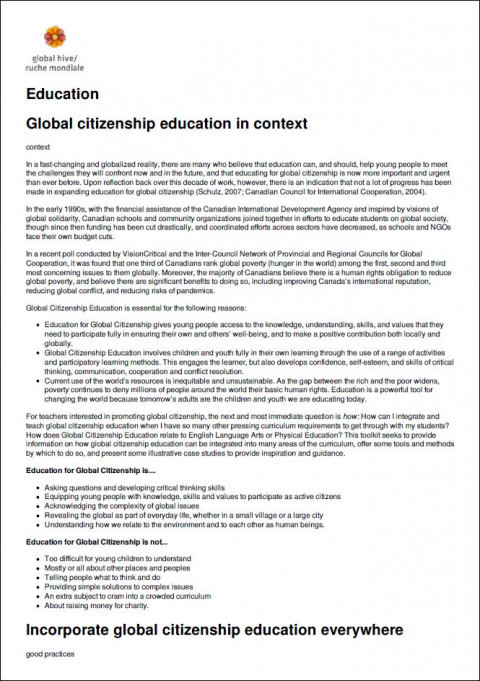 Education: global citizenship education in context 단체 저자: Global Hive In a fast-changing and globalized reality, there are many who believe that education can, and should, help young people to meet the challenges they will confront now and in the future, and that educating for global citizenship is now more important and urgent than ever before. Upon reflection back over this decade of work, however, there is an indication that not a lot of progress has been made in expanding education for global citizenship (Schulz, 2007; Canadian Council for International Cooperation, 2004). In the early 1990s, with the financial assistance of the Canadian International Development Agency and inspired by visions of global solidarity, Canadian schools and community organizations joined together in efforts to educate students on global society, though since then funding has been cut drastically, and coordinated efforts across sectors have decreased, as schools and NGOs face their own budget cuts. In a recent poll conducted by VisionCritical and the Inter-Council Network of Provincial and Regional Councils for Global Cooperation, it was found that one third of Canadians rank global poverty (hunger in the world) among the first, second and third most concerning issues to them globally. Moreover, the majority of Canadians believe there is a human rights obligation to reduce global poverty, and believe there are significant benefits to doing so, including improving Canada’s international reputation, reducing global conflict, and reducing risks of pandemics. Global Citizenship Education is essential for the following reasons: Education for Global Citizenship gives young people access to the knowledge, understanding, skills, and values that they need to participate fully in ensuring their own and others’ well-being, and to make a positive contribution both locally and globally. Global Citizenship Education involves children and youth fully in their own learning through the use of a range of activities and participatory learning methods. This engages the learner, but also develops confidence, self-esteem, and skills of critical thinking, communication, cooperation and conflict resolution. Current use of the world’s resources is inequitable and unsustainable. As the gap between the rich and the poor widens, poverty continues to deny millions of people around the world their basic human rights. Education is a powerful tool for changing the world because tomorrow’s adults are the children and youth we are educating today. For teachers interested in promoting global citizenship, the next and most immediate question is how: How can I integrate and teach global citizenship education when I have so many other pressing curriculum requirements to get through with my students? How does Global Citizenship Education relate to English Language Arts or Physical Education? This toolkit seeks to provide information on how global citizenship education can be integrated into many areas of the curriculum, offer some tools and methods by which to do so, and present some illustrative case studies to provide inspiration and guidance.
 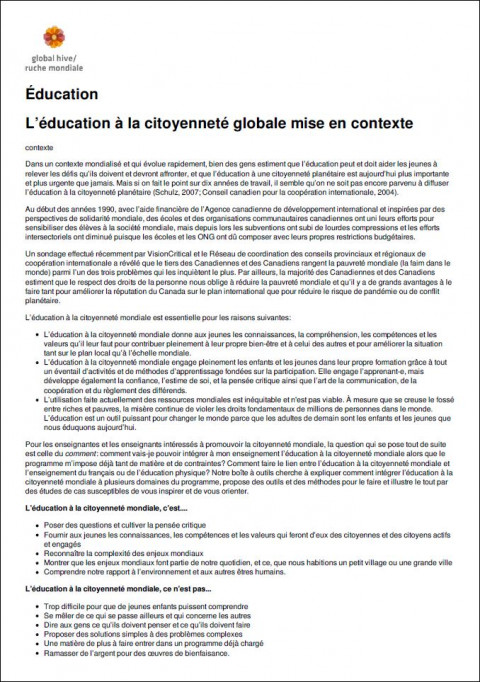 L'éducation à la citoyenneté globale mise en contexte 단체 저자: Global Hive L’éducation à la citoyenneté mondiale est essentielle pour les raisons suivantes:L’éducation à la citoyenneté mondiale donne aux jeunes les connaissances, la compréhension, les compétences et les valeurs qu’il leur faut pour contribuer pleinement à leur propre bien-être et à celui des autres et pour améliorer la situation tant sur le plan local qu’à l’échelle mondiale.L’éducation à la citoyenneté mondiale engage pleinement les enfants et les jeunes dans leur propre formation grâce à tout un éventail d’activités et de méthodes d’apprentissage fondées sur la participation. Elle engage l’apprenant-e, mais développe également la confiance, l’estime de soi, et la pensée critique ainsi que l’art de la communication, de la coopération et du règlement des différends.L’utilisation faite actuellement des ressources mondiales est inéquitable et n'est pas viable. À mesure que se creuse le fossé entre riches et pauvres, la misère continue de violer les droits fondamentaux de millions de personnes dans le monde.L’éducation est un outil puissant pour changer le monde parce que les adultes de demain sont les enfants et les jeunes que nous éduquons aujourd’hui.Pour les enseignantes et les enseignants intéressés à promouvoir la citoyenneté mondiale, la question qui se pose tout de suite est celle du comment: comment vais-je pouvoir intégrer à mon enseignement l’éducation à la citoyenneté mondiale alors que le programme m’impose déjà tant de matière et de contraintes? Comment faire le lien entre l’éducation à la citoyenneté mondiale et l’enseignement du français ou de l’éducation physique? Notre boîte à outils cherche à expliquer comment intégrer l’éducation à la citoyenneté mondiale à plusieurs domaines du programme, propose des outils et des méthodes pour le faire et illustre le tout par des études de cas susceptibles de vous inspirer et de vous orienter.