
자료
세계시민교육에 대한 이해를 넓히고 연구, 옹호 활동, 교수, 학습 등을 향상시킬 수 있는 다양하고 유용한 자료를 찾아보세요.
1,583 건의 결과가 검색되었습니다
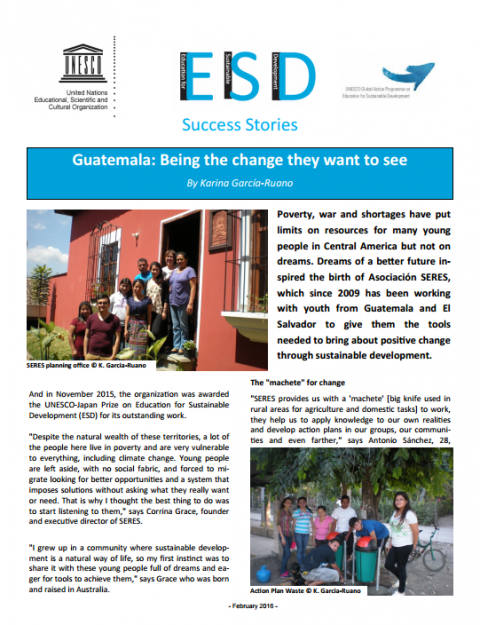 Guatemala: se el cambio que quieres ver 발행 연도: 2016 저자: Karina García-Ruano 단체 저자: UNESCO ESD Success Stories are showcasing compelling stories with a personal/human dimension from all five UNESCO regions (Africa, Arab States, Asia and Pacific, Europe & North America and Latin America & the Caribbean). The stories illustrate the wide diversity of ESD approaches and initiatives taking place in different parts of the world. They show how involvement with ESD has changed the lives of specific individual persons and how they have become more active in their community. Each story centers on one individual or a group of individuals.Asociación SERES, from Guatemala and El Salvador, works with youth to give them the skills needed to bring about positive change through sustainable development.
 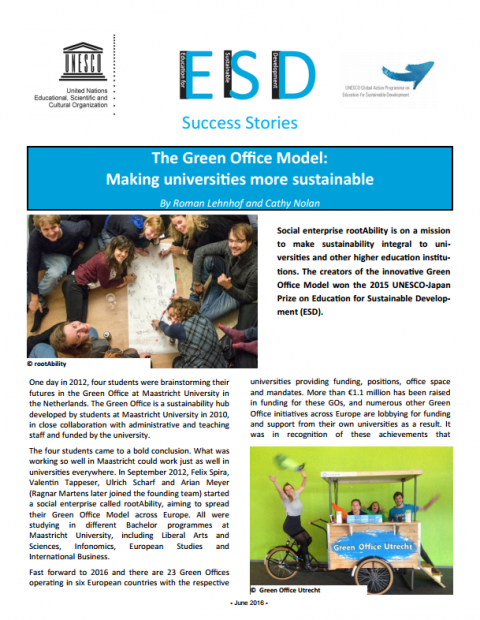 El Modelo de la oficina de sostenibilidad: construyendo unas universidades más sostenibles 발행 연도: 2016 저자: Roman Lehnhof | Cathy Nolan 단체 저자: UNESCO ESD Success Stories are showcasing compelling stories with a personal/human dimension from all five UNESCO regions (Africa, Arab States, Asia and Pacific, Europe & North America and Latin America & the Caribbean). The stories illustrate the wide diversity of ESD approaches and initiatives taking place in different parts of the world. They show how involvement with ESD has changed the lives of specific individual persons and how they have become more active in their community. Each story centers on one individual or a group of individuals.The rootAbility, a social enterprise, is planned by four students at Maastricht University, aiming to spread Green Office Model across Europe. The Green Office can effectively drive a dynamic sustainability process in universities and other institutions of higher education by collaboratively working with students and university staff and integrating sustainability into university’s teaching and research Le Modèle du bureau vert: faire des universités des lieux de développement plus durable 발행 연도: 2016 저자: Roman Lehnhof | Cathy Nolan 단체 저자: UNESCO ESD Success Stories are showcasing compelling stories with a personal/human dimension from all five UNESCO regions (Africa, Arab States, Asia and Pacific, Europe & North America and Latin America & the Caribbean). The stories illustrate the wide diversity of ESD approaches and initiatives taking place in different parts of the world. They show how involvement with ESD has changed the lives of specific individual persons and how they have become more active in their community. Each story centers on one individual or a group of individuals.The rootAbility, a social enterprise, is planned by four students at Maastricht University, aiming to spread Green Office Model across Europe. The Green Office can effectively drive a dynamic sustainability process in universities and other institutions of higher education by collaboratively working with students and university staff and integrating sustainability into university’s teaching and research Guatemala: être le changement qu'ils veulent voir 발행 연도: 2016 저자: Karina García-Ruano 단체 저자: UNESCO ESD Success Stories are showcasing compelling stories with a personal/human dimension from all five UNESCO regions (Africa, Arab States, Asia and Pacific, Europe & North America and Latin America & the Caribbean). The stories illustrate the wide diversity of ESD approaches and initiatives taking place in different parts of the world. They show how involvement with ESD has changed the lives of specific individual persons and how they have become more active in their community. Each story centers on one individual or a group of individuals.Asociación SERES, from Guatemala and El Salvador, works with youth to give them the skills needed to bring about positive change through sustainable development.
  Values Education through Sport 발행 연도: 2016 단체 저자: UNESCO Innovative education for developmentEducation in the 21st century increasingly recognizes the role of values and social skills in tackling global challenges, such as inactivity, obesity, unemployment, and conflict. This approach is at the core of the Sustainable Development Goal 4 on quality education, which advocates for inclusive lifelong learning opportunities and innovative content delivery. Dynamic forms of values-based education using sport can be introduced in schools to support teachers deliver curricula actively and cooperatively.What are sport values?Sport can teach values such as fairness, teambuilding, equality, discipline, inclusion, perseverance and respect. Sport has the power to provide a universal framework for learning values, thus contributing to the development of soft skills needed for responsible citizenship.What can Values Education through Sport offer?Values Education through Sport (VETS) programmes support active learning, complement cognitive skills and give students increasing amounts of responsibility, and enhance their level of concentration and participation. VETS programmes are flexible and have a strong cross-curricular potential: they can reinforce existing curricula and can be streamed across different subjects, including physical education, civic and moral education, nutrition, biology, arts. Ultimately, these programmes help students to transfer and put values into action outside the school environment, by getting engaged in their communities, making informed decisions, being sensitive and respecting the others and the environment. VETS contributes to the development of self-confidence, active and healthy lifestyle choices, and an understanding of rights, supporting the delicate transition to the independence of adulthood. Éducation aux Valeurs par le Sport 발행 연도: 2016 단체 저자: UNESCO Éducation innovante pour le développementL'éducation au 21e siècle reconnaît de plus en plus le rôle des valeurs et des compétences sociales pour relever les défis mondiaux, tels que l'inactivité, l'obésité, le chômage et les conflits. Cette approche est au cœur de l'objectif de développement durable 4 sur l'éducation de qualité, qui milite pour des possibilités d'apprentissage inclusifs et la livraison de contenu innovant. Les formulaires dynamiques de l'éducation fondée sur les valeurs en utilisant le sport peuvent être introduits dans les écoles pour aider les enseignants offrent des programmes activement et en collaboration.Quelles sont les valeurs du sport?Le sport peut enseigner des valeurs telles que l'équité, teambuilding, l'égalité, la discipline, l'inclusion, la persévérance et le respect. Le sport a le pouvoir de fournir un cadre universel pour les valeurs d'apprentissage, contribuant ainsi au développement des compétences générales nécessaires à la citoyenneté responsable. Que peut l'éducation aux valeurs par offre de Sport?Valeurs éducation par le sport (VEPS) programmes appuient l'apprentissage actif, compléter les compétences cognitives et donner aux étudiants les montants de responsabilité de plus en plus, et d'améliorer leur niveau de concentration et de participation. programmes VEPS sont flexibles et ont un fort potentiel transdisciplinaire: ils peuvent renforcer les programmes existants et peuvent être écoutés sur différents sujets, y compris l'éducation physique, l'éducation civique et morale, la nutrition, la biologie, les arts. En fin de compte, ces programmes aident les élèves à transférer et de mettre les valeurs en action en dehors du milieu scolaire, en s'engagés dans leurs communautés, prendre des décisions éclairées, étant sensible et en respectant les autres et l'environnement. VEPS contribue au développement de la confiance en soi, des choix de vie sains et actifs, et une compréhension des droits, soutenir la transition délicate à l'indépendance de l'âge adulte. The Green office model: making universities more sustainable 발행 연도: 2016 저자: Roman Lehnhof | Cathy Nolan 단체 저자: UNESCO ESD Success Stories are showcasing compelling stories with a personal/human dimension from all five UNESCO regions (Africa, Arab States, Asia and Pacific, Europe & North America and Latin America & the Caribbean). The stories illustrate the wide diversity of ESD approaches and initiatives taking place in different parts of the world. They show how involvement with ESD has changed the lives of specific individual persons and how they have become more active in their community. Each story centers on one individual or a group of individuals.The rootAbility, a social enterprise, is planned by four students at Maastricht University, aiming to spread Green Office Model across Europe. The Green Office can effectively drive a dynamic sustainability process in universities and other institutions of higher education by collaboratively working with students and university staffs and integrating sustainability into university’s teaching and research.
 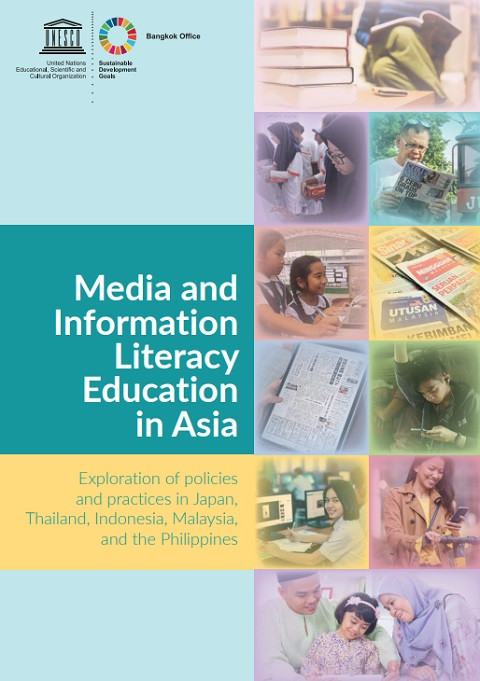 Media and Information Literacy Education in Asia: Exploration of Policies and Practices in Japan,Thailand, Indonesia, Malaysia, and the Philippines 발행 연도: 2020 저자: Masato Kajimoto | Phansasiri Kularb | Bobi Guntarto | Sabariah Mohamed Salleh | Therese Patricia S. Torres | Guillian Mae C. Palcon | Ramon Tuazon 단체 저자: UNESCO This book looked at the current media and information literacy education policies and teaching practices in formal and informal settings. It explores how MIL could address emerging and pressing problems such as political extremism, false news, online harassment and discrimination in Indonesia, Japan, Malaysia, the Philippines, and Thailand.
 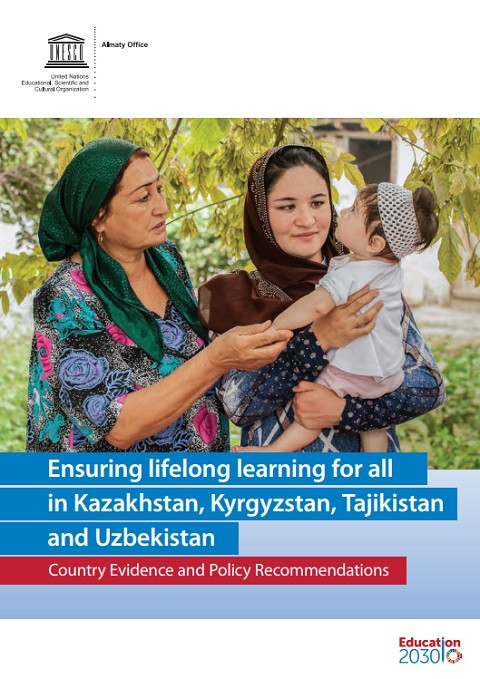 Ensuring Lifelong Learning for All in Kazakhstan, Kyrgyzstan, Tajikistan and Uzbekistan: Country Evidence and Policy Recommendations 발행 연도: 2020 저자: Arne Carlsen 단체 저자: UNESCO Lifelong Learning is at the heart of the 2030 Agenda for Sustainable Development and its 17 goals. More speci¬cally, Sustainable Development Goal 4 is devoted to ensuring quality education and lifelong learning opportunities for all. As the lead agency for education, UNESCO is mandated to support Member States in implementing SDG 4 through the Education 2030 Framework for Action. Central Asian countries – Kazakhstan, Kyrgyzstan, Tajikistan and Uzbekistan – have all shown their commitment to achieving the SDGs by 2030, including SDG 4, and have taken several actions in this regard. This sub-regional study aims to provide a broader picture of lifelong learning in Central Asia, supported by evidence and policy recommendations in order to propose a systemic approach for future education reforms. Обеспечение возможности обучения на протяжении всей жизни для всех в Казахстане, Кыргызстане, Таджикистане и Узбекистане: Опыт отдельных стран и рекомендации по вопросам политики 발행 연도: 2020 저자: Arne Carlsen 단체 저자: UNESCO Обучение на протяжении всей жизни лежит в основе Глобальной программы устойчивого развития, состоящей из 17 целей. Суть Цели 4 в области устойчивого развития заключается в «Обеспечении всеохватного и справедливого качественного образования и поощрение возможности обучения на протяжении всей жизни для всех». ЮНЕСКО, как специализированному учреждению ООН по вопросам образования, было поручено оказывать государствам-членам содействие в достижении ЦУР 4 через выполнение Рамочной программы действий в области образования до 2030 года.Страны Центральной Азии – Казахстан, Кыргызстан, Таджикистан и Узбекистан – выразили заинтересованность в достижении к 2030 году всех ЦУР, включая ЦУР 4, и уже предприняли ряд действий в этом направлении. Цель настоящего субрегионального исследования состоит в предоставлении более точной картины положения дел в области обучения на протяжении всей жизни в Центральной Азии, подкрепленной фактическим материалом и рекомендациями по вопросам политики, для подготовки предложений по системному подходу к будущим реформам образования.