
자료
세계시민교육에 대한 이해를 넓히고 연구, 옹호 활동, 교수, 학습 등을 향상시킬 수 있는 다양하고 유용한 자료를 찾아보세요.
795 건의 결과가 검색되었습니다
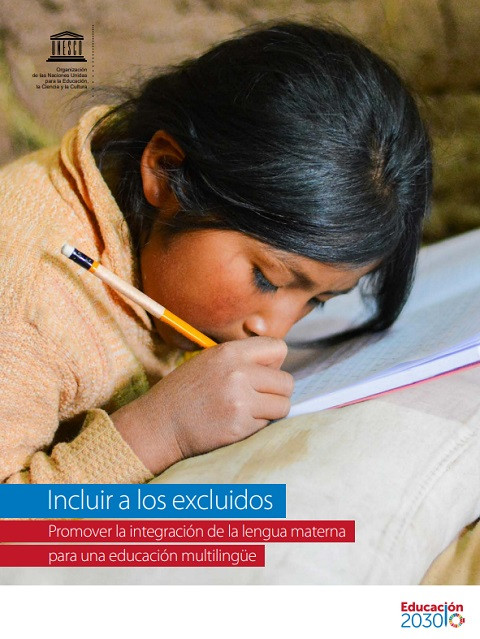 Including the Excluded: Promoting the Integration of the Mother Tongue for a Multilingual Education 발행 연도: 2020 단체 저자: UNESCO This publication presents the advantages of including the mother tongue and promoting multilingual education, as well as guidelines for achieving it.
 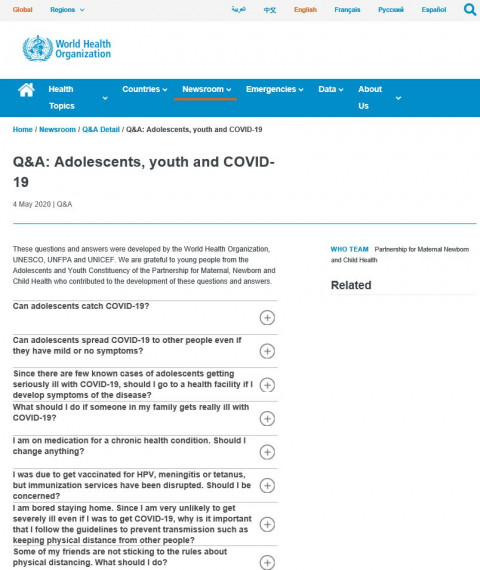 Q&A: Adolescents, Youth and COVID-19 발행 연도: 2020 단체 저자: World Health Organization (WHO) | UNESCO | United Nations Population Fund (UNFPA) | United Nations Children's Fund (UNICEF) As part of UNESCO’s work in promoting better health and well-being for all children and young people, it has contributed to the development of a practical guide in a ‘questions and answers’ (Q&A) format on children and adolescents and COVID-19. This work was led by the World Health Organization, in collaboration with the Adolescents and Youth Constituency of the Partnership for Maternal, Newborn and Child Health, UNESCO, UNFPA, and UNICEF.The Q&A provide children and adolescents with accurate, non-judgmental information and advice around COVID-19, including how to help stop the spread of the virus, what to do if they develop symptoms of the disease, and how to best manage their health and well-being during the confinement period and after. It considers children and young people as critical actors in the response to COVID-19, not as passive beneficiaries.
  UNESCO's work on education for peace and non-violence: building peace through education 발행 연도: 2008 단체 저자: UNESCO The promotion of peace through education is at the heart of UNESCO’s mission. As stated in its constitution of 1945, UNESCO advances international peace and the common welfare of humanity through educational, scientific and cultural relations between peoples of the world. Though the world has changed over the past sixty years and continues to change at an ever increasing rate, UNESCO’s mission - a commitment to promoting universal values of peace and nonviolence, human rights and social justice, intercultural dialogue and mutual understanding – persists with growing urgency. UNESCO’s approach to educating for peace is multidimensional, in that it links education with a range of activities that address the root causes of violence, from human security to sustainable development. The goal of UNESCO’s education programmes and partnerships is the development of comprehensive systems of education that embrace the values of human rights, intercultural understanding and tolerance. Education for peace and non-violence promotes the knowledge, skills, attitudes and behaviours that reflect and inspire these values. As the lead agency within the UN system for the International Decade for a Culture of Peace and Non-Violence for the Children of the World, 2001- 2010, UNESCO is responsible for coordinating and directly implementing activities that promote the objectives of the Decade through education, the sciences, culture, communication and information. The culture of peace is defined as a set of values, attitudes, modes of behaviour and ways of life that reject violence and aim to prevent conflicts by tackling their root causes through dialogue and negotiation between individuals, groups and nations. UNESCO promotes the culture of peace through an intersectoral platform. This platform involves all five sectors of UNESCO: education, natural sciences, social and human sciences, culture, and communication and information. It seeks to mainstream intercultural dialogue in policies and actions with the aim of promoting mutual understanding, tolerance and respect, all of which are considered to be creative forces for a sustainable future. The intersectoral platform will also develop tools based on good practices in intercultural dialogue.
 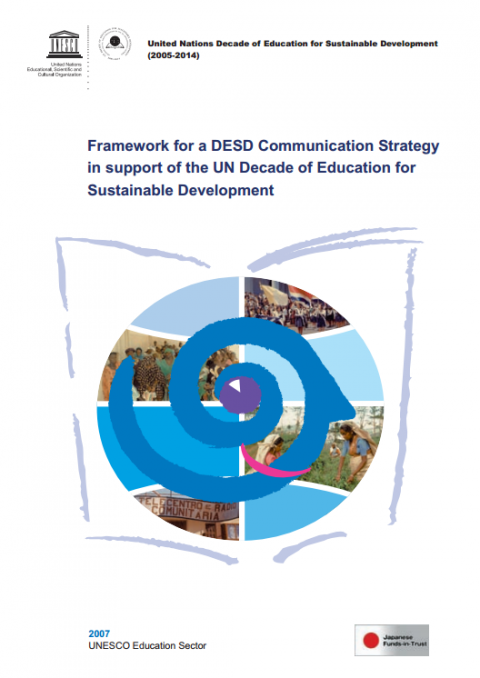 Framework for a DESD communication strategy in support of the UN decade of education for sustainable development 발행 연도: 2007 단체 저자: UNESCO The following framework for a DESD Communication Strategy seeks to provide guidelines for different stakeholders to come together and work on a joint harmonious communication strategy, dedicated to furthering the exchange of information on ESD issues in order to: • share ESD information and resources between and among partners; • promote better cooperation among partners doing ESD work and create synergies; • reduce duplication of efforts in programme planning, design, and ESD advocacy; • strengthen individual partner's ability to help create a viable future by working together with others, with each partner contributing its own "piece of the puzzle". Minimum elements of a DESD communication strategy include an appropriate emphasis on: • dissemination of basic ESD information to all partners; • dissemination of available information sources pertinent to partners’ needs in ESD; • sharing prototype training materials, experiences of demonstration activities and related resources for testing, adapting and translating them to other cultural contexts; • dissemination of information about the experiences of project participants, emphasizing openness and clarity about problems encountered, in order to allow others to benefit from the lessons learned in practice.
  UNESCO prize for peace education, 2008 발행 연도: 2009 단체 저자: UNESCO The UNESCO Prize for Peace Education 2008 was awarded to the Institute for Justice and Reconciliation (South Africa) by Mr Koïchiro Matsuura, Director-General of UNESCO, on the recommendation of the International Jury of the Prize. The prize-giving ceremony, organized as part of the celebrations of the International Day of Peace (21 September), the International Decade for a Culture of Peace and Non-Violence for the Children of the World (2001- 2010) and the 60th anniversary of the Universal Declaration of Human Rights, was held at UNESCO Headquarters on 18 September 2008 in the presence of Mr Mohammed Arkoun, President of the International Jury, and H.E. Mr Javier Pérez de Cuéllar, member of the International Jury, former Prize laureates, Permanent Delegates of Member States and representatives of governmental and non-governmental organizations. The award ceremony was preceded by the screening of an excerpt from the documentary Truth, Justice, Memory: South Africa’s Truth and Reconciliation Process and by a video message from Archbishop Emeritus Desmond Tutu, winner of the 1984 Nobel Peace Prize for his role as a unifying leader in the campaign to resolve the problem of apartheid in South Africa, and former Chairperson of South Africa’s Truth and Reconciliation Commission
  UNESCO education strategy 2014-2021 발행 연도: 2014 단체 저자: UNESCO This publication is a result of extensive collective work by my colleagues in UNESCO’s Education Sector over the past two years. It elaborates on UNESCO’s Medium-Term Strategy (2014–2021), which was drafted by the Organization’s Secretariat and approved by the 37th session of its General Conference in November 2013. This publication elaborates on the education component of the Medium-Term Strategy. While continuing to focus efforts on the ‘unfinished business’ of EFA, such as literacy, teachers and vocational skills development, UNESCO will lead and advocate for strengthened action towards empowering learners to be creative and responsible citizens. In a world of change, when individuals are increasingly called upon to make a positive contribution to their communities through the promotion of peace, solidarity, and respect for others and the environment, I am convinced that Education for Sustainable Development and Global Citizenship Education must also be considered crucial elements for well-rounded educational systems.
  Education for sustainable development; good practices in addressing biodiversity 발행 연도: 2012 단체 저자: UNESCO To support the growing interest in biodiversity issues and ESD, UNESCO is publishing this volume containing 24 examples of programmes addressing biodiversity in ESD settings and practices. These good practices and shared experiences, which were provided by a range of different stakeholders, are concrete examples of successful implementation of ESD in different fields and sectors, from the political to the school level, and including formal, non-formal and informal learning situations. Education for sustainable development and climate change 발행 연도: 2009 단체 저자: UNESCO The Intergovernmental Panel on Climate Change (IPCC), in its 2007 report, stated unequivocally that humans are contributing to climate change. People’s actions are intensifying the climate’s natural variability, and the Earth’s temperature is rising. Scientists make a distinction between climate variability (where climatic variations are attributable to natural causes) and climate change (where human activities are altering the atmospheric composition). Human induced (or anthropogenic) climate change is caused by increased production of greenhouse gases, including carbon dioxide (CO2), methane and nitrous oxide. Carbon dioxide, the main contributor, is produced primarily by the burning of fossil fuels — oil, gas and coal. Although methane occurs in smaller quantities than CO2, it has higher warming effects. Increased methane production is linked to increased levels of livestock farming for meat production. Warming of permafrost areas in Siberia and Canada may also contribute significantly to an increase of methane emissions, since permafrost lakes store methane gases. Increases in greenhouse gas production are directly linked to the post-1750 period of industrialisation in Western countries. These gases now far exceed the natural rate of greenhouse gas production as measured in pre-industrial era ice cores spanning many thousands of years. The IPCC projects that global average temperatures are likely to rise by 1.8 - 4 degrees Celsius by 2100. This might sound small, but the difference between today’s temperatures and the last Ice Age is around 4-5%. A small temperature rise is likely to have a substantial impact. It may also take many years for the real impact of current rises in temperature to show. Even if people substantially reduced CO2 emissions tomorrow, the atmosphere would go on warming for a long time to come. Changes in temperature will impact on the whole of the Earth’s system, and on human activities everywhere. Projected impacts include warming of the oceans, melting of the icecaps, sea level rise, unpredictable weather patterns, increased flooding and droughts, loss of biodiversity, changes in agricultural productivity, increased health risks, massive human migration and economic decline. Scientists are worried that change will be faster than expected due to ‘positive feedback’, which is a process where the warming fuels itself, causing accelerated temperature increase. The acceleration of climate change needs to be reduced urgently, and everyone everywhere needs to be involved. Address by Mr Koïchiro Matsuura, Director-General of UNESCO, on the occasion of the International Seminar on Climate Change Education; UNESCO, 27 July 2009 발행 연도: 2009 단체 저자: UNESCO This document is the address of Mr Mr Koïchiro Matsuura, Director-General of UNESCO, on the occasion of the International Seminar on Climate Change Education; UNESCO, 27 July 2009. He presented the climate change issues and highlighted the importance of education for sustainable future. Sandwatch: adaptar-se à mudança climática e educar para o desenvolvimento sustentável 발행 연도: 2012 저자: Gillian Cambers | Paul Diamond 단체 저자: UNESCO Sandwatch provides a framework for children, youth and adults, with the help of teachers and local communities, to work together to critically evaluate the problems and conflicts facing their beach environments, and to develop sustainable approaches to address these issues. It also helps beaches become more resilient to climate change. The preliminary chapters of this publication focus on how to get started with Sandwatch activities and examine ways to address climate change impacts. The principle aim of this publication is to document the Sandwatch methodology: monitoring, analysing, sharing and taking action. An activities-orientated approach is used to provide step-by-step instructions to cover monitoring methods and data analysis, including observation and recording, erosion and accretion, beach composition, human activities, beach debris, water quality, waves, longshore currents, plants and animals. The activities are related to (a) sustainable development issues, including: beach ownership, mining beaches for construction material, conflict resolution between different beach users, pollution, conservation of endangered species, and (b) climate change adaptation issues: sea level rise, rising temperatures, ocean acidification and increased extreme events. Ways to share findings and create a Sandwatch network are detailed including methods such as the use of local media, websites, social networking and video production. Finally, ways are discussed to design, plan and implement a Sandwatch project to fulfill one or all of the following criteria: (a) addressing a particular beach-related issue, (b) enhancing the beach, and (c) promoting climate change adaptation. Sandwatch stands as an example of Education for Sustainable Development in action, and is being targeted as one of several flagship projects for the United Nations Decade of Education for Sustainable Development (2005–2014). As the world confronts the growing threat of climate change, Sandwatch presents an opportunity to help people and ecosystems respond to present and future changes in a practical manner. Beaches are among the ecosystems most at risk from climate change as they face rising sea levels and increased more intense storms. By contributing to ecosystem health and resilience, Sandwatch can help people from all walks of life learn about climate change and how their actions can contribute to the adaptation process.