
자료
세계시민교육에 대한 이해를 넓히고 연구, 옹호 활동, 교수, 학습 등을 향상시킬 수 있는 다양하고 유용한 자료를 찾아보세요.
795 건의 결과가 검색되었습니다
 Eleventh meeting of the working group on Education for All, 2-3 February 2011, Paris, France: summary report 발행 연도: 2011 단체 저자: UNESCO The eleventh meeting of the Working Group (WG) on Education for All (EFA) took place on 2 and 3 February 2011 at UNESCO headquarters in Paris. The meeting brought together people representing governments, bilateral and multilateral organizations, regional organizations, civil society organizations (CSOs), research institutes, foundations and the private sector. Consisting of seven sessions, the meeting aimed to review the world’s progress towards EFA and identify policy actions that can accelerate EFA progress, in particular as regards quality education, effective advocacy for education, violent conflicts and education and financing for education. The recommendations of the meeting were to be taken to the tenth meeting of the High Level Group (HLG) on EFA (Jomtien, Thailand, 22–24 March 2011). Recommendation concerning Education for International Understanding, Cooperation and Peace and Education Relating to Human Rights and Fundamental Freedoms, adopted by the General Conferences at its 18th session, Paris, 19 November 1974 발행 연도: 1974 단체 저자: UNESCO Following is the authentic text of the Recommendation duly adopted by the General Conference of the United Nations Educational, Scientific and Cultural Organization during its eighteenth session, which was held in Paris and declared closed the twenty-third day of November 1974. The General Conference recommends that Member States should submit to provisions as follows: to apply the following provisions by taking whatever legislative or other steps may be required in conformity with the Constitutional practice of each State to give effect within their respective territories to the principles set forth in this recommendation; to bring this recommendation to the attention of the authorities, departments or bodies responsible for school education, higher education and out-of-school education, of the various organizations carrying out educational work among young people and adults such as student and youth movements, associations of pupils’ parents, teachers’ unions and other interested parties; to submit to it, by dates and in the form to be decided upon by the Conference, reports concerning the action taken by them in pursuance of this recommendation.
  Evaluation of UNESCO's Capacity Development for Education for All (CapEFA) Programme 발행 연도: 2016 단체 저자: UNESCO The main purpose of this evaluation is to determine the relevance and effectiveness of the Capacity Development for Education for All (CapEFA) programme’s overall contribution to progress towards the realization of the Education for All (EFA) goals in its target countries, and to provide actionable and timely recommendations to the United Nations Educational, Scientific and Cultural Organization (UNESCO) on the positioning of the Programme to meet future needs and challenges related to the adoption of the Sustainable Development Goals (SDG) in September 2015, and more specifically to the SDG 4 to ‘Ensure inclusive and equitable quality education and promote lifelong learning opportunities for all’. The focus of this evaluation is on assessing the CapEFA programme’s relevance, effectiveness, efficiency, and sustainability. This evaluation does not focus on how the programme impacts on the EFA goals, due to the challenge in assessing the causality between the programme’s goals and the EFA indicators. The focus of the assessment is on whether the right conditions at the systemic and institutional levels are created to have an impact on these EFA macro-indicators. Declaração e Plano de Ação Integrado sobre a Educação para a Paz, os Direitos Humanos e a Democracia 발행 연도: 1995 단체 저자: UNESCO This document is Declaration of the 44th session of the International Conference on Education (Geneva, October 1994) endorsed by the General Conference Declaration of the 44th session of the International Conference on Education (Geneva, October 1994) endorsed by the General Conference of UNESCO at its twenty-eight session Paris, November 1995 of UNESCO at its twenty-eight session Paris, November 1995.
  UNESCO's Education Evaluation in 2016: A Review 발행 연도: 2017 단체 저자: UNESCO UNESCO completed 12 education related evaluations in 2016. Part A of this review presents the key insights and lessons learned from those evaluations. These learnings are designed to help enhance UNESCO’s leadership and coordination of the SDG 4 – Education 2030 Agenda. Part B of the review provides an assessment of the quality and usefulness of these evaluations based on the UNEG and OECD quality standards for evaluation reports.
  UNESCO and Education 발행 연도: 2017 단체 저자: UNESCO Education is a fundamental human right and
a public good and, as such, has been at the core of UNESCO’s work since its inception.Education is also the path to sustainability – to poverty alleviation, better health, environmental protection and gender equality.As the only United Nations agency with a mandate to cover all aspects of education, UNESCO was entrusted in 2015 to lead the coordination and monitoring of Sustainable Development Goal 4, as part of the new Global Education 2030 Agenda.Goal 4 aims to “ensure inclusive and equitable quality education and promote lifelong learning opportunities for all,” and renewed UNESCO’s and Member States’ commitment to a vision of education that is holistic, inspirational and which leaves no one behind.This commitment is reflected in the size and scope of the Education Sector, the largest in UNESCO, with staff working at its Paris Headquarters and spread across a global network of field offices and specialized institutes and centres. With its close links with education ministries and other partners, UNESCO is strongly placed to press for action and change.UNESCO’s Education Sector supports Member States in developing education systems that foster high-quality and inclusive lifelong learning for all, empowering learners to be creative and responsible global citizens while leading the debate to help shape the future international education agenda.There is no stronger, no more lasting, investment a country can make than educating its citizens. The Education Sector exists to further this collective vision worldwide by transforming lives one by one.
UNESCO and Education 발행 연도: 2017 단체 저자: UNESCO Education is a fundamental human right and
a public good and, as such, has been at the core of UNESCO’s work since its inception.Education is also the path to sustainability – to poverty alleviation, better health, environmental protection and gender equality.As the only United Nations agency with a mandate to cover all aspects of education, UNESCO was entrusted in 2015 to lead the coordination and monitoring of Sustainable Development Goal 4, as part of the new Global Education 2030 Agenda.Goal 4 aims to “ensure inclusive and equitable quality education and promote lifelong learning opportunities for all,” and renewed UNESCO’s and Member States’ commitment to a vision of education that is holistic, inspirational and which leaves no one behind.This commitment is reflected in the size and scope of the Education Sector, the largest in UNESCO, with staff working at its Paris Headquarters and spread across a global network of field offices and specialized institutes and centres. With its close links with education ministries and other partners, UNESCO is strongly placed to press for action and change.UNESCO’s Education Sector supports Member States in developing education systems that foster high-quality and inclusive lifelong learning for all, empowering learners to be creative and responsible global citizens while leading the debate to help shape the future international education agenda.There is no stronger, no more lasting, investment a country can make than educating its citizens. The Education Sector exists to further this collective vision worldwide by transforming lives one by one.  Combating Violence and Bullying in Schools: UNESCO's Action 발행 연도: 2017 단체 저자: UNESCO This item has been included in the provisional agenda of the 201st session of the Executive Board at the request of Morocco, with the support of Algeria, Cambodia, Côte d’Ivoire, Egypt, France, Italy, Lebanon, Qatar and Sudan.
 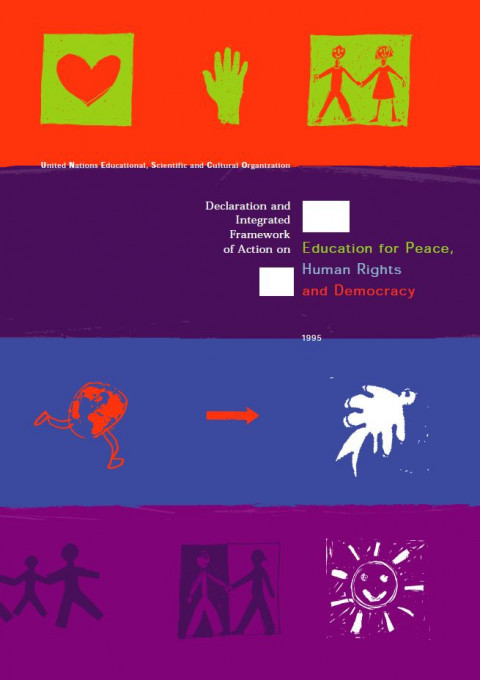 Declaration and Integrated Framework of Action on Education for Peace, Human Rights and Democracy 발행 연도: 1995 단체 저자: UNESCO This document is Declaration of the 44th session of the International Conference on Education (Geneva, October 1994) endorsed by the General Conference Declaration of the 44th session of the International Conference on Education (Geneva, October 1994) endorsed by the General Conference of UNESCO at its twenty-eight session Paris, November 1995 of UNESCO at its twenty-eight session Paris, November 1995.
  UNESCO's role in promoting education as a tool to prevent violent extremism 발행 연도: 2016 단체 저자: UNESCO The Director-General reports on the progress made on the implementation of 197 EX/Decision 46 on “UNESCO’s role in promoting education as a tool to prevent violent extremism”. This report presents the activities that have been implemented as well as those that are underway to take forward the Decision.
 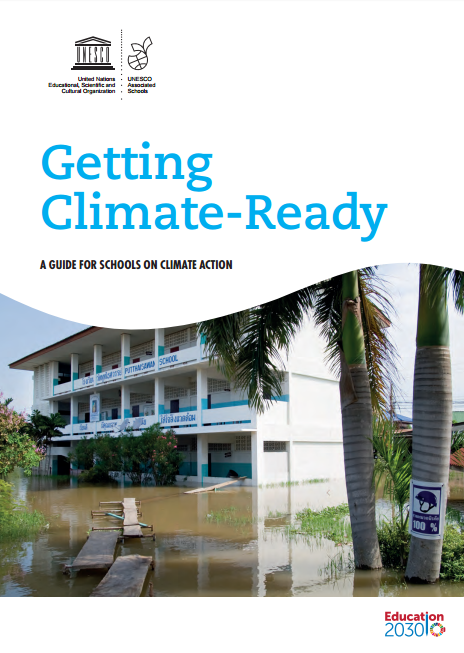 Getting climate ready: a guide for schools on climate action and the whole-school approach 발행 연도: 2016 단체 저자: UNESCO Do you want to help create a healthier, fairer, more environmentally sustainable society? Do you want to empower children and young people to do the same? Do you want to make your school more climate-friendly? If so, this guide is for you! The guidelines and examples are based on a survey looking at climate action projects at 55 schools in 12 countries. All schools in the survey are part of UNESCO’s Associated Schools Project Network (ASPnet). In addition, this guide draws on examples and research published in peer-reviewed journals, books, national and international guidelines and frameworks and programme websites.