
자료
세계시민교육에 대한 이해를 넓히고 연구, 옹호 활동, 교수, 학습 등을 향상시킬 수 있는 다양하고 유용한 자료를 찾아보세요.
795 건의 결과가 검색되었습니다
 Human rights education: learning counts! 발행 연도: 2006 단체 저자: UNESCO This poster was originally published in 2006 and reissued for UNESCO Works for Human Rights: a Poster Exhibition on the Street, held at UNESCO, Paris, 2 December 2008 to 27 February 2009. The round table: putting human rights into practice-the role of education; report 발행 연도: 2008 단체 저자: UNESCO This publication highlights some of the key ideas and features of the events based on the theme “60 years of Human Rights Education” at UNESCO headquarters in Paris from the 2nd of December 2008 till the 27th of February 2009. In addition to substantial opening and closing sessions, the Round Table consisted of four panels, the reporting of each consists of Summary, Introduction, Case Studies, Discussion and Recommendations. This publication can be read on a number of levels: as a retrospective commemoration of human rights education; as a celebration of current good practice; and, through its discussion and recommendations, as a source of guidance for future directions in human right education. Aichi-Nagoya Declaration on Education for Sustainable Development 발행 연도: 2014 단체 저자: UNESCO We, the participants of the UNESCO World Conference on Education for Sustainable Development held in AichiNagoya, Japan, from 10 to 12 November 2014, adopt this Declaration and call for urgent action to further strengthen and scale up Education for Sustainable Development (ESD), in order to enable current generations to meet their needs while allowing future generations to meet their own, with a balanced and integrated approach regarding the economic, social and environmental dimensions of sustainable development. This Declaration recognises that people are at the centre of sustainable development and builds on the achievements of the United Nations (UN) Decade of ESD (2005-2014); the deliberations of the UNESCO World Conference on ESD in Aichi-Nagoya; and the Stakeholder Meetings held in Okayama, Japan, from 4 to 8 November 2014, namely, UNESCO ASPnet International ESD events, the UNESCO ESD Youth Conference, the Global Regional Centres of Expertise Conference, and other relevant events and consultation processes, including regional ministerial meetings. We express our sincere gratitude to the Government of Japan for hosting the UNESCO World Conference on ESD.
 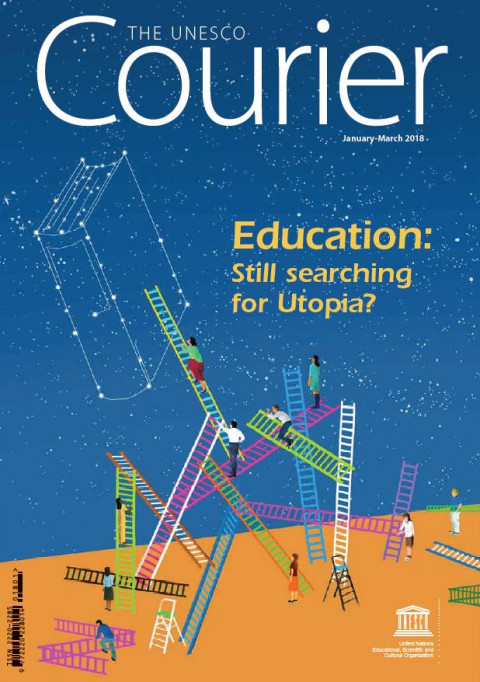 Education: Still Searching for Utopia? (The UNESCO Courier no. 1, January-March 2018) 발행 연도: 2018 단체 저자: UNESCO At a time of heightened global tension, when human rights, freedom of speech, peace and the future of the planet itself may seem challenged as never before, the transformational power of education is of critical importance.In Learning: The Treasure Within, the landmark Report to UNESCO by the International Commission on Education for the Twenty-first Century in 1996, Jacques Delors, then Chairman of the Commission (1992 to 1996), spoke of education as “the necessary Utopia” and “an indispensable asset in its attempt to attain the ideals of peace, freedom and social justice.”Education was held up as neither miracle nor magic, but rather the best means to foster a climate where humanity would be improved −. and where the rich potential for learning, inherent in every individual, would be tapped. Our humanity is confronted with a very strange paradox: the world’s population has never been better educated, and yet, according to the UNESCO Institute for Statistics, 263 million children and young people are out of school, 617 million children and adolescents worldwide do not meet the minimum threshold for literacy and mathematics, at least 750 million adults are illiterate, and girls remain more likely than boys to never set foot in a classroom. Yet education is still called upon to address inequalities, poverty, terrorism and conflict. It is seen as one of the keys to global citizenship and sustainable development, two of UNESCO’s fields of action. The Organization is also mandated to lead the Education 2030 global agenda with a special focus on ensuring that no one is left behind. Under the title, “Education: Still searching for Utopia?”, the UNESCO Courier evaluates the state of global education and explores how it responds to some of the main challenges we face.
  [Video] How Many Languages Can You Recognize? 발행 연도: 2018 단체 저자: UNESCO How many languages can you recognize in the video? People have the right to receive education in their mother language!More languages will be added to the SDG4 video!So don't forget to have a look at our playlist (link below) and let us know your mother tongue on our social media channels!SDG4 PLAYLIST: http://bit.ly/UNESCO-SDG4International Mother Language Day webpage: https://en.unesco.org/international-days/international-mother-language-day
 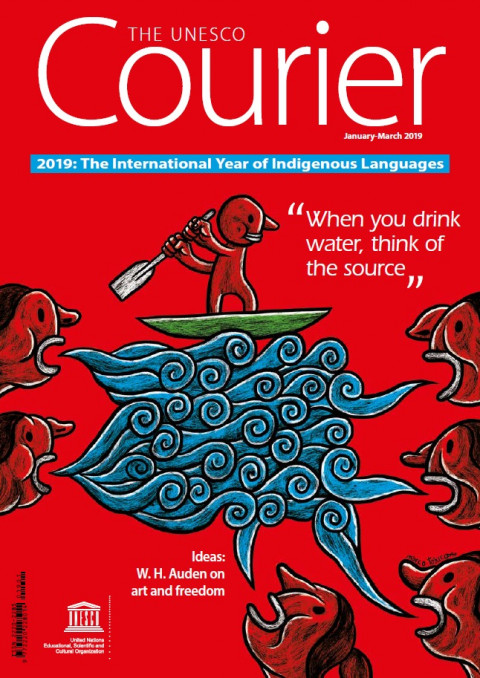 2019: The International Year of Indigenous Languages (The UNESCO Courier. January-March 2019) 발행 연도: 2019 단체 저자: UNESCO With the designation of 2019 as the International Year of Indigenous Languages (IYIL2019), officially launched at UNESCO on 28 January, the international community reaffirms its commitment to supporting indigenous peoples in their efforts to preserve their knowledge and enjoy their rights. Since the adoption of the Declaration on the Rights of Indigenous Peoples (link is external) by the United Nations General Assembly on 13 September 2007, considerable progress has been made in this regard. Nevertheless, indigenous peoples still have a long way to go before they emerge from marginalization and overcome the many obstacles they face. One-third of the world’s people living in extreme poverty belong to indigenous communities, just as in a number of countries, legislation that promotes the rights of indigenous peoples remains incompatible with other laws that deal with issues such as agriculture, land, conservation, forestry, mining and other industries, according to Victoria Tauli-Corpuz (link is external), United Nations Special Rapporteur on the Rights of Indigenous Peoples. The Wide Angle section in this issue of the Courier is dedicated to these indigenous peoples. It takes its title from the Chinese proverb: “When you drink water, think of the source”, to remind us that indigenous knowledge, the source of all knowledge, deserve a prominent place in modernity. The issue also marks the celebration of International Mother Language Day (link is external), 21 February.
  Empowering Students for Just Societies: A Handbook for Secondary School Teachers 발행 연도: 2019 단체 저자: UNESCO | UN. Office on Drugs and Crime (UNODC) The purpose of the handbook is to: Provide teachers with a selection of relevant and accessible in-classroom and out-of-classroom educational resources (summaries of short activities, lessons, units) that aim to instil the principles of the RoL among secondary school students. Assist teachers in applying the teaching resources to their local educational settings by providing ideas for adaptation for a variety of learning environments. This handbook provides: Summaries of existing teaching resources selected from UN agencies, INGOs, NGOs, and ministries that work to meet the learning outcomes on GCED for the RoL. Links to the original resource that offers additional learning opportunities. Tips and suggestions for adaptation, extension and cross-references of teaching resources; and Suggestions for learning assessment. This handbook can be useful for: Teachers and teacher trainers in formal school settings at the secondary school level. It encourages teachers to strengthen the RoL through education by integrating it into their lessons and planning. Professionals working in non-formal education or engaging with young people, for example, in sports associations, community organizations, social work and the justice sector. Parents seeking to raise empowered young citizens who actively contribute to peace and justice.
 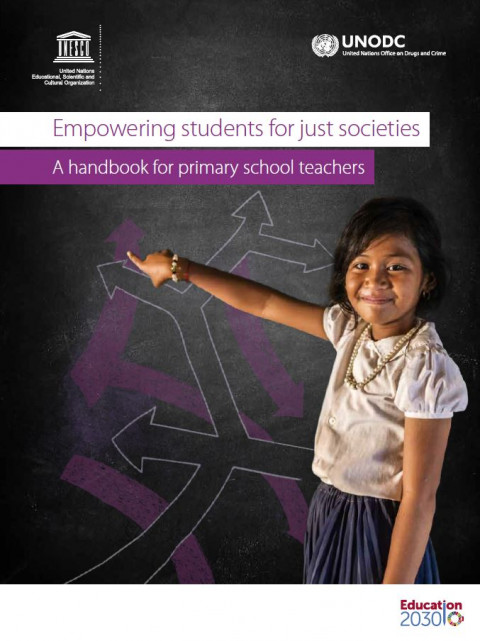 Empowering Students for Just Societies: A Handbook for Primary School Teachers 발행 연도: 2019 단체 저자: UNESCO | UN. Office on Drugs and Crime (UNODC) The purpose of the handbook is to: Provide teachers with a selection of relevant and accessible in-classroom and out-of-classroom educational resources (summaries of short activities, lessons, units) that aim to instil the principles of the RoL among primary school students. Assist teachers in applying the teaching resources to their local educational settings by providing ideas for adaptation for a variety of learning environments. This handbook provides: Summaries of existing teaching resources selected from UN agencies, INGOs, NGOs, and ministries that work to meet the learning outcomes on GCED for the RoL. Links to the original resource that offers additional learning opportunities. Tips and suggestions for adaptation, extension and cross-references of teaching resources; and Suggestions for learning assessment. This handbook can be useful for: Teachers and teacher trainers in formal school settings at the primary school level. It encourages teachers to strengthen the RoL through education by integrating it into their lessons and planning. Professionals working in non-formal education or engaging with young people, for example, in sports associations, community organizations, social work and the justice sector. Parents seeking to raise empowered young citizens who actively contribute to peace and justice.
 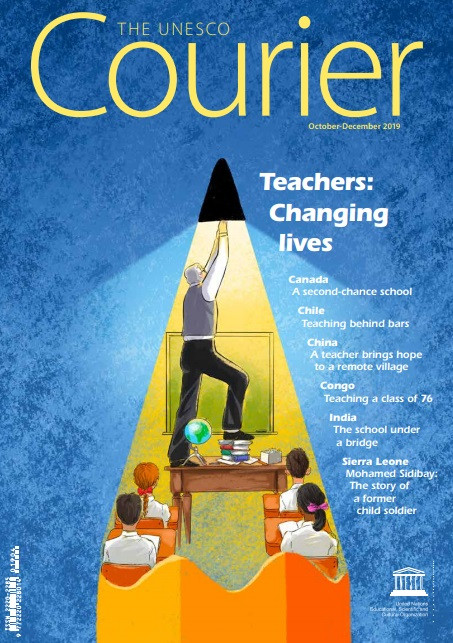 Teachers: changing lives (The UNESCO Courier no. 4, October-December 2019) 발행 연도: 2019 단체 저자: UNESCO Certainly, everyone recognizes the key role teachers play. On a personal level, we can all name at least one teacher who made a difference – sometimes to such an extent that it redirected our whole lives. At the international level, the United Nations Sustainable Development Goals (SDGs), Goal 4 in particular, recognize the importance of teachers in the implementation of the Sustainable Development Agenda by 2030. Yet, the profession is being undermined. The development of cognitive neuroscience and the many applications of new technologies in the field of education are forcing the profession to adapt and reinvent itself.
 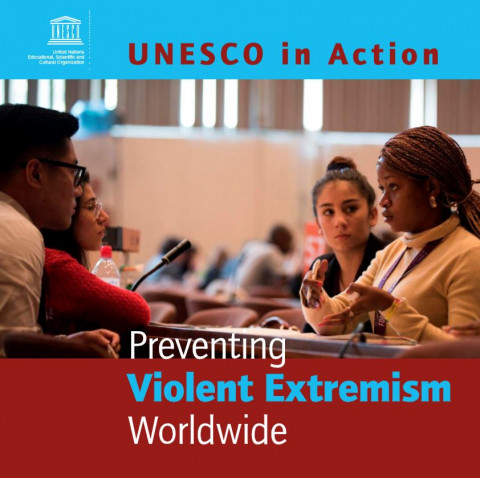 UNESCO in action: preventing violent extremism worldwide 발행 연도: 2018 단체 저자: UNESCO UNESCO supports countries in crafting education programmes that build young people’s resilience to violent extremist messaging and foster a positive sense of identity and belonging. From this angle, the role of education is not to intercept violent extremists or identify individuals who may potentially become violent extremists, but to create conditions to build the defences of peace within learners through values, skills and behaviours that reject violent extremism, and by strengthening their commitment to non-violence and peace. This work is undertaken within the broader framework of Global Citizenship Education, where UNESCO leads implementation of Target 4.7 of the Sustainable Development Goal 4 on Education. The work undertaken in the field of Global Citizenship Education also embraces activities pertaining to human rights and peace education, Holocaust and genocide education, and activities to combat all forms of intolerance, racism and anti-Semitism.