
자료
세계시민교육에 대한 이해를 넓히고 연구, 옹호 활동, 교수, 학습 등을 향상시킬 수 있는 다양하고 유용한 자료를 찾아보세요.
795 건의 결과가 검색되었습니다
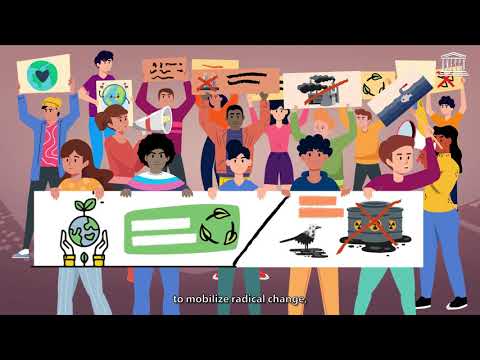 How Can Education Really Contribute to Solving the Climate Crisis? 발행 연도: 2020 단체 저자: UNESCO “Debating the Futures of Education” is a video series produced by UNESCO, within the framework of an initiative that seeks to reimagine the futures of education. The purpose of this video is to think about how education can really contribute to solving the climate crisis.
  UNESCO Green Citizens: A Global Voice for Local Actors of Change 발행 연도: 2020 단체 저자: UNESCO UNESCO launches the UNESCO Green Citizens Initiative, a flagship project to support citizen engagement for the planet. The UNESCO Green Citizens campaign echos the global voice of local actors of change, highlighting innovative citizen projects from around the world.
  Changing Minds, Not the Climate: UNESCO Mobilizes to Address the Climate Crisis 발행 연도: 2019 단체 저자: UNESCO The climate crisis is the challenge of the century. Scientific reports, including those of UNESCO, one after another describe increasingly pessimistic scenarios. All experts agree on one thing: we are in a race against time. A race to try to reserve our natural habitat in all of its beauty and diversity, to protect our ecosystems and natural resources and to pass them on to future generations. A race to mitigate the destructive effects of climate change and find the most appropriate innovative solutions.The disruptions caused by climate change are already part of our daily lives and trigger social, political, geopolitical and humanitarian upheavals. The climate crisis is not only threatening our ecosystems, it is also undermining fundamental rights, widening inequalities and creating new injustices. That is why ethical imperative must guide our action. Beyond the political and legal agreements essential to preparing for the future, change involves a shift in mindset, a different way of considering the place of humans in nature. This challenge mobilizes all resources, including education, research and creativity. It is an ethical and humanistic commitment. This is UNESCO’s mandate, and it is a matter of urgency.
  Global Guidance on Reopening Early Childhood Education Settings 발행 연도: 2020 단체 저자: United Nations Children's Fund (UNICEF) | World Bank | UNESCO This guidance note outlines key principles and practical measures for decision-makers to consider before, during and after the transition from closure to reopening. It focuses on safe operations in ECE settings, staff training and support, child well-being and development, and parental communication and support.
 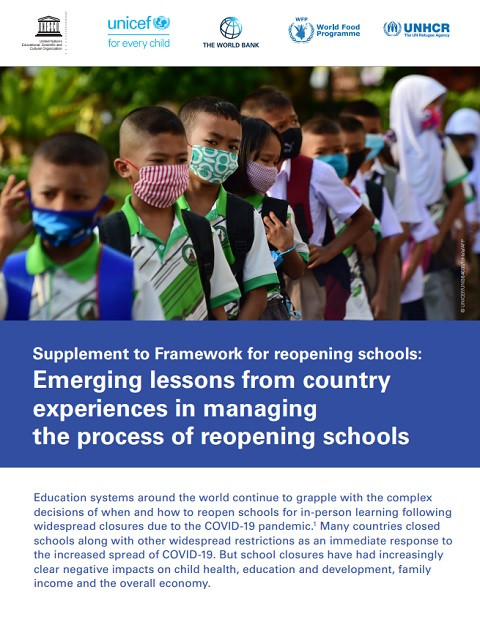 Supplement to Framework for Reopening Schools: Emerging Lessons From Country Experiences in Managing the Process of Reopening Schools 발행 연도: 2020 단체 저자: UNESCO | United Nations Children's Fund (UNICEF) | World Bank | World Food Programme | UN. Office of the United Nations High Commissioner for Refugees (UNHCR) Education systems around the world continue to grapple with the complex decisions of when and how to reopen schools for in-person learning following widespread closures due to the COVID 19 pandemic. This supplement to the Framework for reopening schools, originally published jointly by UNICEF, UNESCO, the World Bank, the World Food Programme, and the UN Refugee Agency (UNHCR) in April 2020, summarizes emerging lessons learnt over the past months.The supplement follows the four main dimensions of the Framework (safe operations, focus on learning, wellbeing & protection, and reaching the most marginalized) and highlighting a number of country examples.
 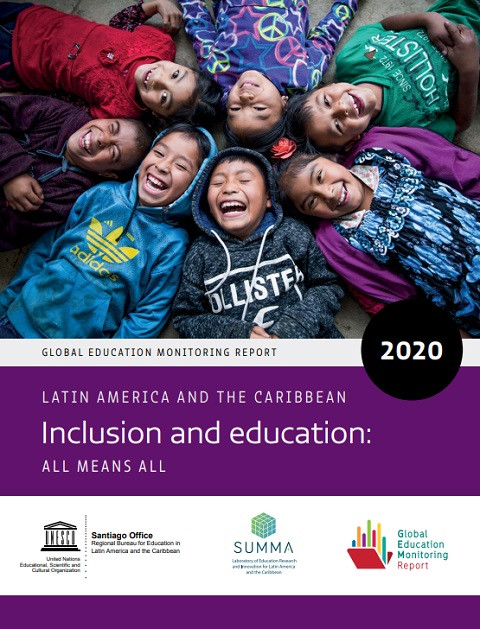 Latin America and the Caribbean 2020: Inclusion and Education; All Means All (Global Education Monitoring Report) 발행 연도: 2020 단체 저자: Global Education Monitoring Report Team | UNESCO | Laboratory of Education Research and Innovation for Latin America and the Caribbean (SUMMA) Latin America and the Caribbean has the largest and most challenging socio-economic inequalities in the world, which have shaped its education systems over the decades. This report looks at everyone both in and excluded from education in the region, pinpointing barriers facing learners, especially when multiple disadvantages intersect. The report also explores challenges in education posed by COVID-19 and the need for urgent action to prevent an exacerbation of inequalities. Produced by the Global Education Monitoring (GEM) Report team, in partnership with the UNESCO Regional Bureau for Education in Latin America and the Caribbean (OREALC) and the Laboratory of Education Research and Innovation for Latin America and the Caribbean (SUMMA), the report assesses key solutions for greater inclusion through several case studies from the region. It provides in-depth analysis on challenges to inclusion in education arising from migration and displacement in Colombia and Costa Rica; remoteness in Brazil and Suriname; disability in Cuba and Nicaragua; gender in Peru and Jamaica; sexual orientation, gender identity and expression in Chile and Mexico; poverty in the Dominican Republic and Honduras; ethnicity in Bolivia and Ecuador; and incarceration in El Salvador and Uruguay. Building on the 2020 Global Education Monitoring Report, this regional edition concludes that strong laws and policies in Latin America and the Caribbean demonstrate a commitment to inclusion, but that the daily realities faced by learners suggest implementation is lagging. Recommendations are aimed at promoting more inclusive education systems to benefit all children and youth, no matter their background, identity or ability. The recommendations provide a systematic framework for identifying and dismantling barriers for vulnerable populations, according to the principle that ‘every learner matters and matters equally’.
  Education for Sustainable Development: A Roadmap 발행 연도: 2022 단체 저자: UNESCO This roadmap sets out the urgent challenges facing the planet and underlines the implementation of the new Education for Sustainable Development: Towards achieving the SDGs (ESD for 2030) framework, which was adopted with the aim of increasing the contribution of education to building a more just and sustainable world. ESD for 2030 will step up actions on five priority action areas on policy, education environments, building capacities of educators, youth and local level action, stressing further ESD’s key role for the successful achievement of the 17 SDGs and the great individual and societal transformation required to address the urgent sustainability challenges. The roadmap also underlines the key areas of implementation of the ESD for 2030 framework. ESD is widely recognized as an integral element of Agenda 2030, in particular Sustainable Development Goal 4 (SDG 4), and a key enabler of all the other SDGs.
 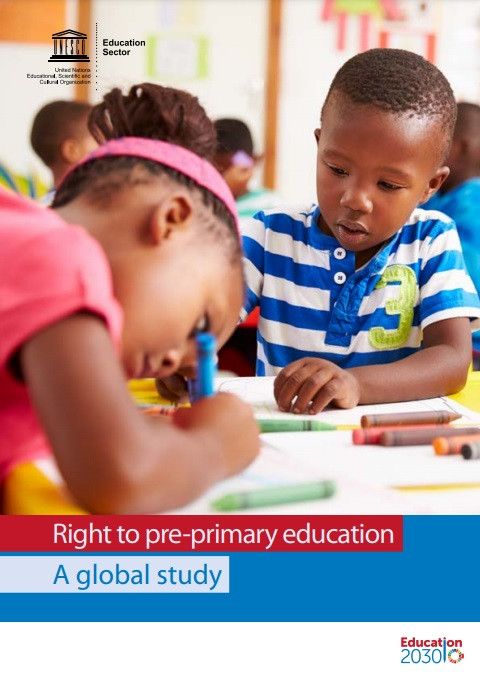 Right to Pre-Primary Education: A Global Study 발행 연도: 2021 단체 저자: UNESCO Early childhood care and education is increasingly recognized as an essential element in realizing a wide range of educational, social and economic rights. Children from vulnerable households and communities stand to gain most from access to quality early learning opportunities. With about 50 per cent of children globally not yet enrolled in pre-primary education, enabling their inclusion remains a central question for education policymakers, stakeholders and parents.This Study provides a global overview and an analysis of the adoption of legal provisions for free and compulsory pre-primary education at national level. By offering a rights-based perspective to the implementation of pre-primary education, it aims to complement existing literature on SDG Target 4.2, which focuses mainly on policy outcomes.The results show that pre-primary education is a well determined and defined right in too few countries. Yet, the benefit of free and compulsory education observed is that children appear to have higher rates of early childhood well-being.In light of the research conducted and its main conclusions, a set of levers to promote the inclusion of early childhood and pre-primary education as a human right within long-term education and development objectives are presented in terms of governance and financing, legal framework, societal expectations, monitoring and evaluation and early childhood development overall. Prioritizing the needs of young children and the fulfilment of their right to free and compulsory pre-primary education is a critical opportunity for governments to make positive differences in children’s lives and to achieve broader national, social and economic goals.
  Toolkit for Urban Inclusion in Arab Cities: Cities Promoting Inclusion Through Public Participation, Access to Information, Sport, and Citizenship and Human Rights Education 발행 연도: 2020 저자: Kareem Ibrahim | Deena Khalil | Marwa Barakat | Salwa Salman 단체 저자: UNESCO | European Training and Research Centre for Human Rights and Democracy (Austria) | UNESCO Cairo Arab cities are witnessing an unprecedented expansion. Home to more than half of the region’s population, Arab cities have transformed into heterogeneous spaces that host diverse identities, cultures, and ethnicities. In order for this transformation to lead to prosperity, city officials must adopt a rights-based, human-centred approach, and implement inclusive policies and measures that provide equal opportunities for all.In this context, the Toolkit for Urban Inclusion in Arab Cities provides Arab city leaders and local government officials with practical tools and advice to guide their efforts towards establishing inclusive and sustainable cities. The Toolkit is based on the real experiences and practices of cities members of the Coalition of Arab Cities against Racism, Discrimination, Xenophobia and Intolerance in planning, implementing and evaluating programs and projects that promote urban inclusion and combat exclusion in all its forms.The Toolkit focuses on four topics of high priority to the Arab Coalition member cities: public participation, access to information, sport for youth inclusion, and citizenship and human rights education.
  Reflect–Share–Act: A Guide to Community-based Education for Sustainable Development 발행 연도: 2021 단체 저자: UNESCO | UNESCO Bangkok This guidebook aspires to build a community where learning for sustainable development takes place everywhere for everyone as an ongoing practice. It introduces you to Reflect-Share-Act, a process to discover and define sustainable development in your own contexts together with others in your community. The guide compiles resources that can support this learning process, including stories of various communities’ actual experiences of Reflect-Share-Act.