
자료
세계시민교육에 대한 이해를 넓히고 연구, 옹호 활동, 교수, 학습 등을 향상시킬 수 있는 다양하고 유용한 자료를 찾아보세요.
1,583 건의 결과가 검색되었습니다
 Sandwatch: s'adapter au changement climatique et éduquer pour le développement durable 발행 연도: 2010 저자: Gillian Cambers | Paul Diamond 단체 저자: UNESCO Sandwatch provides a framework for children, youth and adults, with the help of teachers and local communities, to work together to critically evaluate the problems and conflicts facing their beach environments, and to develop sustainable approaches to address these issues. It also helps beaches become more resilient to climate change. The preliminary chapters of this publication focus on how to get started with Sandwatch activities and examine ways to address climate change impacts. The principle aim of this publication is to document the Sandwatch methodology: monitoring, analysing, sharing and taking action. An activities-orientated approach is used to provide step-by-step instructions to cover monitoring methods and data analysis, including observation and recording, erosion and accretion, beach composition, human activities, beach debris, water quality, waves, longshore currents, plants and animals. The activities are related to (a) sustainable development issues, including: beach ownership, mining beaches for construction material, conflict resolution between different beach users, pollution, conservation of endangered species, and (b) climate change adaptation issues: sea level rise, rising temperatures, ocean acidification and increased extreme events. Ways to share findings and create a Sandwatch network are detailed including methods such as the use of local media, websites, social networking and video production. Finally, ways are discussed to design, plan and implement a Sandwatch project to fulfill one or all of the following criteria: (a) addressing a particular beach-related issue, (b) enhancing the beach, and (c) promoting climate change adaptation. Sandwatch stands as an example of Education for Sustainable Development in action, and is being targeted as one of several flagship projects for the United Nations Decade of Education for Sustainable Development (2005–2014). As the world confronts the growing threat of climate change, Sandwatch presents an opportunity to help people and ecosystems respond to present and future changes in a practical manner. Beaches are among the ecosystems most at risk from climate change as they face rising sea levels and increased more intense storms. By contributing to ecosystem health and resilience, Sandwatch can help people from all walks of life learn about climate change and how their actions can contribute to the adaptation process.
  Guidebook on Education for Sustainable Development for Educators: Effective Teaching and Learning in Teacher Education Institutions in Africa 발행 연도: 2018 단체 저자: UNESCO The guidebook on Education for Sustainable Development for Educators: Effective teaching and learning in teacher education institutions in Africa has been conceived as a tool to mainstream sustainability into all aspects of teacher education and training with useful information concerning teaching, learning and assessment approaches to help achieve the ESD goals and learning outcomes. Fostering peaceful co-existence through analysis and revision of history curricula and textbooks in Southeast Europe: preliminary stocktaking report 발행 연도: 2006 저자: Jean Damascène Gasanabo | Jade Maître 단체 저자: UNESCO To accomplish this aim, the study reviews policies and processes for developing history curricula and producing history textbooks in ten participating countries: Albania, Bosnia and Herzegovina, Bulgaria, Croatia, Greece, Romania, Montenegro, Serbia, Slovenia and The Former Yugoslav Republic of Macedonia (FYROM). The resulting report has been compiled for the dual purpose of (1) presenting a composite picture of the educational policies and practices in these countries with regard to history teaching and textbook production, distribution and use; (2) laying the groundwork for the development of national and/or sub-regional initiatives aimed at improving the processes currently in place. Good practices in education for sustainable development: using the Earth Charter 발행 연도: 2007 단체 저자: UNESCO | Earth Charter International Secretariat This publication has been envisioned to offer stories – case studies from around the world – that highlight how groups and individuals are using the Earth Charter as a tool for education for sustainable development. These stories come from non-formal and formal educational settings and describe a variety of experiences, including the development of guidebooks for primary school teachers, the inclusion of sustainability values in universities’ departments of education, law, engineering and general studies; the reshaping of local, regional and national curricula; and, the creation of vital and engaging programs and workshops for children and youth. Bonnes pratiques en matière d'éducation pour le développement durable: utilisation de la Charte de la Terre 발행 연도: 2007 단체 저자: UNESCO | Earth Charter International Secretariat Cette publication a été conçue pour offrir des histoires - études de cas de partout dans le monde - qui mettent en évidence comment les groupes et les individus utilisent la Charte de la Terre comme outil d'éducation pour le développement durable. Ces histoires viennent de contextes éducatifs non formels et formels et décrivent une variété d'expériences, y compris l'élaboration de guides pour les enseignants du primaire, l'inclusion des valeurs de durabilité dans les départements des universités de l'éducation, du droit, du génie et des études générales; le remaniement des programmes d'études locaux, régionaux et nationaux; et la création de programmes et d'ateliers vitaux et attrayants pour les enfants et les jeunes.
 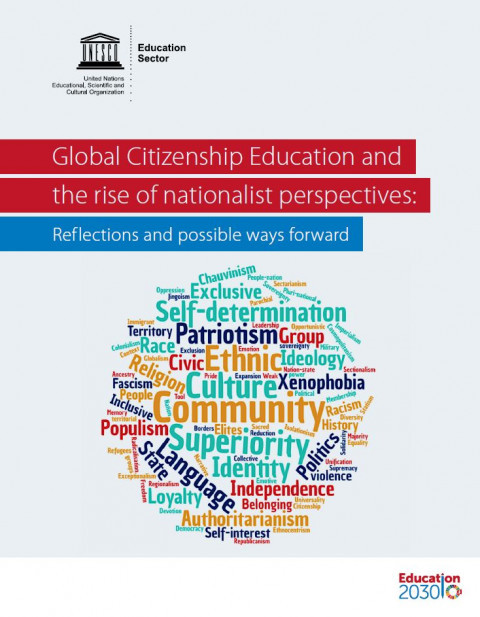 Global Citizenship Education and the Rise of Nationalist Perspectives: Reflections and Possible Ways Forward 발행 연도: 2018 단체 저자: UNESCO | APCEIU Over the past few years, many have observed a rise in nationalist perspectives across the world. These trends raise questions about the role of education and, in particular, one of UNESCO’s key areas of work in the field of education, namely Global Citizenship Education (GCED), which seeks to equip learners with the skills, values and attitudes needed to contribute to the development of peaceful and just societies. This paper seeks to clarify the evidence of the rise of nationalist perspectives and its causes, and to lay out how GCED is challenged by this phenomenon. It recommends ways forward for education stakeholders in promoting GCED, in order to strengthen ‘learning to live together’ by embedding GCED meaningfully in local and country contexts. 세계시민교육과 민족주의적 관점의 부상: 성찰과 나아갈 길 발행 연도: 2018 단체 저자: UNESCO | APCEIU 지난 몇 년간 많은 이들이 전 세계에서 민족주의적 관점의 부상을 목도해왔다. 이에 관해 평론가들은 배타성과 외국인 공포증, 때로 인종주의적 주장과 공공장소 내 폭력적 행위가 증가하고 있는 것뿐만 아니라, 일부 국가에서 경제적 보호주의에 더욱 중점을 두는 현상에 대해 언급해왔다. 이러한 추세는 교육의 역할에 대해 많은 의문을 불러일으키고 있으며, 특히 평화롭고 공정한 사회의 발전에 필요한 능력·가치·태도 함양을 목적으로 하는, 유네스코 교육 분야의 핵심 사업인 세계시민교육(GCED, Global Citizenship Education)에 있어 심각한 도전이 되고 있다. 이 책에서는 민족주의적 관점이 부상하고 있다는 증거 및 그 원인을 규명하고, 이러한 현상으로부터 세계시민교육이 어떠한 도전을 받고 있는지를 보여주고자 한다. 이 책은 유네스코의 사업과 더불어 세계시민교육을 추진하는 다른 교육 종사자들에게 앞으로 나아갈 수 있는 방안을 권고하고자 한다.
  Global Citizenship Education: Taking It Local 발행 연도: 2018 단체 저자: UNESCO UNESCO is leading global efforts on Global Citizenship Education (GCED), which is at the core of Target 4.7 of Sustainable Development Goal 4 on Education. To address the perception that the concept of GCED is concerned mainly with global matters and maybe dissociated from local needs and realities, UNESCO has identified local/national/traditional precepts and concepts that are similar to the UNESCO understanding of global citizenship.As culturally relevant expressions of GCED and to contribute to building peace through the implementation of GCED, the concepts identified here can serve as entry-points to teach and learn about GCED in more locally relevant ways. Education à la citoyenneté mondiale: pour une approche locale 발행 연도: 2018 단체 저자: UNESCO L’UNESCO mène les efforts mondiaux portant sur l’éducation à la citoyenneté mondiale, qui est au coeur de la cible 4.7 de l’Objectif 4 de développement durable sur l’éducation. Afin de clarifier la perception selon laquelle le concept de l’éducation à la citoyenneté mondiale concerne principalement des questions mondiales et qu’il est peut-être dissocié des réalités et des besoins locaux, l’UNESCO a identifié des préceptes et des concepts locaux/nationaux/traditionnels qui sont comparables à la compréhension qu’a l’UNESCO de la citoyenneté mondiale. En tant qu’expressions culturellement pertinentes de l’éducation à la citoyenneté mondiale, et dans le but de contribuer à l’édification de la paix grâce à la mise en oeuvre de l’éducation à la citoyenneté mondiale, les concepts identifiés dans ce document peuvent servir de points d’entrée pour enseigner l’éducation à la citoyenneté mondiale et pour l’apprendre, de manière plus pertinente au niveau local. Discours du Sous-Directeur général de l'UNESCO pour la culture M. Francesco Bandarin à l'occasion de la Journée internationale de la langue maternelle: Les langues locales pour la citoyenneté mondiale: zoom sur la science; UNESCO, le 21 février 2014 발행 연도: 2014 단체 저자: UNESCO This is an address by Mr. Francesco Bandarin, Assistant Director-General for culture of UNESCO, on the occasion of the International Mother Language Day: Local languages for global citizenship: focusing on science. Although little progress has been made to extend the benefits of multilingual education in the areas such as science, development of science will be considerably consolidated if people better understand and utilize local and international languages.