
자료
세계시민교육에 대한 이해를 넓히고 연구, 옹호 활동, 교수, 학습 등을 향상시킬 수 있는 다양하고 유용한 자료를 찾아보세요.
68 건의 결과가 검색되었습니다
 Sharing Malaysian experience in participation of girls in STEM education 발행 연도: 2016 단체 저자: UNESCO International Bureau of Education (IBE) The Malaysia government has placed STEM as a focus in developing the country towards achieving the status of a developed nation. The government acknowledges the role of women as equal partners in nation building. Thus, various policies ranging from economy, education, women’s welfare and human resources have been formulated through the years. These policies have resulted in among others, the increase in women researchers from 35.8% in 2004 to 49.9% in 2012 as well as more women’s participation in selected STEM courses at the tertiary level. A total of 84 girls’ day schools with 6 of them as residential STEM Girls’ schools have been built since 1939. There are many female role models in STEM for the girls to emulate. This has been made possible by the successful implementation of the various policies related to women in STEM as well as innovative measures in facing the continuing challenges in STEM education.
  Ten Clues for Rethinking Curriculum (In-Progress Reflection; No. 42, 2021) 발행 연도: 2021 저자: Renato Opertti 단체 저자: UNESCO International Bureau of Education (IBE) This discussion document highlights the urgency of rethinking curriculum in light of reinforcing the commitments of the Education 2030 Agenda on learning, disruptive systemic worldwide societal changes, and crucially, the profound transformation of education and education systems post Covid-19. Curriculum is always at the core of giving effect to social aspirations and ideals on the why, what, how, when, and where of teaching, learning, and assessing. We propose a series of 10 interconnected clues to deepen on the systemic and holistic understanding of curriculum as contributing to lay foundations for a better, sustainable and fair future. These clues are: understanding the new generations; combatting factors related to vulnerability; reinforcing understanding between school and families; deepening glo-local education; enhancing the focus on the person; promoting synergies among values; valuing diversity; focusing on education that enhances freedom; moving toward hybrid modes of education; and inspiring affection for educators.
  Citizenship education in Latin America: priorities of school curricula (IBE working papers on curriculum issues no. 14) 발행 연도: 2014 저자: Cristián Cox | Martín Bascopé | Juan Carlos Castillo | Daniel Miranda | Macarena Bonhomme 단체 저자: UNESCO International Bureau of Education (IBE) This work focuses on the curricula of six Latin American countries – Colombia, Chile, the Dominican Republic, Guatemala, Mexico and Paraguay – which at the close of the past decade agreed to be part of the project Regional System of Evaluation and Development of Citizenship Competencies (SREDECC). With the support of the Inter-American Development Bank, SREDECC developed the Latin American module of the International Civic and Citizenship Study (ICCS- 2009) undertaken by the International Association for the Evaluation of Educational Achievement (IEA), in addition to encouraging the participation of the countries in that study (Cox 2010; Schulz, Ainley, Friedman and Lietz 2011).This document comprises four parts. The first section takes stock of the state of democratic belief in the region, drawing upon the most significant opinion studies of the past decade, so as to offer broader meaning bases for curriculum analysis and, more generally, for educational work in the field of citizenship. The second section describes the organizational (or structural) characteristics of the curricula of the six countries and presents a framework of categories for their comparative analysis. The subsequent section describes and analyses the contents of the six curricula examined and how they deal with the values, institutions and citizenship relations in their civic (political) and civil (coexistence) dimensions. On the basis of the most significant findings, the closing section includes some reflections regarding curriculum development with regard to citizenship. Éducation à la Citoyenneté en Amérique latine: les priorités de programmes scolaires(BIE papiers de travail sur les questions de curriculum no.14) 발행 연도: 2014 저자: Cristián Cox | Martín Bascopé | Juan Carlos Castillo | Daniel Miranda | Macarena Bonhomme 단체 저자: UNESCO International Bureau of Education (IBE) Ce travail se concentre sur les programmes de six pays d'Amérique latine - Colombie, le Chili, la République dominicaine, le Guatemala, le Mexique et le Paraguay - qui à la fin de la dernière décennie aCECpté de faire partie du projet de système régional d'évaluation et de développement des compétences citoyennes (SREDECC). Avec le soutien de la Banque interaméricaine de développement, SREDECC latino-américaine a développé le module de l'Étude internationale civique et la citoyenneté (ICCS- 2009) Pratiqué par l'Association internationale pour l'évaluation du rendement scolaire (AIE), en plus d'encourager la participation des clubs de pays dans cette étude (Cox 2010, Schulz, Ainley, Friedman et Lietz 2011). Ce document comprend quatre parties. La première section fait le point sur l'état de croyance démocratique dans la région, en tirant sur les études d'évaluation les plus importants de la dernière décennie, de manière à offrir la base de sens plus large pour l'analyse des programmes et, plus généralement, pour le travail éducatif dans le domaine de la citoyenneté . La deuxième section décrit les caractéristiques organisationnelles (ou structurelles) des programmes d'études des six clubs de pays et présente un cadre de catégories pour leur analyse comparative. La section suivante décrit le contenu et les analyses des six programmes examinés et comment ils traitent avec les valeurs, les institutions et les relations de citoyenneté dans leurs civiques (politiques) et civiles (coexistence) dimensions. Sur la base des conclusions les plus importantes, la section de fermeture comprend quelques réflexions concernant le développement de curriculum vitae à l'égard de la citoyenneté. Educación ciudadana en América Latina: prioridades de los currículos escolares (IBE working papers on curriculum issues no. 14) 발행 연도: 2014 저자: Cristián Cox | Martín Bascopé | Juan Carlos Castillo | Daniel Miranda | Macarena Bonhomme 단체 저자: UNESCO International Bureau of Education (IBE) This work focuses on the curricula of six Latin American countries – Colombia, Chile, the Dominican Republic, Guatemala, Mexico and Paraguay – which at the close of the past decade agreed to be part of the project Regional System of Evaluation and Development of Citizenship Competencies (SREDECC). With the support of the Inter-American Development Bank, SREDECC developed the Latin American module of the International Civic and Citizenship Study (ICCS- 2009) undertaken by the International Association for the Evaluation of Educational Achievement (IEA), in addition to encouraging the participation of the countries in that study (Cox 2010; Schulz, Ainley, Friedman and Lietz 2011).This document comprises four parts. The first section takes stock of the state of democratic belief in the region, drawing upon the most significant opinion studies of the past decade, so as to offer broader meaning bases for curriculum analysis and, more generally, for educational work in the field of citizenship. The second section describes the organizational (or structural) characteristics of the curricula of the six countries and presents a framework of categories for their comparative analysis. The subsequent section describes and analyses the contents of the six curricula examined and how they deal with the values, institutions and citizenship relations in their civic (political) and civil (coexistence) dimensions. On the basis of the most significant findings, the closing section includes some reflections regarding curriculum development with regard to citizenship.
 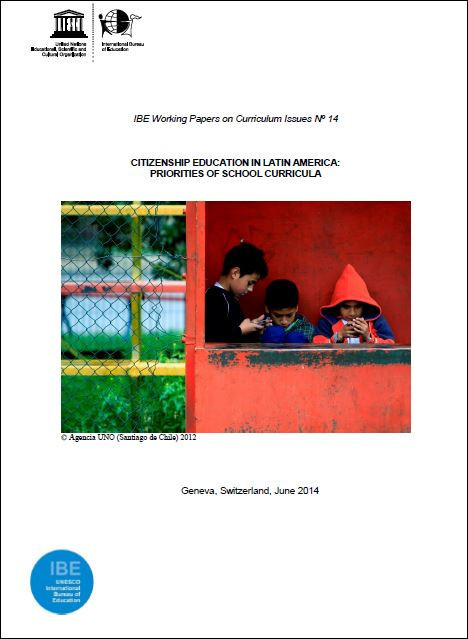 Citizenship education in Latin America: Priorities of School Curricula 발행 연도: 2014 저자: Cristián Cox | Martín Bascopé | Juan Carlos Castillo | Daniel Miranda | Macarena Bonhomme 단체 저자: UNESCO International Bureau of Education (IBE) This work focuses on the curricula of six Latin American countries – Colombia, Chile, the Dominican Republic, Guatemala, Mexico and Paraguay – which at the close of the past decade agreed to be part of the project Regional System of Evaluation and Development of Citizenship Competencies (SREDECC). With the support of the Inter-American Development Bank, SREDECC developed the Latin American module of the International Civic and Citizenship Study (ICCS- 2009) undertaken by the International Association for the Evaluation of Educational Achievement (IEA), in addition to encouraging the participation of the countries in that study (Cox 2010; Schulz, Ainley, Friedman and Lietz 2011). This document comprises four parts. The first section takes stock of the state of democratic belief in the region, drawing upon the most significant opinion studies of the past decade, so as to offer broader meaning bases for curriculum analysis and, more generally, for educational work in the field of citizenship. The second section describes the organizational (or structural) characteristics of the curricula of the six countries and presents a framework of categories for their comparative analysis. The subsequent section describes and analyses the contents of the six curricula examined and how they deal with the values, institutions and citizenship relations in their civic (political) and civil (coexistence) dimensions. On the basis of the most significant findings, the closing section includes some reflections regarding curriculum development with regard to citizenship. Educación Ciudadana en América Latina: Prioridades de los Currículos Escolares 발행 연도: 2014 저자: Cristián Cox | Martín Bascopé | Juan Carlos Castillo | Daniel Miranda | Macarena Bonhomme 단체 저자: UNESCO International Bureau of Education (IBE) El documento se organiza en cuatro partes. En la primera se da cuenta del estado de la creencia democrática en la región, recurriendo a evidencia de los estudios de opinión más importantes de la última década, de modo de ofrecer contexto y bases de significado amplios al análisis curricular, así como, más en general, al trabajo educativo en el área de ciudadanía. En la segunda sección se describe las características organizativas (o de estructura) de los currículos de los seis países y se presenta un esquema de categorías para el análisis comparado de los mismos. La sección siguiente describe y analiza los contenidos de los seis currículos examinados y su tratamiento de los valores, las instituciones y las relaciones de ciudadanía, en su dimensión cívica (política) y civil (convivencia). A partir de los hallazgos más importantes, la sección de cierre ofrece unas reflexiones orientadas al desarrollo curricular en el área.
  Education for peace: planning for curriculum reform; guidelines for integrating an education for peace curriculum into education sector plans and policies 발행 연도: 2015 단체 저자: UNESCO | UNESCO International Bureau of Education (IBE) | UNESCO International Institute for Educational Planning (IIEP) This Resource and Development Capacity Package was developed based on the belief that, as part of a wider social, economic and political effort, education can play a significant role in a country’s peace-building efforts. Its purpose is to assist Member States in integrating or strengthening peace education programs in their national education systems to promote peace and prevent future conflict. UNESCO, IBE, and IIEP developed this resource within the framework of UNESCO’s Intersectoral Project, Promoting a culture of peace and nonviolence in Africa through education for peace and conflict prevention. The Package contains Technical Guidelines and Capacity Development training modules on policy, program design and curriculum planning to integrate peace and conflict prevention into all aspects of the education system. It is meant for curriculum developers and planners from Africa. The development of the package received the support of the UNESCO Addis-Ababa Office, which assisted in the testing of materials in Addis-Ababa (Ethiopia) and Yaounde (Cameroon).This resource will furthermore help to ensure that curricula, teaching and learning resources and teacher education are in line with the post-2015 vision of education for holistic development. This vision reconceptualises education in terms of global citizenship and responsibility by focusing on inclusion and social cohesion that is global in orientation. In this regard, Global Citizenship Education (GCED) seeks to empower learners with knowledge, skills, values and attitudes that are needed to forge more just and inclusive societies, capable of resolving existing conflicts and emerging global challenges. Éducation pour la paix: la planification de la réforme du curriculum; lignes directrices pour l'intégration d'un programme d'éducation pour la paix dans les plans et politiques du secteur éducatif 발행 연도: 2015 단체 저자: Organisation des Nations Unies pour l'éducation, la science et la culture (UNESCO) | UNESCO International Bureau of Education (IBE) | UNESCO International Institute for Educational Planning (IIEP) Cette trousse de ressources et de développement des capacités a été élaborée sur la base de la conviction que, dans le cadre d'un effort plus large social, économique et politique, l'éducation peut jouer un rôle important dans les efforts de consolidation de la paix d'un pays. Son but est d'aider les États membres à intégrer ou renforcer les programmes d'éducation à la paix dans leurs systèmes nationaux d'éducation pour promouvoir la paix et prévenir les conflits futurs. UNESCO, le BIE, et l'IIPE ont développé cette ressource dans le cadre du projet intersectoriel de l'UNESCO, Promouvoir une culture de la paix et de la non-violence en Afrique par l'éducation pour la paix et la prévention des conflits. Le paquet contient des directives techniques et des modules de formation de renforcement des capacités sur la politique, la conception des programmes et de la planification des programmes pour intégrer la paix et de prévention des conflits dans tous les aspects du système d'éducation. Il est destiné aux concepteurs de programmes et les planificateurs de l'Afrique. Le développement de l'emballage a reçu le soutien du Bureau d'Addis-Abeba de l'UNESCO, qui a participé à l'essai des matériaux à Addis-Abeba (Ethiopie) et Yaoundé (Cameroun).Cette ressource sera en outre aider à faire en sorte que les programmes, les ressources d'enseignement et d'apprentissage et la formation des enseignants sont en ligne avec la vision post-2015 de l'éducation pour le développement holistique. Cette vision reconceptualise l' éducation en termes de citoyenneté et de responsabilité globale en mettant l'accent sur l'inclusion et la cohésion sociale qui est mondiale dans l'orientation. À cet égard, Éducation à la Citoyenneté Mondiale (ECM) vise à habiliter les apprenants des connaissances, des compétences, des valeurs et des attitudes qui sont nécessaires pour forger des sociétés plus justes et inclusives, capables de résoudre les conflits existants et nouveaux défis mondiaux.
  Education in a Post-COVID World: Additional Considerations (In-Progress Reflection; No.43, 2021) 발행 연도: 2021 저자: Renato Opertti 단체 저자: UNESCO International Bureau of Education (IBE) This discussion document analyses some implications of the ideas proposed in the seminal UNESCO document “Education in a post-COVID world: Nine ideas for public action” (2020). Based on the work of the International Commission on the Futures of Education, the documents’ contributors included prominent figures with a wide range of professional and policy experience who hail from various regions of the world. The set of nine interconnected ideas illuminates the way forward toward the transformation of education and education systems and a reimagined future seen through a progressive lens. On one hand, it reaffirms basic principles, understandings, and commitments with regard to education as a global common good and universal human right; it also articulates the need to both reinvent multilateralism for a new global order and, crucially, to mobilize ideas and funding for transforming education. On the other hand, the document advocates for a comprehensive educational agenda, including the following critical issues: (i) visualizing educators as decision-makers in educational systems; (ii) appreciating students as active actors with rights; (iii) recognizing the value and specificity of the school space; (iv) addressing the dilemmas around technology’s ability to serve as an equalizer of opportunities; and (v) revisiting educational content for the sustainability of younger generations.