
자료
세계시민교육에 대한 이해를 넓히고 연구, 옹호 활동, 교수, 학습 등을 향상시킬 수 있는 다양하고 유용한 자료를 찾아보세요.
46 건의 결과가 검색되었습니다
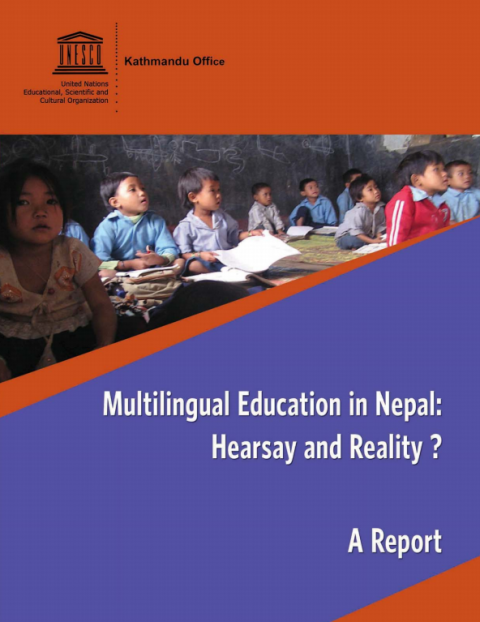 Multilingual education in Nepal: hearsay and reality? A report 발행 연도: 2011 저자: Vishnu S. Rai | Maya Rai | Prem Phyak | Nabina Rai 단체 저자: UNESCO Kathmandu The present study entitled “Multilingual Education in Nepal: Hearsay and Reality?” was started in April 2011 and completed on 25th May 2011. The main aim of the study was to explore and analyze the realities of the Multilingual Education (MLE) programme being practiced in seven schools from six different districts. The MLE programme was launched by the Department of Education (DOE) with the technical assistance of the Government of Finland in 2007. Nepal Government has planned to implement MLE in 300 schools in the coming years but there have been no comprehensive studies conducted to give an accurate picture of the MLE programme. In this context, the present study was carried out.
 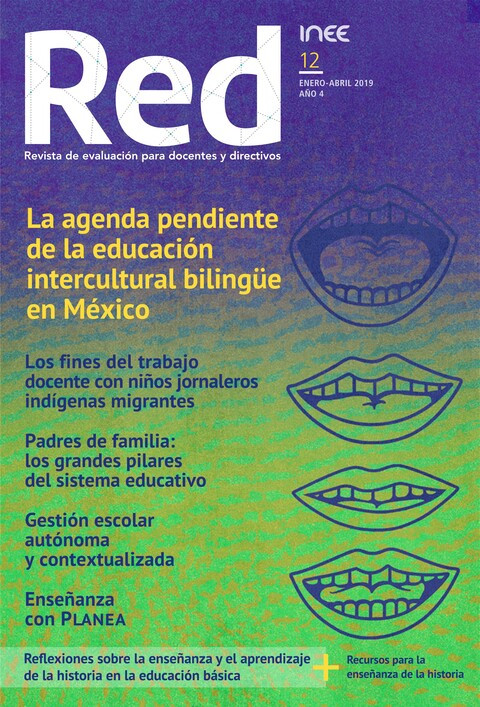 Journal of Evaluation for Teachers and Managers: The Pending Agenda of Bilingual Intercultural Education in Mexico (Red Magazine; No.4, 2019) 발행 연도: 2019 단체 저자: National Institute for the Evaluation of Education (NIEE) This journal addresses an outstanding concern within the Mexican state: indigenous, intercultural, and bilingual education in our nation. It delves into the pedagogy of history at the elementary and secondary levels, along with an exploration of the internet's resources for stimulating student interest in this subject, as presented in our inaugural issue of 2019. Equally noteworthy are inquiries into teacher professionalization and insights shared by several educators on this subject. In the direct discourse titled "From Educator to Educator," Ms. Tsut Tsuy Tamayo also imparts her experiences in the realm of mathematics education. Additionally, this issue includes substantial statistics from the PLANEA assessment, an investigative report on parental involvement in their children's academic pursuits, and an extensive evaluation course tailored for educators, elucidated through an interview with Bernardo Naranjo, a counselor at the National Institute for the Evaluation of Education (INEE). Revista de evaluación para docentes y directivos: La agenda pendiente de la educación intercultural bilingüe en México (Revista Red; No.4, 2019) 발행 연도: 2019 단체 저자: National Institute for the Evaluation of Education (NIEE) Esta revista aborda una asignatura pendiente del Estado mexicano: la educación indígena, intercultural y bilingüe en nuestro país. La enseñanza de la historia en primaria y secundaria, y los recursos que nos ofrece internet para propiciar el interés de los alumnos en esta asignatura también se plantean en nuestra primera entrega de 2019. No menos interesantes resultan la profesionalización docente y las opiniones que varias maestras nos comunican sobre este tema. En el diálogo directo “De profesor a profesor”, la maestra Tsut Tsuy Tamayo nos comparte igualmente su experiencia en la enseñanza de las matemáticas. Las significativas cifras arrojadas por PLANEA, un reportaje sobre la participación de los padres de familia en la educación académica de sus hijos, un curso masivo sobre evaluación dirigido a docentes expuesto en entrevista por Bernardo Naranjo, consejero del INEE.
  The Clandestine Schools in Ecuador. Roots of Intercultural Indigenous Education 발행 연도: 2015 저자: María Isabel González Terreros By the mid-twentieth century in Ecuador, indians implemented clandestine schools to teach their people. Those schools were persecuted and harassed by landowners, who did not see pertinent that indians were educated. This was a pioneering, innovative and different project. Pioneer because it is the first known project with these features in Ecuador; innovative because it was leaded by Indians who took their cultural background to school (such as the teaching of ancestral language and some knowledge about nature and territory); and different because it was a proposal contrary to the homogenizing and assimilationist education that the Nation-state was implementing in rural areas. That proposal was led by Dolores Cacuango, a Quechua Indian who was subject to the hacienda system (in which communities did farm work for the employer, in exchange for a piece of land to live in with their families). She, who suffered injustice and had no chance to go to school, insisted that children and young people should "learn letter" (that is, they should learn Castilian). Las Escuelas Clandestinas en Ecuador. Raíces de la Wducación Indígena Intercultural 발행 연도: 2015 저자: María Isabel González Terreros A mediados del siglo xx en Ecuador los indígenas implementaron escuelas clandestinas para enseñar a los suyos, escuelas que fueron perseguidas y hostigadas por los hacendados que no veían pertinente que los indígenas se educaran. Se trató de un proyecto pionero, novedoso y diferente. Pionero porque es el primero que se conoce con estas características en el Ecuador; novedoso porque fue dirigido por indígenas que llevaron los saberes culturales a la escuela, como la enseñanza del idioma ancestral y algunos conocimientos sobre la naturaleza y el territorio; y diferente porque fue una propuesta contraria a la educación homogeneizante y asimilacionista que el Estado-nación implementaba en zonas rurales. Esta propuesta fue dirigida por Dolores Cacuango, una indígena kichwa que estuvo sometida al sistema de hacienda, en el que las comunidades realizaban trabajos agrícolas para el patrón a cambio de tener un pedazo de tierra y vivir con sus familias. Ella, que vivió la injusticia y no tuvo la posibilidad de ir a la escuela, se empeñó en que los niños y jóvenes “aprendieran letra”.
  MTB-MLE: mother tongue-based multilingual education; lessons learned from a decade of research and practice 발행 연도: 2014 단체 저자: UNESCO What role can language play in improving education for minority language communities? What are language rights? What place does Mother Tongue-Based Multilingual Education have in realizing other development goals?These important questions were addressed by the 4th International Conference on Language and Education. The conference brought together over 300 practitioners from 30 countries, reflecting the incredible diversity of the Asia-Pacific region and clearly demonstrating the importance of Mother Tongue-Based Multilingual Education (MTB-MLE). This brochure summarizes some of the key messages from this landmark event. MTB-MLE: langue maternelle basée sur l'éducation multilingue; les enseignements tirés d'une décennie de recherche et de pratique 발행 연도: 2014 단체 저자: UNESCO Quel rôle la langue peut jouer dans l'amélioration de l'éducation pour les communautés de langue minoritaire? Quels sont les droits linguistiques? Quelle est la place langue maternelle basée sur l'éducation multilingue ont dans la réalisation d'autres objectifs de développement?Ces questions importantes ont été abordées par la 4e Conférence internationale sur la langue et de l'éducation. La conférence a réuni plus de 300 praticiens de 30 pays, ce qui reflète l'incroyable diversité de la région Asie-Pacifique et démontre clairement l'importance de la langue maternelle basée sur l'éducation multilingue (MTB-MLE). Cette brochure résume les principaux messages de cet événement historique.
 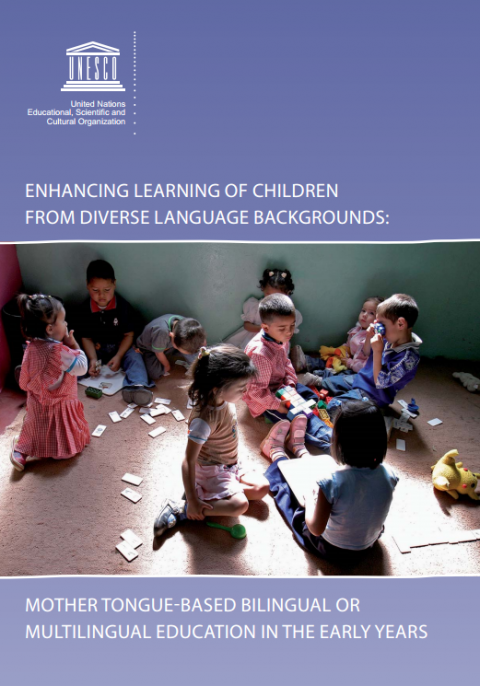 Enhancing learning of children from diverse language backgrounds: mother tongue-based bilingual or multilingual education in the early years 발행 연도: 2011 저자: Jessica Ball 단체 저자: UNESCO This literature review discusses mother tongue based bilingual or multilingual education for children starting in early childhood. The report: (1) informs policy-makers of existing research and practices in mother-tongue instruction in early childhood and early primary school years; and (2) raises awareness of the value of maintaining the world’s languages and cultures by promoting and resourcing mother tongue-based education for young children. This analysis of current literature is framed within UNESCO’s mandate and strong commitment to quality education for all and to cultural and linguistic diversity in education (UNESCO, 2003a). This discussion is especially timely, given the slow and uneven progress (UNESCO, 2000) in meeting international targets for universal education articulated in the Education for All Goals 1 (ECCE), Goal 2 (Primary Education), and Goal 6 (Quality of Education) (World Declaration on Education for All, 1990).1 Impetus for the current report is provided by the UNESCO (2008a) ‘Global Monitoring Report on Education for All: Will we make it?’ The 2008 GMR report calls for unwavering political will to ensure that education from early childhood onwards is a priority of national governments, civil society and the private sector in order to ensure educational inclusion for the 72 million children out of school and to reduce the numbers of young learners who leave school without acquiring essential skills and knowledge. The report calls for increased investments in the provision of pre-primary education for children aged 3 and above, and for policy measures to provide care and education to children below age 3. UNESCO (2007a) emphasizes the role of early childhood care and development in laying the foundation for learning and setting the stage for successful engagement in formal education. UNESCO has encouraged mother tongue instruction in early childhood and primary education since 1953 (UNESCO, 1953). Yet, monolingualism in official or dominant languages is still the norm around the world (Arnold, Bartlett, Gowani, & Merali, 2006; Wolff & Ekkehard, 2000). In its report, ‘Strong Foundations: Early Childhood Care and Education’, UNESCO (2007a) points out the overlooked advantages of multilingual education in the early years. When children are offered opportunities to learn in their mother tongue, they are more likely to enrol and succeed in school (Kosonen, 2005) and their parents are more likely to communicate with teachers and participate in their children’s learning (Benson, 2002). Mother tongue based education especially benefits disadvantaged groups, including children from rural communities (Hovens, 2002), and girls, who tend to have less exposure to an official language and tend to stay in school longer, achieve better, and repeat grades less oft en when they are taught in their mother tongue (UNESCO Bangkok, 2005). Renforcer l'apprentissage des enfants issus de milieux linguistiques diverses: basée sur la promotion de l'enseignement en langue maternelle ou de l'éducation bilingue multilingue 발행 연도: 2011 저자: Jessica Ball 단체 저자: UNESCO Cette revue de la littérature aborde la langue maternelle basée éducation bilingue ou multilingue pour les enfants à partir de la petite enfance. Le rapport: (1) informe les décideurs de la recherche et des pratiques en enseignement en langue maternelle dans la petite enfance et les premières années de l'école primaire existante; et (2) soulève conscience de la valeur du maintien des langues et des cultures du monde par la promotion et de ressourcement mère éducation fondée sur la langue, pour les jeunes enfants. Cette analyse de la littérature actuelle est encadrée au sein de l'UNESCO mandat et engagement fort à l'éducation de qualité pour tous et à la diversité culturelle et linguistique dans l'éducation (UNESCO, 2003a). Cette discussion est particulièrement opportune, compte tenu des progrès lents et inégaux (UNESCO, 2000) pour atteindre les objectifs internationaux pour l'Éducation Universelle énoncée dans l'Éducation Pour Tous les Objectifs 1, Objectifs 2 (enseignement primaire), et Objectifs 6 (qualité de l'éducation ) (déclaration mondiale sur l'éducation pour tous, 1990) .1 Impetus pour le rapport actuel est fourni par l'UNESCO (2008a) «Rapport mondial de suivi sur l'éducation pour tous: Allons-nous faire?» le rapport GMR 2008 appelle à une volonté politique sans faille veiller à ce que l'éducation de la petite enfance est en avant une priorité des gouvernements nationaux, la société civile et le secteur privé afin d'assurer l'insertion scolaire pour les 72 millions d'enfants de l'école et de réduire le nombre de jeunes apprenants qui quittent l'école sans avoir acquis les compétences essentielles et de la connaissance.
 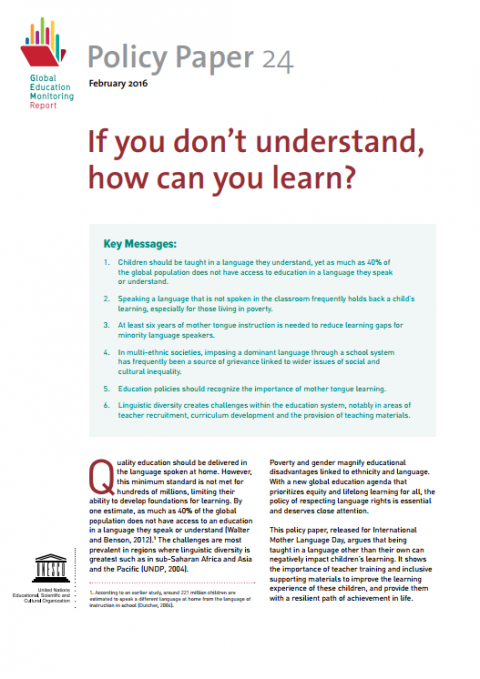 فيكف مهفت لا تنك اذإ ؟مَّلعتت نأ كل 발행 연도: 2016 단체 저자: UNESCO Key Messages:1. Children should be taught in a language they understand, yet as much as 40% of the global population does not have access to education in a language they speak or understand.2. Speaking a language that is not spoken in the classroom frequently holds back a child’s learning, especially for those living in poverty.3. At least six years of mother tongue instruction is needed to reduce learning gaps for minority language speakers.4. In multi-ethnic societies, imposing a dominant language through a school system has frequently been a source of grievance linked to wider issues of social and cultural inequality.5. Education policies should recognize the importance of mother tongue learning. 6. Linguistic diversity creates challenges within the education system, notably in areas of teacher recruitment, curriculum development and the provision of teaching materials.