
자료
세계시민교육에 대한 이해를 넓히고 연구, 옹호 활동, 교수, 학습 등을 향상시킬 수 있는 다양하고 유용한 자료를 찾아보세요.
26 건의 결과가 검색되었습니다
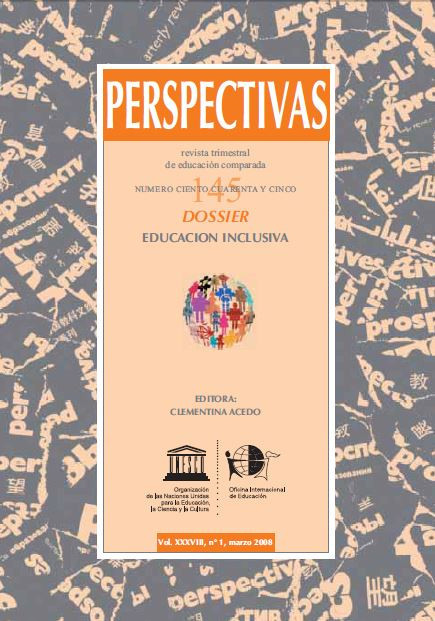 Education pour l'inclusion 발행 연도: 2008 단체 저자: UNESCO International Bureau of Education (IBE) L’auteur présente ce numéro spécial qui offre une sélection d’articles alliant recherche théorique et pratique sur la notion de l’éducation pour l’inclusion et sur les problèmes rencontrés dans l’élaboration de politiques et leur application pratique. Ces articles reflètent les approches diversifiées et à volets multiples de l’inclusion, eu égard aux aspects théoriques, disciplinaires et méthodologiques. Tout au long de ce numéro, l’inclusion est le principe de base qui oriente l’Éducation pour tous (EPT) de qualité —- c’est-à-dire, l’établissement de systèmes éducatifs tirant profit de la diversité et visant à édifier une société plus juste et plus démocratique.Ce numéro spécial est consacré au thème de la quarante-huitième session de la Conférence internationale de l’éducation (CIE) « L’éducation pour l’inclusion : la voie de l’avenir » (Genève, 25-28 novembre 2008).
 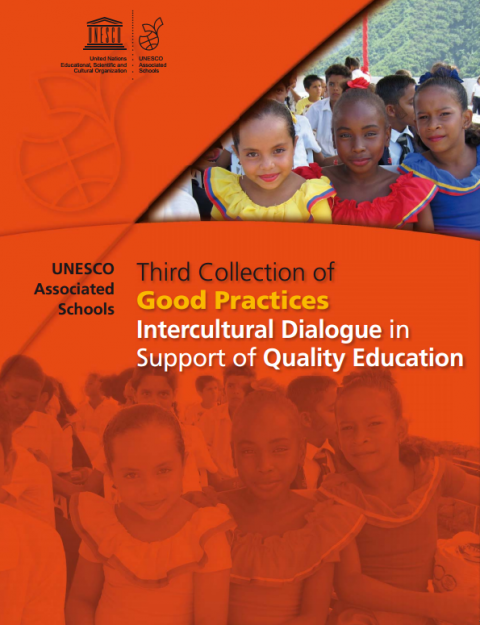 Third collection of good practices: intercultural dialogue in support of quality education 발행 연도: 2013 단체 저자: UNESCO Associated Schools Project Network (ASPnet) The UNESCO Associated Schools Project Network (ASPnet) conducts pilot projects aimed at reinforcing the humanistic and ethical principles of UNESCO in school curricula and throughout the learning process, often within the framework of UN and UNESCO International Day, Years and Decades, Promoting intercultural dialogue is thus an ASPnet priority. The initiatives presented in this Third Collection of ASPnet Good Practices were carried out by ASPnet schools and their partner institutions in the context of the International Year for the Rapprochement of Cultures (2010). The selected projects illustrate both multicultural education and intercultural education in action. Troisième recueil de bonnes pratiques: le dialogue interculturel à l'appui de l'éducation de qualité 발행 연도: 2013 단체 저자: UNESCO Associated Schools Project Network (ASPnet) Les écoles associées de l'UNESCO (réSEAU) mènent des projets pilotes visant à renforcer les principes humanistes et éthiques de l'UNESCO dans les programmes scolaires et tout au long du processus d'apprentissage, souvent dans le cadre de l'ONU et de la Journée internationale de l'UNESCO, années et décennies, la promotion du dialogue interculturel est donc une priorité Reseau. Les initiatives présentées dans ce troisième Collection de Reseau bonnes pratiques ont été réalisées par les écoles Reseau et leurs institutions partenaires dans le cadre de l'Année internationale du rapprochement des cultures (2010). Les projets sélectionnés illustrent à la fois l'éducation multiculturelle et l'éducation interculturelle dans l'action.
  Global Security, Religion and Education Development: a Crisis for the Field of Comparative Education? 발행 연도: 2011 저자: Yusuf Sayed | Lynn Davies | Mike Hardy | Abbas Madandar Arani | Lida Kakia | Masooda Bano 단체 저자: Taylor & Francis Building common ground on shared values should be a high priority for a diverse and devout society in an era of religious conflict. Otherwise we might fall into the equally false and far more dangerous illusion that we agree on nothing at all – and perhaps we tend to assume that education helps to do this, which is not necessarily the case. There is a greater concern that education is not just failing to step up effectively to the task of contesting undifferentiated and negative views of religions, but that it might not always be a force for good at all. It may in some cases help reinforce difference and create the conditions for conflict.The relationship, therefore, between religious difference, security and the assumed supportive role of education is far from a simple one. Global security, religion and education development: a crisis for the field of comparative education? 발행 연도: 2011 저자: Yusuf Sayed | Lynn Davies | Mike Hardy | Abbas Madandar Arani | Lida Kakia | Masooda Bano 단체 저자: Taylor & Francis Partager des valeurs communes devrait être une priorité absolue dans une société diversifiée et dévote en cette période de conflits religieux. Autrement, on pourrait tomber dans l’illusion, fausse et dangereuse, que nous sommes d’accord en rien - et on pense, probablement que l'éducation contribue à cet état de choses, alors que ce n’est pas forcément le cas. On est de plus en plus préoccupé par la question suivante : celle de considérer que non seulement l'éducation échoue quand il s’agit de contester d’une manière solide et efficace les points de vues non nuancés et négatifs en matière de religions, mais aussi que l’éducation n’est finalement pas une bonne chose. Dans certains cas, elle peut contribuer à renforcer la différence et créer les conditions d'un conflit. La relation, donc, entre la différence religieuse, la sécurité et le rôle présumé de soutien de l'éducation est loin d'être simple.
  Global Citizenship Education in Hong Kong and Shanghai Secondary Schools: Ideals, Realities and Expectations (Citizenship Teaching and Learning vol 2, no. 2) 발행 연도: 2006 저자: Wing On Lee | Sai Wing Leung 단체 저자: Intellect The world has become increasingly interdependent with the ongoing trend of globalization. Preparation for citizenship obviously needs to extend beyond students’ national boundary, such as understanding the impact of citizenship behaviors in one region upon the other parts of the world, and the promotion of peace and justice across nations. This paper reports a study on global citizenship education (GCE) in secondary schools in Hong Kong and Shanghai conducted from December 2002 to June 2003, organized by the Centre for Citizenship Education of the Hong Kong Institute of Education, the Department of Education of the Shanghai Teachers' University, and the Love Outreach Education Academy and Oxfam Hong Kong, with funding provided by the latter. The study aimed at understanding (1) teachers’ knowledge, skills and values toward GCE, (2) GCE curriculum available in schools and its implementation; (3) difficulties in implementing GCE in schools; and (4) the kind of change and support that teachers expected for enhancing the development of GCE. The study also provided data for comparing the similarities and differences in the two major international cities in China. The study finds that that teachers in Hong Kong and Shanghai both support global citizenship education in their schools, but they have encountered problems and difficulties such as pressure from the exam-oriented curriculum, lack of training, lack of support from the school and government, and also a lack in self-efficacy, not feeling that personal efforts can bring about changes in the world. There are interesting contrasts between Hong Kong and Shanghai teachers. Shanghai teachers are comparatively more interested in global affairs, whereas Hong Kong teachers are relatively more interested in local affairs. Shanghai teachers tend to focus on knowledge and skills in global citizenship education, whereas Hong Kong teachers tend to focus on values. L'éducation à la citoyenneté Mondiale (ECM) à Hong Kong et Shanghai écoles secondaires: les idéaux, les réalités et les attentes (vol 2, no 2). 발행 연도: 2006 저자: Wing On Lee | Sai Wing Leung 단체 저자: Intellect Le monde est devenu de plus en plus interdépendante avec la tendance actuelle de la mondialisation. Préparation à la citoyenneté doit évidemment aller au-delà les frontières nationales des élèves, telles que la compréhension de l'impact des comportements de citoyenneté dans une région sur les autres parties du monde, et la promotion de la paix et de la justice entre les nations. Cet article présente une étude sur L'éducation à la citoyenneté Mondiale (ECM) dans les écoles secondaires à Hong Kong et Shanghai réalisées à partir de Décembre 2002 à Juin 2003 organisé par le Centre d'éducation à la citoyenneté de l'Institut de Hong Kong de l'éducation, le ministère de l'éducation de l'Université de Shanghai enseignants, et la sensibilisation Amour Education Academy et Oxfam Hong Kong, grâce au financement fourni par ce dernier. L'étude visant à comprendre (1) les connaissances, les compétences et les valeurs des enseignants vers ECM, (2) programme d'ECM disponibles dans les écoles et sa mise en œuvre; (3) des difficultés dans la mise en œuvre ECM dans les écoles; et (4) le genre de changement et de soutien que les enseignants attendus pour améliorer le développement de l'ECM. L'étude a également fourni des données pour comparer les similitudes et les différences dans les deux grandes villes internationales en Chine. L'étude conclut que les enseignants à Hong Kong et Shanghai à la fois soutenir L'éducation à la citoyenneté Mondiale (ECM) dans leurs écoles, mais ils ont rencontré des problèmes et des difficultés telles que la pression du programme orienté vers les examens, le manque de formation, le manque de le soutien de l'école et du gouvernement, et aussi un manque dans l'auto-efficacité, ne se sentant pas que les efforts personnels peuvent apporter des changements dans le monde. Il y a des contrastes intéressants entre Hong Kong et Shanghai enseignants. Les enseignants Shanghai sont relativement plus intéressés dans les affaires mondiales, alors que les enseignants de Hong Kong sont relativement plus intéressés par les affaires locales. les enseignants de Shanghai ont tendance à se concentrer sur les connaissances et les compétences en matière d'éducation à la citoyenneté mondiale, alors que les enseignants de Hong Kong ont tendance à se concentrer sur les valeurs. المجموعة الثانية من الممارسات الجيدة في مجال التعليم من أجل التنمية المستدامة 발행 연도: 2009 단체 저자: UNESCO Associated Schools Project Network (ASPnet) This second collection of ASPnet good practices for quality education takes stock of some of the contributions being made by UNESCO Associated Schools in support of the United Nations Decade of Education for Sustainable Development (DESD). Segundo compendio de prácticas ejemplares en materia de educación para el desarrollo sostenible 발행 연도: 2009 단체 저자: UNESCO Associated Schools Project Network (ASPnet) This second collection of ASPnet good practices for quality education takes stock of some of the contributions being made by UNESCO Associated Schools in support of the United Nations Decade of Education for Sustainable Development (DESD). Second recueil de bonnes pratiques: l'éducation pour le développement durable 발행 연도: 2009 단체 저자: UNESCO Associated Schools Project Network (ASPnet) This second collection of ASPnet good practices for quality education takes stock of some of the contributions being made by UNESCO Associated Schools in support of the United Nations Decade of Education for Sustainable Development (DESD).