
자료
세계시민교육에 대한 이해를 넓히고 연구, 옹호 활동, 교수, 학습 등을 향상시킬 수 있는 다양하고 유용한 자료를 찾아보세요.
178 건의 결과가 검색되었습니다
 다문화가정 대상국가와의 교육교류사업 발행 연도: 2019 단체 저자: 유네스코 아시아태평양 국제이해교육원 | Korea R. Ministry of Education 「다문화가정 대상국가와의 교육교류사업」은 대한민국 교육부가 주최하고 유네스코 아시아태평양 국제이해교육원이 주관하며, 교류 대상국 교육부가 현지 협력주체로서 함께하는 한국 - 아태지역 국가양자 간 교육교류 사업이다. 2012년도에 몽골과 필리핀, 두 나라를 대상으로 시작한 본 교육교류사업은 지난 8년간 급성장하여, 2020년 현재에는 아태지역 7개국 (말레이시아, 몽골, 라오스, 인도네시아, 캄보디아, 태국, 필리핀)과 교류를 실시하고 있다.
  Why Contextualization is Critical for Global Citizenship Education 발행 연도: 2019 저자: Waqar Shams 단체 저자: APCEIU This video is an interview on "Why contextualization is Critical for Global Citizenship Education". It is also under UNESCO's APCEIU "Meet the Global Citizens" series.Do you want to know why Contextualization is Critical for GCED? Check out what Waqar has to say. This is a story of Waqar Shams from Pakistan.In this video you will learn why Contextualization is Critical for GCED and through it, learn to think globally but act locally.
  EIU Best Practices Series No. 19: Culture-Based Education Programme for Indigenous Children & Youth in the Philippines 발행 연도: 2010 저자: Benjamin David Abadiano 단체 저자: APCEIU This monograph is one of APCEIU's EIU Best Practices Series, which aims to encourage educators, scholars, and activists to implement and share local initiatives on EIU. The Series No.19 introduces the Pumulaan program, a successful culture-based education programme for indigenous children and youth in the Philippines. The program is similar to that of Tugdaan, a widely recognized education program that promote learning for the Indigenous people. The Pumulaan program focuses on providing culturally sensitive, appropriate, and relevant education to students in Mangyan Tribe in Mindoro and the Matigsalog Tribe in Mindanao, incorporating values of peace, harmony, and diversity within the education programs.
 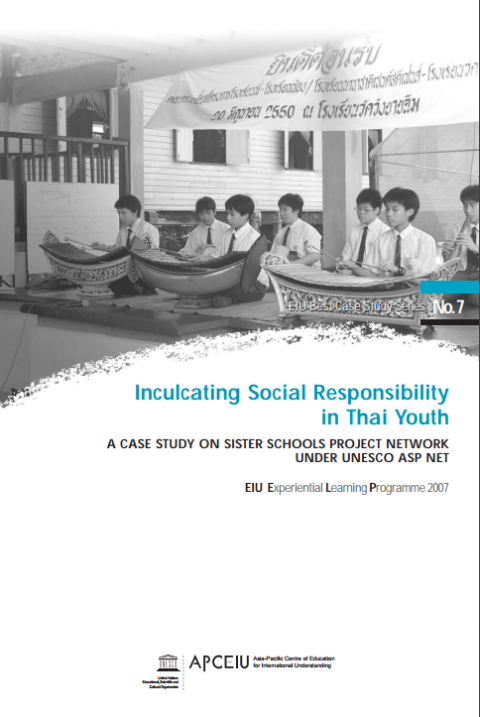 EIU Best Practices Series No. 7: Inculcating School Responsibility in Thai Youth: A Case Study on Sister Schools Project Network under UNESCO ASPNet 발행 연도: 2007 단체 저자: APCEIU This monograph is one of APCEIU's EIU Best Practices Series, which aims to encourage educators, scholars, and activists to implement and share local initiatives on EIU. The Series No.7 is a case study of two Thai schools within the Sister Schools Project Network, which is under the UNESCO ASP NET and UNESCO Club. As schools visited other schools in the network, students became involved in fundraising to support one another, thereby naturally acquiring invaluable team building skills, intercultural understanding, and social responsibility. This case shows that sister school network system can foster values of sharing, caring, and loving, despite socio-economic disparity among students.
  다문화가정대상국가와의 교육교류사업 후속활동 길라잡이 발행 연도: 2023 단체 저자: APCEIU The Asia-Pacific Teacher Exchange for Global Education(APTE) is a bilateral teacher exchange programme between the Republic of Korea and Asia-Pacific countries, hosted by the Ministry of Education of the Republic of Korea (MOE ROK) and implemented by the Asia-Pacific Centre of Education for International Understanding under the auspices of UNESCO (APCEIU), in collaboration with the Ministries of Education of the partner countries. Since 2012, the Office of International Teacher Exchange of APCEIU has been playing a pivotal role in implementing APTE. APCEIU prepared this book in the hope of spreading the fruits of teachers’ efforts and the seeds of peace in them, which were nurtured on the ground of APTE, to a broader world. <Contents>IntroductionI. Understanding follow-up activitiesII. Types of follow-up activities and model examples1. Types of follow-up activities2. Model examples of follow-up activities- [Real-Time Online Video Class] Starting online international education exchange- [Visiting / Invitational Program] An insight into international exchange programme- [Club-Oriented Inter-School Exchange] Follow-up exchange with invention club activity- [Inter-School Cooperative Agreement] Precious ties- [Participation In Various Support Programs] Heart of Korea, multicultural values: overcoming the limits of the classroomIII. Follow-up activity operation1. The nine-step preparation process for independent operation of educational exchange2. Procedures for independent operation of international exchangeIV. Annex1. Asia-Pacific Teacher Exchange for Global Education2. UNESCO APCEIU: Asia-Pacific Centre of Education for International Understanding under the auspices of UNESCO3. Reference programs for follow-up activities 다문화가정대상국가와의 교육교류사업 후속활동 길라잡이 발행 연도: 2023 단체 저자: 유네스코 아시아태평양 국제이해교육원 다문화가정대상국가와의 교육교류사업(APTE: Asia-Pacific Teacher Exchange for Global Education)은 대한민국 교육부가 주최하고 유네스코 아시아태평양 국제이해교육원이 주관하며, 교류 대상국 교육부가 현지 협력주체로서 함께하는 한국 아태지역 국가 양자 간 교육교류사업입니다. 아태교육원 국제교사교류실은 2012년부터 2022년 현재까지 10년간 APTE 사업 시행을 담당하고 있습니다. 지난 10년간 APTE 사업이라는 터전에서 선생님들께서 맺으신 열매와 그 속에 담긴 평화의 씨앗이 더 널리 퍼지길 기대하며 이 책자를 제작합니다. 목차:머리말I. 후속활동의 이해II. 후속활동 유형 및 우수 사례1. 후속활동 유형 소개2. 후속활동 우수 사례 - [온라인 실시간 화상수업 사례] 온라인 국제교육교류 시작하기 - [방문 및 초청 프로그램 운영 사례] 국제교류프로그램에 대한 고찰 - [동아리 중심 학교 간 교류 사례] 발명 동아리 활동과 함께한 후속교류사업 - [학교 간 협약 체결 사례] 소중한 인연들 - [각종 지원사업 참가 사례] 한마음, 다가치 교실의 경계를 넘다III. 후속활동 운영 방법1. 교육교류 자체 운영을 위한 9단계 준비 과정2. 국제교류 자체 운영의 절차IV. 붙임1. 다문화가정대상국가와의 교육교류사업 소개2. 유네스코아시아태평양국제이해교육원 소개3. 후속교류 시 참고 프로그램
 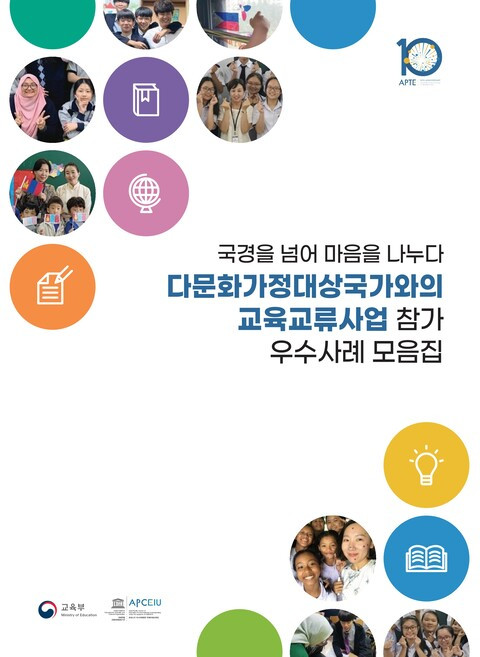 다문화가정대상국가와의 교육교류사업 참가 우수사례 모음집 발행 연도: 2023 단체 저자: APCEIU A carefully curated collection of best practices is presented as part of the 10th-anniversary celebrations of the Asia Pacific Teacher Exchange for Global Education (APTE). Over 30 teachers share their honest and vivid experiences, as well as outstanding follow-up activities. Each story aims to inspire teachers who are interested in the APTE Programme, and to serve as a valuable resource for future participants. 다문화가정대상국가와의 교육교류사업 참가 우수사례 모음집 발행 연도: 2023 단체 저자: 유네스코 아시아태평양 국제이해교육원 다문화가정 대상국가와의 교육교류사업의 10주년을 맞아 우수사례를 선별한 모음집을 선보인다. 국경을 넘어 마음을 나누는 교사들의 솔직하고 생생한 경험과 후속활동 사례가 수록되어 있다. 교사들의 생동감 있는 이야기가 향후 참가 교사들에게 긍정적인 영향과 소중한 자산이 되길 바란다.
  2022 SSAEM Conference: Final Report 발행 연도: 2023 단체 저자: APCEIU | Korea R. Ministry of Education The 2022 SSAEM (Sharing Stories of Asia-Pacific Education Movements) Conference is a space for examining and sharing the educational outcomes of the participating teachers and schools of the programme. This conference, which has been held annually since 2014, aims to provide an excellent opportunity for the participants and stakeholders to showcase the impact of the programme and to explore methods for strengthening cooperation for further development of the programme. The main programme included the panel discussion of the Ministry representatives of the 8 countries, the presentation of 2022 programme participants, etc. 2022 쌤 컨퍼런스: 결과보고서 발행 연도: 2023 단체 저자: 유네스코 아시아태평양 국제이해교육원 | Korea R. Ministry of Education 쌤 컨퍼런스(SSAEM Conference)는 「다문화가정 대상국가와의 교육교류사업」 종합 성과보고회로서, 교류국가 교육부 관계자를 비롯한 국내·외 사업 참가교사가 사업 참가 경험 및 활동을 소개하는 소통의 장이다. 현장과 온라인 동시에 진행되는 하이브리드 형식으로 개최된 2022 쌤 컨퍼런스에서는, 8개국 교육부 관계자의 사업 성과 공유 패널토론, 22년도 사업에 참가한 국내외 교사의 사례 발표 등이 진행되었다. 또한 2022 쌤 컨퍼런스를 통해 향후 사업에 대한 비전 수립 등이 이루어졌다.