
자료
세계시민교육에 대한 이해를 넓히고 연구, 옹호 활동, 교수, 학습 등을 향상시킬 수 있는 다양하고 유용한 자료를 찾아보세요.
35 건의 결과가 검색되었습니다
 Mainstreaming the General History of Africa into Education Systems: The Curriculum Pathway 발행 연도: 2025 단체 저자: UNESCO Education about the history of Africa in formal, non-formal and informal learning settings continues to be dominated by Eurocentric perspectives, which has led to imbalanced representation of Africa’s history and preconceptions.This publication is a tool to support countries in challenging the skewed perspectives on how African history is taught and how Africa is perceived. It aims to bring to the foreground Africa’s history, cultures and heritage through the curriculum to strengthen knowledge, skills, values and attitudes that contribute towards addressing long-standing hegemonic, colonial thinking and connected racial bias, while forging a united, prosperous and peaceful Africa and world.Stemming from the decolonial vision and content of the volumes of the General History of Africa, the publication proposes guiding principles and approaches for designing and implementing the General History of Africa into the curriculum. It puts forth curriculum outlines for basic and secondary education to offer renewed and broader perspectives on the history of Africa and its diasporas, and their contributions to humanity.The curriculum outlines are structured around nine thematic Learning Units, arranged chronologically from the origins of humanity and civilizations to Africa’s most recent history.
  Guide on Human Rights Education Curriculum Development 발행 연도: 2021 저자: Cecilia Decara | Carol Rask | Felisa Tibbitts 단체 저자: Danish Institute for Human Rights This document aims to bring conceptual clarity on human rights education and curriculum development and provide concrete suggestions on how to build human rights curricula ft for 21st century human rights challenges, while contributing to the realisation of the SDG goals and targets set by the international community.
  Curriculum in Transformation Mode: Rethinking Curriculum for the Transformation of Education and Education Systems 발행 연도: 2023 저자: Renato Opertti 단체 저자: UNESCO International Bureau of Education (IBE) Through these pages, Renato Opertti shares a series of reflections that invite us to revisit the curriculum as an opportunity and lever for societies to express their visions and aspirations. Curriculum can serve to position education as the pillar of a renewed social contract grounded on the welfare of all learners as persons and supporting societies and communities give effect to sustainable and better futures for the younger generations. To do so, we need to re-conceptualize curriculum at large: from a mere specification of frequently fragmented learning contents to its understanding as both a process and product of public policy developments in which diversity of stakeholders own and take responsibility for education as a global common good. Curriculum and pedagogy, by going hand-inhand, and supported by effective teaching, learning and assessment processes, can play a key role in fulfilling the right to education for every learner equally, according to their own individual needs. Key ideas in this book help us to rethink curriculum with future-oriented approaches, entailing a stronger involvement of younger generations in the decision-making process and a careful attention to vulnerability and disadvantaged groups. A curriculum that embraces individuality and diversity within collaborative and caring learning settings, nurtures freedom and autonomous thinking, connects meaningfully the global and the local, and assumes the hybridization of education. The book also delves into perspectives for educational transformation prioritizing the development of learners’ foundational and transformative competencies as the barometer of a progressive curriculum. Crucially, this entails rethinking the mindsets and practices of education systems in light of the interconnected challenges posed by the Fourth Industrial Revolution, post COVID-19, generative AI and the sustainability of the planet and the world.
  The Impact of AI on Curriculum Systems: Towards an Orbit-Shifting Dialogue (In-Progress Reflection; no. 32, 2019) 발행 연도: 2019 단체 저자: UNESCO International Bureau of Education (IBE) ‘Artificial Intelligence’ (AI) refers to the theory and development of computer systems able to perform tasks normally requiring human intelligence. In order to achieve transformational change in contemporary curriculum systems and learning environments, we need to engender an orbitshifting dialogue about the potential relationship between AI and education, in terms of both independent variables (threats), and dependent variables (opportunities). Through such a dialogue, we need to create foresight indicators that can predict the process of this relationship. It is, however, crucial that the relationship between AI and education is strong and directly proportionate. If the potential of the relationship is not exploited sufficiently, then underdeveloped education systems will lag behind and fail to achieve their potential for transformation, whether radical or incremental. Indeed, some may even become obsolete. The paper contends that in order to effectively contribute to the knowledge economy and to sustainable development in the age of the 4th Industrial Revolution (characterized by a fusion of cyber-physical technologies) modern educational systems need to overcome obstacles to innovation in order to maximize the potential for transformative change. To achieve this will require an ‘orbital shift’ in educational planning, practice and resourcing, to enable schools to respond more effectively to the rapidly changing needs of young people, society, the economy and environment in the third decade of the 21st century. Schools, educational institutions and environments, need to transform from being primarily spaces for teaching and taking exams, into spaces for innovation and personal learning, based on a culture of actively listening to the voices, choices, needs and goals of learners. Teachers need to become facilitators, coaches and mentors for learners. Schools need to create AI-enabled, flexible, collaborative working spaces. Visionary, energetic educational leaders need to communicate effectively with all stakeholders, including employers and parents, to inspire and manage change and smart decision-making to develop schools of the future. The aim of this reflection is to initiate an ‘orbit-shifting’ dialogue about the potential of AI applications to transform all components of the curriculum system to meet emergent 21st century educational goals. The conceptualization aims to explore the variable roles and impact of curriculum learning and assessment on these emerging educational goals. Theme 1 of the paper outlines the concepts and characteristics of a range of existing AI systems and their potential to enhance teaching learning and assessment. Theme 2 reflects on the potential to embrace AI systems across the curriculum system. Theme 3 proposes an action model to enable AI to have an ‘orbit shifting impact’ on all the components of the curriculum system (i.e. learners, teachers, learning environments, leadership and management, content, pedagogy and assessment) by enhancing opportunities for individualization, creativity and uniqueness.
  Strengthening Social and Emotional Learning in Hybrid Modes of Education: Building Support for Students, Teachers, Schools and Families; A UNESCO-IBE Discussion Paper 발행 연도: 2024 단체 저자: UNESCO International Bureau of Education (IBE) The COVID-19 pandemic intensified existing educational disparities globally, prompting a reevaluation of school curricula to include Social and Emotional Learning (SEL). This shift recognized the holistic needs of learners, teachers, and families, emphasizing competencies beyond traditional knowledge acquisition. Despite SEL's increasing global recognition, it is often absent from formal curricula, prompting the UNESCO-IBE to address this gap. This Discussion Paper explores the crucial role of SEL in the broader transformation of global education, particularly in the post-COVID-19 era. It highlights six key topics, presenting diverse experiences in integrating SEL into education. Experts from various fields contribute insights, focusing on socio-emotional and hybrid learning advancements worldwide. The report aims to inspire global change-makers, advocating for robust policies aligned with UNESCO's Futures of Education framework. This call to action aligns with the UNESCO-IBE's HELA initiative, promoting flexible hybrid learning models for crisis response and sustainable educational strategies in line with the UN Transforming Education Summit's vision.
  Confronting the Causes and Repercussions of Climate Change: What Role for the Moroccan School and Educational Action? 발행 연도: 2016 저자: Abdulaziz Faras 단체 저자: Mohammed V University. Faculty of Education An article discussing the role that the public school and environmental education should play in tackling climate change. The study indicates the importance of the number of model programs for environmental education. The article also deals with the role imposed by the Moroccan school in confronting the causes and repercussions of climate change. مواجهة أسباب وتداعيات التغيرات المناخية: أي دور للمدرسة المغربية وللفعل التربوي؟ 발행 연도: 2016 저자: Abdulaziz Faras 단체 저자: Mohammed V University. Faculty of Education مقال يناقش الدور الذي يجب أن تساهم به المدرسة عامة والتربية البيئية في مواجهة تغير المناخ. تشير الدراسة لأهمية أعداد البرامج النموذجية للتربية البيئية. والمقال أيضا يتعرض للدور المفروض القيام به من قبل المدرسة المغربية في مواجهة أسباب وتداعيات التغير المناخي.
 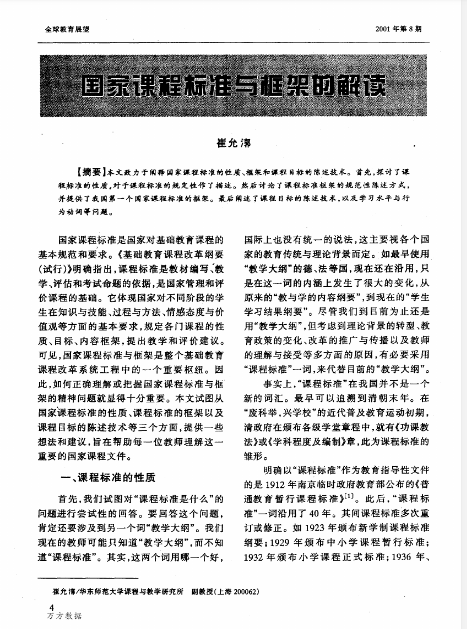 Research on National Curriculum Standards and Framework 발행 연도: 2001 저자: Cui Yunkuo This article is devoted to explaining the nature and framework of the national curriculum standards and the presentation techniques of the curriculum objectives. First, this article discusses the nature of the curriculum standard, describing the prescriptiveness of the curriculum standards, and then discussed the normative presentation of the curriculum standard framework. It also provides the framework of the first national curriculum standards in China and finally explains the presentation techniques of the course objectives, as well as the level of learning and behavioral verbs. 国家课程标准与框架的解读 발행 연도: 2001 저자: Cui Yunkuo 本文致力于阐释国家课程标准的性质、框架和课程目标的陈述技术。首先,探讨了课程标准的性质,对于课程标准的规定性作了描述。然后讨论了课程标准框架的规范性陈述方式,并提供了我国第一个国家课程标准的框架。最后阐述了课程目标的陈述技术,以及学习水平与行为动词等问题。
  Ten Clues for Rethinking Curriculum (In-Progress Reflection; No. 42, 2021) 발행 연도: 2021 저자: Renato Opertti 단체 저자: UNESCO International Bureau of Education (IBE) This discussion document highlights the urgency of rethinking curriculum in light of reinforcing the commitments of the Education 2030 Agenda on learning, disruptive systemic worldwide societal changes, and crucially, the profound transformation of education and education systems post Covid-19. Curriculum is always at the core of giving effect to social aspirations and ideals on the why, what, how, when, and where of teaching, learning, and assessing. We propose a series of 10 interconnected clues to deepen on the systemic and holistic understanding of curriculum as contributing to lay foundations for a better, sustainable and fair future. These clues are: understanding the new generations; combatting factors related to vulnerability; reinforcing understanding between school and families; deepening glo-local education; enhancing the focus on the person; promoting synergies among values; valuing diversity; focusing on education that enhances freedom; moving toward hybrid modes of education; and inspiring affection for educators.