
자료
세계시민교육에 대한 이해를 넓히고 연구, 옹호 활동, 교수, 학습 등을 향상시킬 수 있는 다양하고 유용한 자료를 찾아보세요.
16 건의 결과가 검색되었습니다
 Asia-Pacific Education 2030: SDG 4 Midterm Review 발행 연도: 2024 단체 저자: UNESCO Institute for Statistics (UIS) | UNESCO Bangkok This publication marks the conclusion of the collaborative national midterm reviews of SDG 4 achievement in the Asia-Pacific. More importantly, it represents the beginning of the final sprint to the 2030 finish line. It also serves as a comprehensive analytical and policymaking tool for all stakeholders in the region to reflect and be better prepared for the second half of the journey. At the midway point of implementing the Education 2030 Agenda, we are observing both challenges and progress in achieving Sustainable Development Goal 4 (SDG 4) in the Asia-Pacific. The region, overall, has made advances in reaching the globally and regionally most important targets under SDG 4, yet it is still far from delivering the common commitment of the Education 2030 Agenda, to ‘ensure inclusive and equitable quality education and promote lifelong learning opportunities for all’. Eight years into implementation, the Asia-Pacific has shown progress, especially in improving access to lower levels of basic education, as well as expanding early childhood education (ECE). Across most subregions of Asia and the Pacific, over 95% of primary school students complete primary education within the expected timeframe, while more than 80% of children one year before the official primary entry age are enrolled in organized early childhood education. However, participation in education is only one part of the puzzle, and the quality of learning, evidenced by limited data for the Asia-Pacific region on learning outcomes, remains concerning. More than half of students in Eastern and South-Eastern Asia do not reach the minimum proficiency level in mathematics at the end of lower secondary education. Overall and from a regional perspective, with priorities having accelerated in ECE, primary education reaching universal participation, and higher education being consistently regarded as prestigious to accomplish, secondary education is currently the weakest link apart from the chronically undervalued technical vocational education and training path. Fulfilling our commitment to the Education 2030 Agenda and leaving no one behind is not an easy endeavour and we need everyone on board in this unprecedented, yet necessary feat. This publication is meant to facilitate taking stock of the current situation and accelerate focused advances on the most relevant education topics for the Asia-Pacific region.
  Continental Overview: Bridging CESA and SDG 4 in Africa; Africa Regional Report 발행 연도: 2021 단체 저자: UNESCO Institute for Statistics (UIS) Monitoring progress toward Sustainable Development Goal 4 for education (SDG 4) is crucial to ensuring that children around the world have access to a quality education where they can learn and gain the skills they need to meet their full potential. SDG 4 indicators are organized with a view to global, thematic, regional and national targets.This report by the UNESCO Institute for Statistics (UIS) is the first in a series intended to bring a regional focus to SDG 4 monitoring, highlight the work being done in the regions and compare SDG 4 targets with those established by regional bodies.This new series of regional reports serve two purposes. Firstly, to map regional and SDG 4 targets to provide an overview of the symmetries between the two. Continental Overview: Bridging CESA and SDG 4 in Africa looks at how the strategic objectives of the Continental Education Strategy for Africa (CESA) compares with SDG 4 targets. Secondly, it analyses progress towards these objectives by African sub-regions.
  Asia and the Pacific SDG Progress Report 2025: Engaging Communities to Close the Evidence Gap 발행 연도: 2025 단체 저자: UN. Economic and Social Commission for Asia and the Pacific (UN. ESCAP) The SDG progress report 2025 presents the latest data and insights on progress toward the Sustainable Development Goals (SDGs) in the Asia-Pacific region. While celebrating regional achievements, it also highlights persistent challenges—such as climate change, natural disasters, and critical data gaps—that risk leaving marginalized communities behind. By showcasing innovative community-level partnerships, the report explores how local efforts can help bridge the evidence gap, ensuring that progress toward the SDGs is inclusive and leaves no one behind.
  World Education Statistics 2024 발행 연도: 2024 단체 저자: UNESCO Institute for Statistics (UIS) The report summarizes the education data published by UIS and serves as a fundamental resource and essential guide for policy-makers, researchers and analysts, as well as anyone interested in education data and statistics. Statistics are presented in 11 thematic chapters, covering primary and secondary education; early childhood; technical, vocational and tertiary education; skills for work; parity; literacy and numeracy; sustainable development and global citizenship; learning environment; scholarships; teachers; and financing education.
 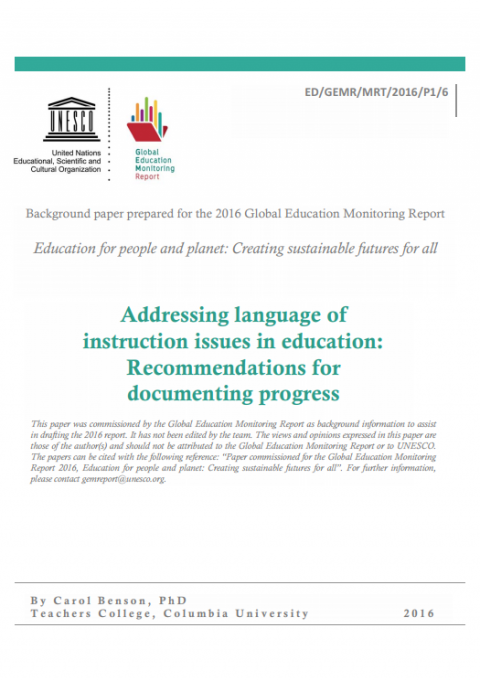 Addressing language of instruction issues in education: recommendations for documenting progress 발행 연도: 2016 저자: Carol Benson 단체 저자: Columbia University (USA). Teachers College This paper offers evidence-based recommendations for documenting international progress towards addressing language issues in education. The focus is on adapting the school language(s) of instruction to the home language(s) of learners. The paper begins by defining terms like L1 and explaining the concepts underlying multilingual education (MLE). Next there is a discussion of how to capture relevant linguistic and educational information from policy documents and linguistic sources, with examples from lowincome countries. This is followed by a set of questions that can and should be asked of any program to evaluate progress in addressing instructional language issues, focusing on the approach/methodology, teacher languages and skills, learner assessment, and program management, monitoring and evaluation. The paper concludes with some possible global indicators and suggestions for further research.
 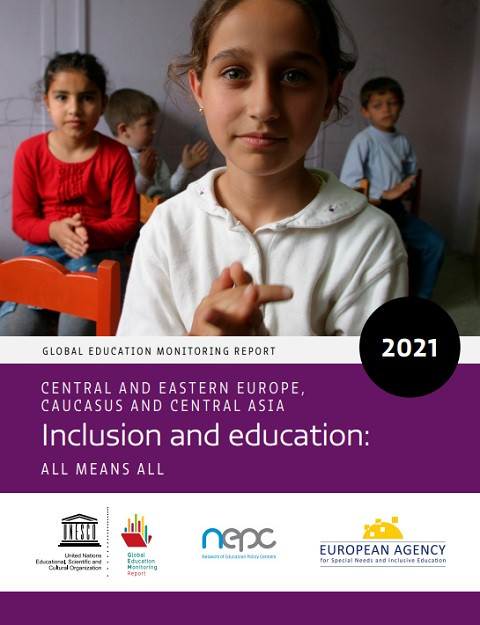 Global Education Monitoring Report, 2021, Central and Eastern Europe, Caucasus and Central Asia: Inclusion and Education; All Means All 발행 연도: 2021 단체 저자: Global Education Monitoring Report Team | European Agency for Special Needs and Inclusive Education | Network of Education Policy Centers Prepared by the Global Education Monitoring (GEM) Report, in partnership with the European Agency for Special Needs and Inclusive Education and the Network of Education Policy Centers, the regional report on inclusion and education in Central and Eastern Europe, the Caucasus and Central Asia offers a deep dive into the core challenges and key solutions. The region is working hard to overcome a legacy, whereby children with disabilities attended special schools, once wrongly regarded as an effective solution, segregated by type of disability, if not fully excluded from education.The report draws on in-depth profiles of 30 education systems in the region. It also presents the additional risks to inclusion now posed by the COVID-19 pandemic. Building on the 2020 Global Education Monitoring Report, it documents barriers facing learners, particularly where multiple disadvantages intersect. Its recommendations provide a systematic framework for identifying and dismantling these barriers, according to the principle that ‘every learner matters and matters equally’. Всемирный доклад по мониторингу образования 2021 г. : для всех означает для всех инклюзивность и образование; центральная и восточная европа,кавказ и средняя азия 발행 연도: 2021 단체 저자: Global Education Monitoring Report Team | European Agency for Special Needs and Inclusive Education | Network of Education Policy Centers В этом докладе описана огромная и географически разнородная территория, которую объединили в один регион схожие образовательные системыи подходы, сформированные во второй половине 20 века в рамках государственного социализма. Образование было доступно, гендерное неравенство и неравенство, связанное с местом проживания, было искоренено. Но образовательные системы подвергали дискриминации детей с особыми потребностями, которые посещали специальные школы. Это решение ошибочно считалось эффективным: ученики разделялись по типу инвалидности, а некоторые из них полностью исключались из системы образования.Начиная с 1989 года, регион старается преодолеть это тяжелое наследие и перейти к инклюзивному образованию, основанному на правах человека, подходу, который часто поддерживается международными организациями. В законодательство и образовательную политику было включено более широкое понимание инклюзии. Педагогическое образование и программы повышения квалификации учителей были пересмотрены и реструктурированы. Тем не менее, прогресс неравномерен. Многие изменения произошли на бумаге, в то время как глубинные убеждения и реальная практика практически не изменились. В то же время образовательные системы пытаются преодолеть негативные последствия политического и экономического кризисов, которые углубили неравенство и усилили социальную напряженность. Такие факторы как гендер, удаленное место проживания, бедность, этническая принадлежность, язык, миграция, принадлежность к числу перемещенных лиц, тюремное заключение, сексуальная ориентация, гендерная идентичность и религиозные и другие убеждения связаны с неравенством образовательных возможностей.Составленный группой по подготовке Всемирного доклада по мониторингу образования, в партнерстве с Европейским агентством по специальным потребностям и инклюзивному образованию и Сетью центров образовательной политики, этот доклад содержит подробные описания 30 образовательных систем региона. В докладе также представлены дополнительные риски для инклюзии, возникшие в результате пандемии COVID-19. Основываясь на Всемирном докладе ЮНЕСКО по мониторингу образования, этот документ фиксирует барьеры, с которыми сталкиваются учащиеся. Рекомендации, данные в докладе, предлагают систему для выявления и устранения этих барьеров, в основе которой лежит принцип «каждый ученик важен и важен одинаково».
  Pandemic-Related Disruptions to Schooling and Impacts on Learning Proficiency Indicators: A Focus on the Early Grades 발행 연도: 2021 저자: Martin Gustafsson 단체 저자: UNESCO Institute for Statistics (UIS) This report focusses on the impacts of the pandemic on learning proficiency, specifically as measured by Sustainable Development Goal (SDG) Indicator 4.1.1. Over the last couple of decades, there has been a growing awareness of how crucial learning proficiency, especially that of younger children, is for human development. The evidence is clear that improvements in proficiency underpin future economic development, and the building of more cohesive and equal societies. The indicators on learning proficiency are among the most discussed indicators within the SDG framework. This report explains the impact of COVID-19 on learning losses for primary-aged children and the need for an effective response.
  Education 2030: Incheon declaration and framework for action towards inclusive and equitable quality education and lifelong learning for all 발행 연도: 2015 단체 저자: UNESCO | United Nations Development Programme (UNDP) | United Nations Population Fund (UNFPA) | UN. Office of the United Nations High Commissioner for Refugees (UNHCR) | United Nations Children's Fund (UNICEF) | United Nations Entity for Gender Equality and the Empowerment of Women (UN Women) | World Bank This framework — painstakingly drafted over many months with input from governments, international agencies, civil society and experts — provides guidance for implementing the education commitments made in the 2030 Agenda for Sustainable Development at a national, regional and global level. In particular: it aims at mobilizing all countries and partners around Sustainable Education Goal 4 and its targets;it proposes ways of implementing, coordinating, financing and monitoring the new commitments; andit proposes indicative strategies which countries may wish to draw upon in developing their plans, taking into account different national realities, capacities and levels of development and respecting national policies and priorities. 교육 2030 인천선언과 실행계획: 포용적이고 공평한 양질의 교육과 모두를 위한 평생학습을 향해 발행 연도: 2015 단체 저자: 유네스코 | United Nations Development Programme (UNDP) | United Nations Population Fund (UNFPA) | UN. Office of the United Nations High Commissioner for Refugees (UNHCR) | United Nations Children's Fund (UNICEF) | United Nations Entity for Gender Equality and the Empowerment of Women (UN Women) | World Bank 정부, 국제기구, 시민사회와 전문가의 조언을 받아 몇 달 동안 많은 노력을 기울여 초안이 작성된 이 실행계획은 지속가능한 발전을 위한 2030 아젠다의 국가적, 지역적, 세계적 단계에서의 실현을 위한 교육의 역할에 대한 실천 가이드를 제공한다. 이는 모든 국가와 지속가능목표 4와 그 대상을 둘러싼 파트너들을 움직이도록 하는 데에 그 목적을 둔다.이 실행계획은 새로운 역할에 대한 실천, 협력, 자금조달과 관찰 방안을 제안한다.이 실행계획은 각 국가들이 서로 다른 국가적 상황과 역량, 발전 단계 및 각국의 정책과 우선순위를 존중한 계획을 세울 수 있도록 전략을 보여준다.