
자료
세계시민교육에 대한 이해를 넓히고 연구, 옹호 활동, 교수, 학습 등을 향상시킬 수 있는 다양하고 유용한 자료를 찾아보세요.
19 건의 결과가 검색되었습니다
 ‘Hate Speech’ Explained: A Toolkit 발행 연도: 2015 단체 저자: ARTICLE 19 In this toolkit, ARTICLE 19 provides a guide to identifying ’hate speech‘ and how effectively counter it, while protecting the rights to freedom of expression and equality. It responds to a growing demand for clear guidance on identifying “hate speech,” and for responding to the challenges ‘hate speech’ poses within a human rights framework.The toolkit is guided by the principle that coordinated and focused action taken to promote the rights to freedom of expression and equality is essential for fostering a tolerant, pluralistic and diverse democratic society in which all human rights can be realised for all people.As such, it addresses three key questions: How do we identify ‘hate speech’ that can be restricted, and distinguish it from protected speech?What positive measures can States and others take to counter ‘hate speech’? Which types of ‘hate speech’ should be prohibited by States, and under which circumstances? The toolkit is guided by the principle that coordinated and focused action taken to promote the rights to freedom of expression and equality is essential for fostering a tolerant, pluralistic and diverse democratic society in which all human rights can be realised for all people. It is informed by, and builds upon, ARTICLE 19’s existing policy work in this field.In Part I, we outline that there is no uniform definition of ‘hate speech’ under international human rights law, rather, it is a broad concept which captures a wide range of expression. The toolkit advances a typology for identifying and distinguishing different forms of ‘hate speech’ according to their severity, guided by states’ international human rights law obligations. In Part II, we provide guidance on what policy measures State and non-state actors can undertake to create an enabling environment for freedom of expression and equality that addresses the underlying causes of ‘hate speech’ while maximising opportunities to counter it.Finally, in Part III, we outline the exceptional circumstances in which the State is obliged by international law to prohibit the most severe forms of ‘hate speech’, and where also States may under international law place other restrictions on ‘hate speech’. This includes guidance on ensuring that such prohibitions are not abused, and to ensure that where sanctions are imposed they are appropriate and proportionate, as well as ensuring support and redress for victims.ARTICLE 19 believes that ensuring that responses to ‘hate speech’ comply with international human rights law is crucial. Prohibitions that censor offensive viewpoints are often counter-productive to the aim of promoting equality, as they fail to address the underlying social roots of the kinds of prejudice that drive ‘hate speech’. In most instances, equality is better-promoted through positive measures which increase understanding and tolerance, rather than through censorship.This toolkit is not a definitive version, and will be continuously updated to reflect the developing case law and best practices in this area.
  Regulatory Authorities for Electronic Media and Media Literacy: Comparative Analysis of the Best European Practices 발행 연도: 2018 저자: Robert Tomljenović 단체 저자: Council of Europe Information event for stakeholders of the media community in Serbia on presentation of the Study “Regulatory Authorities for Electronic Media and Media Literacy - Comparative analysis of the best European practices” was organized by the Council of Europe Office in Belgrade, JUFREX Programme and the Embassy of Finland in Serbia, on 20 December 2018, in order to jointly point out the importance of the development of media literacy in Serbia and the Western Balkans region.The study analyzes and indicates challenges and issues that come with living in a digitalized, hypertechnological mediated world, in which we are faced with countless information, issues of disinformation and fake news, algorithmic separation in ideological echo chambers, hate speech, clickbait journalism, and decreased trust in both mainstream media and the level of journalistic professionalism. With such a media ecosystem, it is vital to define the position of a regulatory authority for electronic media as well as its responsibilities and obligations, and stress the regulator's role in promoting and developing media literacy, one of the key skills for living in the 21st century and the answer to many questions and challenges that come with the modern era."The Council of Europe considers media literacy one of the main tools for strengthening media pluralism and the quality of media content. All media actors in Serbia have the responsibility to promote media literacy to enable understanding and critical analysis of content offered by traditional and digital media. Especially children have the right to a safe and stimulating media environment" said Head of the Council of Europe Office in Belgrade, Tobias Flesenkemper.The study emphasizes that a prerequisite for every democratic process is a well-informed citizen. The Study presents several examples of best European practices and how to engage regulatory bodies and all other relevant actors to increase media literacy, with a particular focus on the Finnish model in this area. Media education is implemented in Finland wherever there are children and youth, not only in kindergartens and schools, but also in libraries, playrooms, youth centers, even in virtual communities and digital games.As pointed out by the Ambassador of Finland in Belgrade, Perti Ikonen, the high level of media literacy of citizens is what the media in Finland forces to adhere to high professional standards, and basically the work of the institutions responsible for the promotion of media literacy. Finland took over the chairmanship of the Committee of Ministers of the Council of Europe in November this year, and during its term of office, until May 2019, the priorities of the Finnish Presidency will be to strengthen the human rights and rule of law system in Europe, support equality as well as inclusiveness with a particular focus on youth and the prevention of radicalization.The study was developed within the framework of the Joint European Union and the Council of Europe Programme "Strengthening the Judicial Expertise on Freedom of Expression and Media in South-East Europe (JUFREX)".
  Artificial Intelligence: Media and Information Literacy, Human Rights and Freedom of Expression 발행 연도: 2020 저자: Igor Shnurenko | Tatiana Murovana | Ibrahim Kushchu 단체 저자: UNESCO Institute for Information Technologies in Education (IITE) | TheNextMinds The collection of papers “Artificial Intelligence: Media and Information Literacy, Human Rights and Freedom of Expression” continues the UNESCO IITE’s series of publications entitled “Digital Transformation of Education”.The publication describes the fundamentals of artificial intelligence and AI-based technologies, their impact on the modern information and media environment, new challenges in the field of media and information literacy associated with the growing automation of the processes of creating, disseminating and accessing information, the use of AI in decision-making and control systems in various areas. There is a strong focus on the growing risks of reducing individual agency, people’s ability to interpret reality autonomously and to act according to their own agenda.These issues are more relevant now than ever before for education undergoing digital transformation. The publication seeks to contribute to a critical understanding of the digital environment in which learning and teaching unfold, and strategies and tactics for the use of new technologies and the digitalization of educational interactions.
  Learning About Human Rights in the Primary School 발행 연도: 2013 단체 저자: Amnesty International UK This booklet provides a sample of our human rights education resources produced for primary schools. It helps provide pupils with an understanding of their own human rights and the values and attitudes that underpin them. It will help to foster attitudes of respect and an appreciation of the uniqueness of each individual. Pupils will also develop skills to enable them to take action to defend human rights.You will find a set of 10 interactive lessons for children – five for age 5+ (England and Northern Ireland: Key Stage 1; Wales: Foundation Phase; Scotland: Early and First Level) and five for age 7-11 (England, Nothern Ireland and Wales: Key Stage 2; Scotland: Second Level). Please photocopy and adapt these exercises for your own classroom use.All the activities are designed to encourage pupils to take a basic starting point, often based on something close to home or an event or situation they’ve experienced or can relate to, and then develop it. Pupils are then invited to expand their understanding beyond themselves and to begin to think outwards and towards others, whether locally, nationally or globally.The final activity, Taking action for human rights, explains how schools can sign up to the Junior Urgent Action Network. It’s an opportunity for children to become more actively involved with Amnesty International’s human rights work through our letter-writing campaign. In addition, you can download free resources on a range of human rights issues and order free posters for your school from www.amnesty.org.uk/resources-schools.
  Guidelines for the governance of digital platforms: safeguarding freedom of expression and access to information through a multi-stakeholder approach 발행 연도: 2023 단체 저자: UNESCO Guidelines for an Internet for TrustSafeguarding freedom of expression and the right to information while dealing with dis- and misinformation, hate speech, and conspiracy theories requires a multistakeholder approach. This is the reason why UNESCO, the leading UN agency for the promotion and protection of freedom of expression and to information, is launching Guidelines for the Governance of Digital Platforms. The Guidelines outline a set of duties, responsibilities and roles for States, digital platforms, intergovernmental organizations, civil society, media, academia, the technical community and other stakeholders to enable the environment where freedom of expression and information are in the core of digital platforms governance processes. The Guidelines were produced through a multi-stakeholder consultation that gathered more than 10,000 comments from 134 countries. These global-scale consultations fostered inclusive participation, ensuring a diversity of voices to be heard, including those from groups in situation of marginalization and vulnerability. Cultivating an Internet of Trust is a shared responsibility among all stakeholders. It calls upon us all to sustain an enabling environment for freedom of expression and the right to information.
 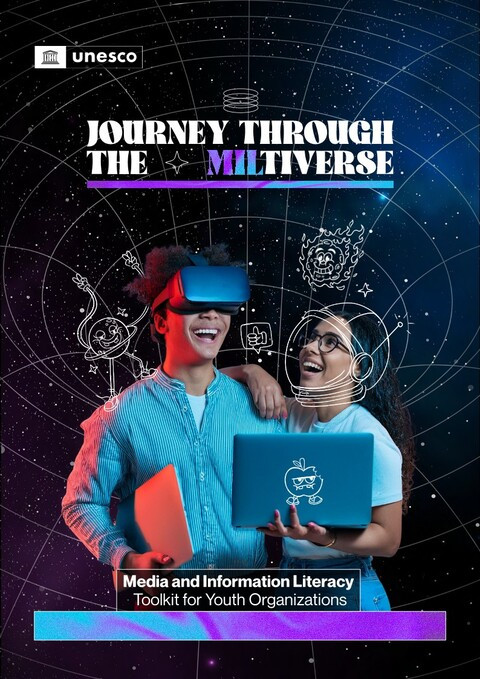 Journey through the MILtiverse: Media and Information Literacy Toolkit for Youth Organizations 발행 연도: 2024 저자: Sandra Acero Pulgarin | Natalia González-Gil | Alejandro Santamaría Virviescas 단체 저자: UNESCO Empowering Youth Organizations with and for Media and Information LiteracyIn an era where digital interactions dominate, young people must be equipped with more than just basic digital literacy skills. Media and Information Literacy (MIL) has become an essential competency, enabling them to critically navigate the overwhelming ow of information in our fast-paced and complex information ecosystem. \With the Internet user base getting younger every day — data shows that one in three internet users is a child — countries worldwide are increasingly working on integrating MIL into their education systems. Despite these advancements, many young people still grapple with challenges such as disinformation, hate speech, and other harmful online content. Additionally, new technologies continue to emerge, creating challenges with unknown impacts. For example, 80% of young people aged 10 to 24 use AI multiple times a day for education, entertainment, and other purposes. Global youth organizations are at the forefront of UNESCO’s eorts to promote MIL among young people through informal education. This toolkit serves as a primary resource to help these organizations incorporate MIL into their strategies, policies, and operations, aiming to make MIL a lasting component of their practices and peer-to-peer educational programs. Join us on this journey through the MILtiverse and empower the next generation by making MIL a fundamental life competence for their futures.
  Addressing Hate Speech Through Education: A Guide for Policy-Makers 발행 연도: 2023 단체 저자: UNESCO | UN. Office on Genocide Prevention and the Responsibility to Protect Hate speech is spreading faster and further than ever before as a result of social media user growth and the rise of populism. Both online and offline, hate speech targets people and groups based on who they are. It has the potential to ignite and fuel violence, spawn violent extremist ideologies, including atrocity crimes and genocide. It discriminates and infringes on individual and collective human rights, and undermines social cohesion. Education can play a central role in countering hateful narratives and the emergence of group-targeted violence. Educational responses to hate speech and all forms of hateful communication include:• Training teachers and learners on the values and practices related to being respectful global and digital citizens;• Adopting pedagogical and whole-school approaches to strengthening social and emotional learning;• Revising and reviewing curricula and educational materials to make them culturally responsive and to include content that identifies hate speech and promotes the right to freedom of expression;This policy guide developed by UNESCO and the United Nations’ Office on Genocide Prevention and the Responsibility to Protect explores these educational responses and provides guidance and recommendations to policy-makers on how to strengthen education systems to counter hate speech.
  Combatir el discurso de odio a través de la educación: una guía para los responsables de la formulación de políticas 발행 연도: 2024 단체 저자: UNESCO | UN. Office on Genocide Prevention and the Responsibility to Protect Como producto de las redes sociales y del aumento del populismo, el discurso de odio se está difundiendo más rápido y con mayor alcance que nunca. Ya sea en línea o no, se dirige a las personas sobre la base de quiénes son y tiene el potencial de incitar a la violencia, así como engendrar ideologías extremistas y violentas, crímenes atroces e incluso el genocidio. Además, discrimina, infringe derechos humanos individuales y colectivos y socava la cohesión social.La educación puede cumplir un papel fundamental en la lucha contra los discursos de odio y el surgimiento de la violencia dirigida a grupos específicos. Las respuestas educativas al discurso de odio y a todas las formas de comunicación relacionadas incluyen:• La capacitación de docentes y estudiantes sobre los valores y las prácticas que necesitan para ser ciudadanos y ciudadanas respetuosos a nivel global y en el ámbito digital;• La adopción de pedagogías y enfoques escolares integrales para el fortalecimiento del aprendizaje social y emocional;• La adopción y revisión del currículo y de los materiales educativos para que sean culturalmente sensibles e incluyan contenido que identifique la presencia del discurso de odio y promueva el derecho a la libertad de expresión.Esta guía para la formulación de políticas, elaborada por la Oficina de las Naciones Unidas para la Prevención del Genocidio y la Responsabilidad de Proteger (OSAPG) y la UNESCO, analiza en detalle estas y otras respuestas educativas con la intención de brindar a las y los formuladores de políticas las orientaciones y recomendaciones sobre cómo fortalecer los sistemas educativos para combatir el discurso de odio.
  Lutter contre les discours de haine par l’éducation 발행 연도: 2025 단체 저자: UNESCO | United Nations Office on Genocide Prevention and the Responsibility to Protect Lutter contre les discours de haine par l’éducationLes discours de haine se propagent plus vite et plus loin que jamais du fait de l’augmentation du nombre d’utilisateurs des médias sociaux et de la montée du populisme. En ligne comme hors ligne, les discours de haine ciblent des personnes et des groupes sur la base de ce qu’ils sont. Ces discours sont susceptibles d'inciter et d’attiser la violence et d’engendrer des idéologies extrémistes violentes, pouvant mener à des atrocités criminelles et des génocides. Ils sont discriminatoires, portent atteinte aux droits humains individuels et collectifs et menacent la cohésion sociale.L’éducation peut jouer un rôle essentiel dans la lutte contre les discours de haine et l’émergence de violences visant des groupes particuliers. Les réponses éducatives aux discours de haine et à toutes les formes de communication haineuse comprennent :• la formation des enseignants et des apprenants aux valeurs et aux pratiques permettant d’être des citoyens du monde et des citoyens numériques respectueux ;• l'adoption d'approches scolaires globales et pédagogiques pour renforcer l’apprentissage social et émotionnel ;• l'examen et la révision des programmes scolaires et des supports pédagogiques pour les rendre culturellement adaptés et inclure des contenus qui permettent d'identifier les discours de haine et promeuvent le droit à la liberté d’expression.Ce guide stratégique, élaboré par l’UNESCO et le Bureau de la prévention du génocide et de la responsabilité de protéger des Nations Unies, analyse ces réponses éducatives et fournit des conseils et des recommandations aux décideurs politiques sur la manière de renforcer les systèmes éducatifs pour lutter contre les discours de haine.
  Freedom of Expression Toolkit: A Guide for Students 발행 연도: 2013 단체 저자: UNESCO Everyone should have all the necessary tools and mechanism to allow the free flow of information. Much has been written about freedom of expression, indeed it is one of the most debated concepts and issues of our times. However, few such publications are written with youth as the main target readers, especially for young women and men still in high schools and pre-university level. This Toolkit is one such tool targeted at high schools and pre-university students. Young women and men must be empowered and literate in the issues and concepts of freedom of expression in order to become a discerning citizen in a democracy.