
자료
세계시민교육에 대한 이해를 넓히고 연구, 옹호 활동, 교수, 학습 등을 향상시킬 수 있는 다양하고 유용한 자료를 찾아보세요.
54 건의 결과가 검색되었습니다
 Report on Roundtable for Advocating Global Citizenship Education and Climate Change Education 발행 연도: 2023 단체 저자: APCEIU This report shares the overview of the Roundtable for Advocating Global Citizenship Education and Climate Change Education, held on Saturday, 11 November 2023. The event was co-organized by the Permanent Delegation of the Republic of Korea to UNESCO, Office for Climate Education, Asia-Pacific Centre of Education for International Understanding (APCEIU) in partnership with the Group of Friends for Solidarity and Inclusion with GCED (Afghanistan, Armenia, Austria, Bangladesh, Canada, Colombia, Italy, Jordan, Kenya, Kuwait, Philippines, Republic of Korea, Saudi Arabia, Senegal, Serbia, Nigeria and Oman), in support of the Korean National Commission for UNESCO and the French National Commission for UNESCO. This report shares the summary of the event, particularly the presentations on GCED activities and Climate Change Education by experts from Uganda, the Republic of Korea, and France to promote the values and initiatives of GCED and CCE.
  Second Annual Meeting of the Global Citizenship Education Actors’ Platform: Meeting Report 발행 연도: 2020 단체 저자: APCEIU This meeting report provides readers with an overview of the sharing and discussion points during the “Second Annual Meeting of the GCED Actors’ Platform” held on 19 November 2020 virtually. The meeting was attended by regional coordinators and key representatives from the five Regional GCED Network (Arab States, Asia-Pacific, Europa and North America, Latin America and the Caribbean and Sub-Saharan Africa) and a representative from the GCED Youth Network. The meeting provided a space for discussion on the current implementation of GCED in each region, with focus on research, and suggestions on how to further strengthen the GCED promotion and collaboration across different regions amid the pandemic.
  Feasibility Study on Monitoring Global Citizenship Competences in the Asia-Pacific Region (Phase I) 발행 연도: 2020 저자: Aaron Benavot 단체 저자: APCEIU In accordance with SDG 4.7, countries are promoting GCED and other aspects of Target 4.7. It is necessary to measure learner levels and progress in global citizenship competencies to assess the extent to which learners are acquiring knowledge, attitudes, and skills related to global citizenship.This report is organized into three substantive sections. Section II discusses existing definitions and conceptualization of GCED and GCC drawing on different sources. Section III describes which Asia-Pacific countries are included in this feasibility study and how relevant policy and curriculum documents are identified and analyzed. This section also discusses some common and share features of GCED that emerge from an analysis of country documents. Section IV briefly reviews existing measurement approaches of GCED or related concepts and then proposes a Measurement Framework of GCC for possible use in the A-P region. Section V of the report provides some forward-looking suggestions.
  Ethical AI and GCED: Exploring the Expanding Domain of Artificial Intelligence (SangSaeng; No. 62, 2024) 발행 연도: 2024 단체 저자: APCEIU The 62nd issue of SangSaeng has been published with the theme of “Ethical AI and GCED: Exploring the Expanding Domain of Artificial Intelligence.” AI has never been as pervasive and influential as it is in today’s rapidly changing world. Despite the convenience and cutting-edge technology AI has offered us, it has the potential to pose a threat to humanity. This is where ethics for AI should come forward. In this regard, this issue will lead readers to the alarming side of AI as well as its future developments, focusing on the importance of GCED and AI ethics in tackling any potential problems. Contents03 Editor's Note 04 Special ColumnEmbracing Change to Cultivate Success — Integrating Global Citizenship Education into Tertiary Education / Dendev Badarch 08 FOCUS: Ethical AI and GCED: Exploring the Expanding Domain of Artificial IntelligenceRole of Ethics in the Era of AI — Protecting and Guiding AI Processes for Humanity to Flourish / Emma Ruttkamp-BloemPaying Attention to AI Ethics — An Avenue for a New Competitive Edge in Business / Myoungshin KimDriving Innovative Education — Balancing Future Possibilities and Ethical Concerns: How GCED Can be Used to Address AI Issues / Angelique Southern 20 Special ReportEmpowering a Climate Generation — From Classrooms to Climate Frontlines: The Transformative Role of Education highlighted at COP28 / Djian Sadadou 22 Best PracticesNavigating an AI Future — Ethical AI and the Importance of Critical Thought / Hannah GrantGLACE Brings the World to a City — Empowering Youth as Global Citizens: Lessons from Navotas City’s Project GLAC / Marco D. MedurandaLowering Eco-Anxiety — Teaching Climate Change Through Media and Information Literacy / Laetitia Legrand 33 GCED YOUTH NETWORK New Wave of Youth Advocacy — Role of AI in Youth Advocacy and its Ethical Implications to Global Citizenship / Oshan M. Gunathilake and Diego Manrique 36 Understanding the Asia Pacific RegionDiscovering Auroville — Where Boundaries Fade, Nature Thrives, and Global Minds Unite / Akanksha Arya 39 Peace in My MemoryHappiness without Violence — Mindanao Peace ForumCelebrates Building a Culture of Peace / Ludivina Borja-DekitPeace Scholar Passes Away Amidst Turbulent Times / Kwang-Hyun KIM 45 Story TimeThe Right Footing — My Life Has Purpose Thanks to Football / Hajar Abulfazl 48 LetterShared Challenges of Global Citizens / Natsuki Nagata 50 APCEIU in Action
 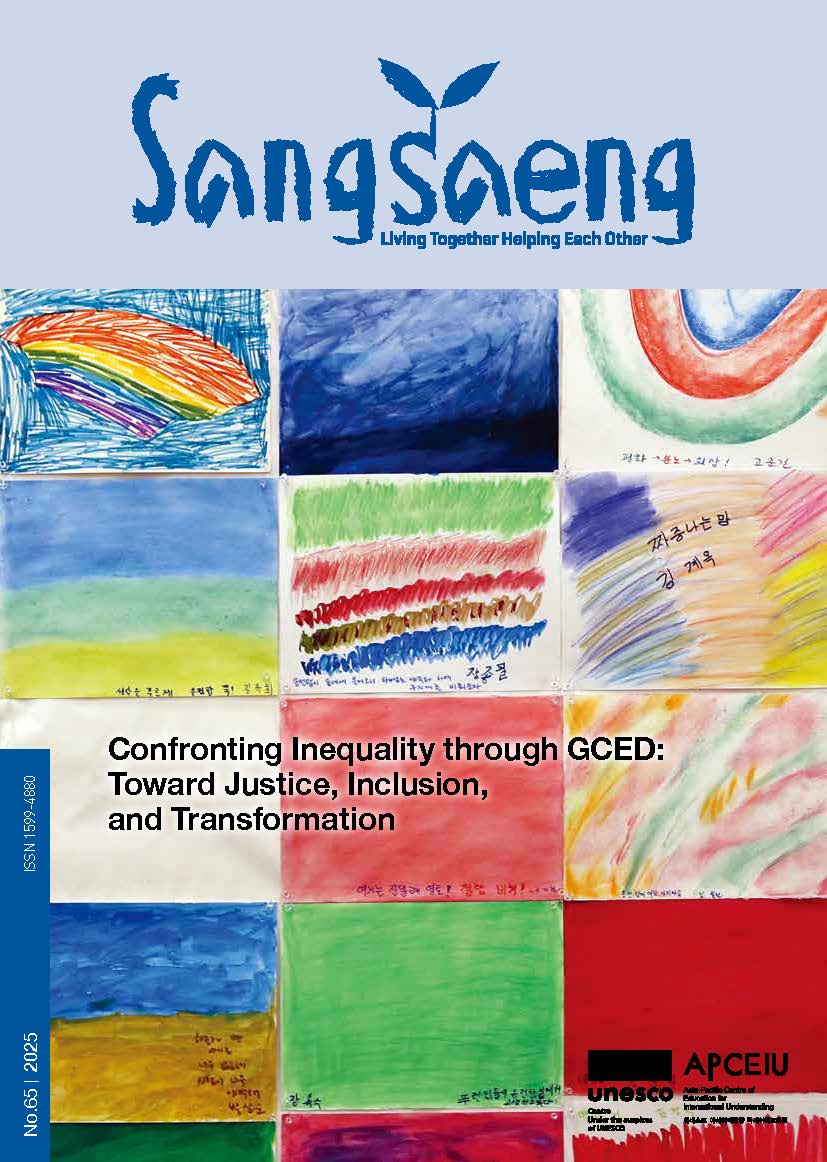 Confronting Inequality through GCED: Toward Justice, Inclusion, and Transformation (SangSaeng; No.65, 2025) 발행 연도: 2025 단체 저자: APCEIU The 62nd issue of SangSaeng has been published with the theme of “Ethical AI and GCED: Exploring the Expanding Domain of Artificial Intelligence.”AI has never been as pervasive and influential as it is in today’s rapidly changing world. Despite the convenience and cutting-edge technology AI has offered us, it has the potential to pose a threat to humanity. This is where ethics for AI should come forward. In this regard, this issue will lead readers to the alarming side of AI as well as its future developments, focusing on the importance of GCED and AI ethics in tackling any potential problems.Contents03 Editor's Note 04 Special ColumnEmbracing Change to Cultivate Success — Integrating Global Citizenship Education into Tertiary Education / Dendev Badarch08 FOCUS Ethical AI and GCED: Exploring the Expanding Domain of Artificial IntelligenceRole of Ethics in the Era of AI — Protecting and Guiding AI Processes for Humanity to Flourish / Emma Ruttkamp-BloemPayingAttention to AI Ethics — An Avenue for a New Competitive Edge in Business / Myoungshin KimDriving Innovative Education — Balancing Future Possibilities and Ethical Concerns: How GCED Can be Used to Address AI Issues / Angelique Southern 20 Special ReportEmpowering a Climate Generation — From Classrooms to Climate Frontlines : The Transformative Role of Education highlighted at COP28 / Djian Sadadou 22 Best PracticesNavigating an AI Future — Ethical AI and the Importance of Critical Thought / Hannah GrantGLACE Brings the World to a City — Empowering Youth as Global Citizens: Lessons from Navotas City’s Project GLAC / Marco D. MedurandaLowering Eco-Anxiety — Teaching Climate Change Through Media and Information Literacy / Laetitia Legrand 33 GCED YOUTH NETWORKNew Wave of Youth Advocacy — Role of AI in Youth Advocacy and its Ethical Implications to Global Citizenship / Oshan M. Gunathilake and Diego Manrique36 Understanding the Asia Pacific RegionDiscovering Auroville — Where Boundaries Fade, Nature Thrives, and Global Minds Unite / Akanksha Arya 39 Peace in My MemoryHappiness without Violence — Mindanao Peace Forum Celebrates Building a Culture of Peace / Ludivina Borja-DekitPeace Scholar Passes Away Amidst Turbulent Times / Kwang-Hyun KIM 45 Story TimeThe Right Footing — My Life Has Purpose Thanks to Football / Hajar Abulfazl 48 LetterShared Challenges of Global Citizens / Natsuki Nagata 50 APCEIU in Action
  Envisioning the Future of Assessment in Transformative Education: A Synthesis Report of the Expert Meeting on Evaluation and Assessment for Transformative Education: Towards and Beyond 2030 발행 연도: 2025 저자: Esther Care 단체 저자: APCEIU Transformative education calls for learning that nurtures not only knowledge, but also the values, attitudes, and behaviours essential for inclusive, just, and sustainable societies. Recent global discussions, including UNESCO’s Reimagining Our Futures Together: A New Social Contract for Education and the Recommendation on Education for Peace and Human Rights, International Understanding, Cooperation, Fundamental Freedoms, Global Citizenship and Sustainable Development, emphasise learning that fosters critical thinking, empathy, cooperation, and action-oriented engagement. Within this vision, assessment needs to evolve from primarily measuring achievement to supporting a process of learning that actively enables and evidences learners’ reflection, growth, and empowerment. Traditional approaches, which prioritise standardisation and summative outcomes, are insufficient for capturing the complex competencies at the heart of transformative education, such as socio-emotional development, critical reflection, ethical reasoning, and responsible action. These limitations raise fundamental questions about not only how transformative learning outcomes can be assessed across diverse systems and contexts, but also what purposes assessment should serve.To examine these issues, APCEIU convened the Expert Meeting on Evaluation and Assessment for Transformative Education: Towards and Beyond 2030, held in Seoul, Republic of Korea, on 2–3 July 2025. The meeting brought together global experts, researchers, and policymakers to discuss current challenges, share emerging practices, and consider strategic directions for reimagining assessment in support of transformative education.Building on these rich discussions, this report synthesises the key reflections and forward-looking perspectives shared during the meeting. Part I presents analytical insights and strategic considerations for advancing assessment in transformative education, while Part II documents the meeting proceedings, including presentations and collaborative discussions.
  [Summary] First Meeting of UNESCO Chairs Relating to Global Citizenship Education 발행 연도: 2022 단체 저자: 联合国教科文组织 (UNESCO) | 亚太地区促进国际理解教育中心 (APCEIU) This report shares the overview of the First Meeting of UNESCO Chairs Relating to Global Citizenship Education held on Friday, 30 September 2022. The event was co-organized by UNESCO and APCEIU with the main objective of gathering UNESCO Chairs from GCED-related fields to discuss the need for a platform for information sharing and knowledge exchanges and share ideas of how UNESCO Chairs could collaborate through joint projects.As UNESCO is in the process of revising the 1974 UNESCO Recommendation concerning Education for International Understanding, Co-operation and Peace and Education relating to Human Rights and Fundamental Freedoms, the report also shared the summary of the discussion over the meeting regarding the current status of the revision process and UNESCO Chairs' thoughts and suggestions on the revised Recommendation.
  Participatory Diagnosis of Youth Perceptions and Attitudes Towards Hate Speech and Denialism of Gender Violence and Rights of Migrants From the Approaches of Global Citizenship Education 발행 연도: 2024 저자: Bárbara Biglia | Aloe Cubero 단체 저자: InteRed | Agencia Española de Cooperación Internacional para el Desarrollo (AECID) This diagnosis seeks to respond to the need to explore the perceptions and attitudes of youth regarding hate speech, specifically those that deny gender violence and the rights of migrants. We wanted to carry out this process recognizing the agency of young people and therefore we seek to generate collective and mobilizing reflections that increase their commitment as agents of change in our society. To this end, we place ourselves within the framework of Feminist Activist Research (IAF) using photovoice as a research strategy. Diagnóstico participativo a través de photovoice sobre percepciones y actitudes de la juventud en torno a los discursos de odio y negacionistas de la violencia de género y de los derechos de las personas migrantes desde los enfoques de la educación para 발행 연도: 2024 저자: Bárbara Biglia | Aloe Cubero 단체 저자: InteRed | Agencia Española de Cooperación Internacional para el Desarrollo (AECID) Este diagnóstico busca responder a la necesidad de explorar las percepciones y actitudes de la juventud en torno a los discursos de odio, específicamente sobre aquellos negacionistas de las violencias de género y en contra de los derechos de las personas migrantes. Hemos querido hacer este proceso reconociendo la agencia de las personas jóvenes y por ello buscamos generar reflexiones colectivas y movilizadoras que aumenten su compromiso como agentes de cambio en nuestra sociedad. Para tal fin, nos ubicamos en el marco de la Investigación Activista Feminista (IAF) haciendo uso del photovoice como estrategia de investigación.
  Empowering Students for Just Societies: A Handbook to Teach Integrity in Secondary Schools 발행 연도: 2024 단체 저자: UNESCO | UN. Office on Drugs and Crime (UNODC) The importance of education lies in its power to shape the values of upcoming generations and equip them with the knowledge to make informed decisions. Contemporary challenges, including corruption must be addressed through education, transparency, accountability and the rule of law, among other efforts. This joint publication by UNODC and UNESCO is a response to this important issue. It is aimed at educators who are striving to inspire and prepare future generations to actively contribute to societies grounded in integrity, ethics and respect for the rule of law. The handbook builds on the first two launched in 2019. This publication highlights the transformative power of education in strengthening the knowledge, skills, attitudes and values necessary for addressing global challenges, especially those that stem from a lack of integrity, like corruption. It underlines the crucial role education plays in nurturing critical thinking, empathy, ethical behaviour, and a commitment to justice and equality among people. The handbook presents a catalogue of educational activities, lesson plans and outside the classroom resources designed to empower youth to reject corrupt practices and become agents of change, promoting integrity and upholding democratic values.