
자료
세계시민교육에 대한 이해를 넓히고 연구, 옹호 활동, 교수, 학습 등을 향상시킬 수 있는 다양하고 유용한 자료를 찾아보세요.
33 건의 결과가 검색되었습니다
 Artificial Intelligence and Gender Equality: Key Findings of UNESCO’s Global Dialogue 발행 연도: 2020 단체 저자: UNESCO The purpose of the UNESCO’s Dialogue on Gender Equality and AI was to identify issues, challenges, and good practices to help: Overcome the built-in gender biases found in AI devices, data sets and algorithms; Improve the global representation of women in technical roles and in boardrooms in the technology sector; and Create robust and gender-inclusive AI principles, guidelines and codes of ethics within the industry. This Summary Report sets forth proposed elements of a Framework on Gender Equality and AI for further consideration, discussion and elaboration amongst various stakeholders. It reflects experts’ inputs to the UNESCO Dialogue on Gender Equality and AI, as well as additional research and analysis. This is not a comprehensive exploration of the complexities of the AI ecosystem in all its manifestations and all its intersections with gender equality. Rather, this is a starting point for conversation and action and has a particular focus on the private sector. It argues for the need to 1. Establish a whole society view and mapping of the broader goals we seek to achieve in terms of gender equality;2. Generate an understanding of AI Ethics Principles and how to position gender equality within them; 3. Reflect on possible approaches for operationalizing AI and Gender Equality Principles; and4. Identify and develop a funded multi-stakeholder action plan and coalition as a critical next step.
  UNESCO Women for Ethical AI: Outlook Study on Artificial Intelligence and Gender 발행 연도: 2024 단체 저자: UNESCO The gender chapter of the UNESCO Recommendation on the Ethics of AI is a concrete commitment by 194 Member States to advance gender equality in the AI ecosystem. To track progress in the implementation of the gender provisions of UNESCO’s Recommendation, and to assess the impacts of AI on gender equality, the UNESCO Women for Ethical AI (W4EAI) Platform has been established. This report advances the workstream through evidence-based insights in three critical areas: women’s participation in AI development and deployment, the inclusion of gender equality concerns in AI governance and the impact of AI on gender equality. It highlights the significant underrepresentation of women in AI, the lack of gender-disaggregated data, and the compounded challenges women face in the field. The report also addresses the neglect of gender dimensions in AI policy, the risks posed by AI systems to women, and the need for responsible and ethical AI governance to promote gender equality. Finally, it outlines actionable recommendations to enhance gender equality through and in AI, emphasizing the importance of comprehensive data collection, targeted interventions, and inclusive policy-making.
 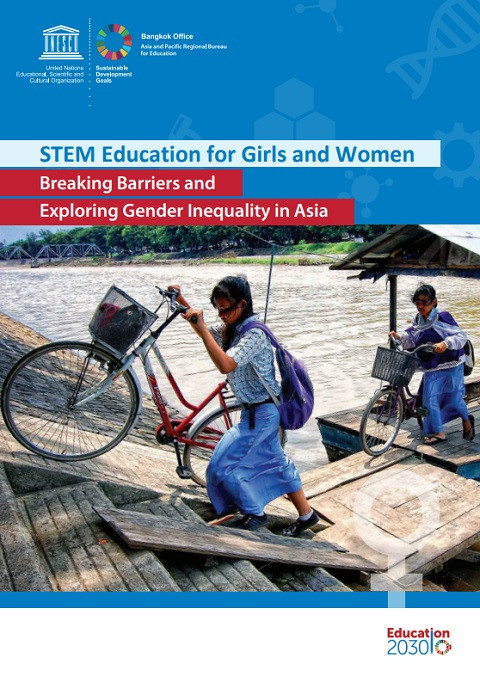 STEM Education for Girls and Women: Breaking Barriers and Exploring Gender Inequality in Asia 발행 연도: 2020 단체 저자: UNESCO Bangkok | UNESCO Science, Technology, Engineering and Mathematics (STEM) fields are considered catalysts for the achievement of the 2030 Agenda for Sustainable Development. Yet, particularly for STEM fields, girls and women, for a multitude of social, cultural and psychological reasons, engage and participate at a lower rate than boys and men. This research collection aims to highlight the contextual barriers that girls and women face in STEM education and careers and offer concrete examples of interventions that successfully encourage participation of girls and women in STEM. These eight case studies from across Asia explore both the barriers and the achievements in SDG 4 and SDG 5, and give context-specific analysis of different aspects of gender disparities in the respective countries.