
자료
세계시민교육에 대한 이해를 넓히고 연구, 옹호 활동, 교수, 학습 등을 향상시킬 수 있는 다양하고 유용한 자료를 찾아보세요.
170 건의 결과가 검색되었습니다
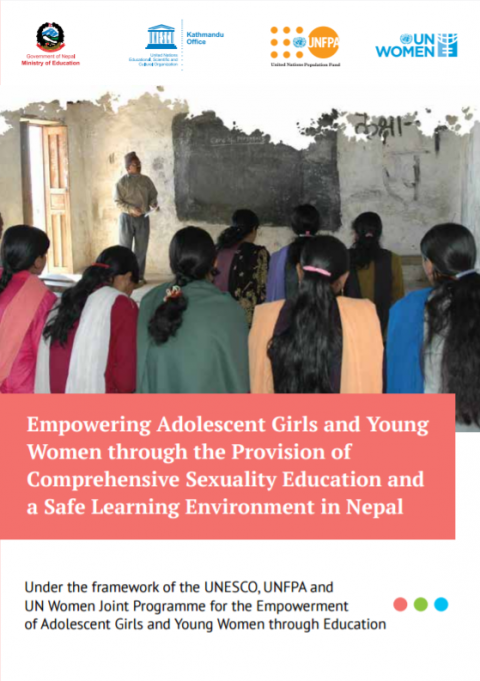 Empowering Adolescent Girls and Young Women through the Provision of Comprehensive Sexuality Education and a Safe Learning Environment in Nepal 발행 연도: 2016 단체 저자: UNESCO Kathmandu | United Nations Entity for Gender Equality and the Empowerment of Women (UN Women) | United Nations Population Fund (UNFPA) There are many challenges for adolescent girls and young women in Nepal in terms of access, participation, and completion of good quality education. Child marriage and early pregnancy, gender-based violence, lack of knowledge or provision of proper hygiene facilities such as WASH (water, sanitation and hygiene) are factors preventing adolescent girls and young women from accessing education. This publication is a project plan for empowering adolescent girls and young women in Nepal.
  Addressed by Irina Bokova, Director-General of UNESCO on the Occasion of Launch of the Joint Programme in Nepal Empowering Adolescent Girls and Young Women through Education; Kathmandu, 18 April 2016 발행 연도: 2016 단체 저자: UNESCO. Director-General, 2009-2017 (Bokova, I.G.)
  الاستدامة: المساواة بين الجنسين 발행 연도: 2019 단체 저자: CSR Egypt الفيديو يتطرق لمفهوم الهدف الخامس من اهداف التنمية المستدامة (المساواة بين الجنسين) و ان المرأة لها دور اساسى لتحقيق اهداف التنمية المستدامة و لذلك يجب ان يتم اتاحة الفرصة لها و دعمها للحصول على كافة حقوقها و مشاركتها الفعاله للنهوض بالمجتمعات العربية. Sustainability: Gender Equality 발행 연도: 2019 단체 저자: CSR Egypt This video deals with the concept of the fifth goal of the sustainable development goals (gender equality) and that women have a fundamental role to achieve the goals of sustainable development, and that is why they must be given the opportunity and support to obtain all their rights and effective participation in the advancement of Arab societies.
  Global Monitoring of Target 4.7: Themes in National Curriculum Frameworks; Background Paper Prepared for the 2016 Global Education Monitoring Report 발행 연도: 2016 단체 저자: UNESCO International Bureau of Education (IBE) This study is an initial attempt to monitor ESD and GCED content in curricula globally. The goal here is to analyse national curriculum documents to reveal if, how, and to what extent ESD and GCED content is present across the globe. For this purpose, the research team developed a coding scheme based on key ESD and GCED knowledge, skills, behaviours and pedagogies that was used in evaluating the various national curriculum documents for evidence of ESD and GCED content. In this paper, we present the study in the following order. Further explanation of ESD and GCED, and a discussion of issues relating to their implementation and monitoring will come first. Then we will review similar studies that have also attempted to monitor GCED and ESD through content analysis. The study’s methods and findings will then be presented, followed by a discussion of the challenges addressed in developing a coding system to monitor curricula effectively. Finally, we share a series of recommendations that will focus on ways for moving forward in monitoring GCED and ESD effectively, both at a curricular level and beyond.
  [Video] Central Asian Kids Share Their Views on Gender Inequality 발행 연도: 2020 단체 저자: World Bank In Central Asia, and around the world, women earn 30% less than men. In anticipation of March 8, we asked the children what they think about it. [Видео] Что говорят дети в Центральной Азии о гендерном неравенстве в оплате труда 발행 연도: 2020 단체 저자: World Bank В Центральной Азии, и по всему миру, женщины зарабатывают на 30% меньше, чем мужчины. В преддверии 8 марта мы спросили детей, что они думают об этом.
 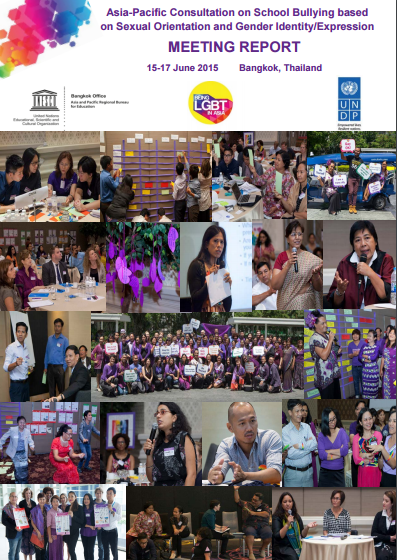 Asia-Pacific Consultation on School Bullying Based on Sexual Orientation and Gender Identity/Expression 발행 연도: 2015 단체 저자: UNESCO Bangkok This report documents the presentations and discussions made during the Asia-Pacific Consultation on School Bullying based on Sexual Orientation and Gender Identity/Expression held from 15-17 June 2015 at the Pullman King Power Hotel in Bangkok, Thailand.
  Globalising the school curriculum: gender, EFA and global citizenship education (RECOUP working paper 17) 발행 연도: 2008 저자: Harriet Marshall | Madeleine Arnot 단체 저자: Research Consortium on Educational Outcomes and Poverty (RECOUP) This paper aims to bring the school curriculum into the analysis of gender, education and development. There is a marked absence of discussion both in the academic field of development studies and in the political domain of educational policy making around Education for All about what is required of the school curriculum so that it could help promote gender equality. All too often national school curricula reproduce gender inequalities in the public and private sphere and sustain hegemonic male regimes on a national and global scale (Arnot, 2002). Curriculum research, however, can challenge these social messages embedded in curricular formations as well as raise deeper questions about whose forms of knowledge should be transmitted through official forms of schooling. Critical sociological research, for example, recognises the importance of the rules governing the access and redistribution of knowledge, and also the politics behind the selection, organisation and evaluation of legitimate knowledge through formal national educational institutions within developing economies and the impact these have on indigenous social stratifications. It can also critically assess new global interventions into the school curriculum whether in the name of economic progress, human rights or social justice. These global developments are controversial not least because of the challenge they represent to what has been considered the prerogative of national governments – to transmit its own selection of educational knowledge to its citizens, using its own contextualised pedagogic style. The study of national curricula therefore offers the possibility of exploring the equity dimensions of global–national and local educational interfaces and policy agendas. The paper has limited but hopefully valuable ambitions. It aims to initiate discussion of the curriculum in relation to gender, education and development by exploring the global significance of recent interventions on gender, and in particular girls’ education. The first section briefly considers the implications of globalisation as a transformative process on the development of educational knowledge and queries whether the school curricula could address persistent worldwide gender disparities, inequalities and female subjugation. In the second section, we focus specifically on whether new global declarations around gender equality such as those analysed in the UNESCO Education for All Global Monitoring Reports imply certain roles for the school curriculum. The final section addresses the possibilities for gender equality implied by recent interest global citizenship education – a new curriculum subject and approach that promises much. We consider in a preliminary way whether these new developments represent a move towards forms of educational knowledge that are critical rather than legitimating and ‘normalising’ in relation to gender inequalities. Mondialiser le programme scolaire: le sexe, l'EPT et L'éducation à la Citoyenneté Mondiale (ECM) (papier de travail 17) 발행 연도: 2008 저자: Harriet Marshall | Madeleine Arnot 단체 저자: Research Consortium on Educational Outcomes and Poverty (RECOUP) Ce document vise à amener le programme scolaire dans l'analyse de genre, l'éducation et le développement. Il y a une absence marquée de la discussion à la fois dans le domaine académique des études de développement et dans le domaine politique de la politique en matière d'éducation autour de l'éducation pour tous à propos de ce qui est requis du programme scolaire afin qu'il puisse aider à promouvoir l'égalité des sexes. Tous les programmes scolaires nationaux trop souvent reproduisent les inégalités entre les sexes dans le domaine public et privé et de soutenir les régimes de sexe masculin hégémonique à l'échelle nationale et mondiale (Arnot, 2002). la recherche des programmes, cependant, ne peut contester ces messages sociaux intégrés dans les formations scolaires ainsi que soulever des questions plus profondes sur dont les formes de connaissances doivent être transmises par le biais des formulaires officiels de scolarité. recherche sociologique critique, par exemple, reconnaît l'importance des règles régissant l'accès et la redistribution des connaissances, ainsi que la politique derrière la sélection, l'organisation et l'évaluation des connaissances légitimes par les institutions éducatives nationales officielles dans les économies en développement et de l'impact qu'elles ont sur autochtones stratifications sociales. Il peut également évaluer de façon critique les nouvelles interventions mondiales dans le programme scolaire que ce soit au nom du progrès économique, les droits de l'homme ou de la justice sociale. Ces développements mondiaux sont controversés pas moins à cause du défi qu'ils représentent pour ce qui a été considéré comme la prérogative des gouvernements nationaux - de transmettre sa propre sélection de connaissances sur l'éducation de ses citoyens, en utilisant son propre style pédagogique contextualisée. L'étude des programmes nationaux offre donc la possibilité d'explorer les dimensions d'équité des interfaces éducatives globales nationales et locales et les agendas politiques. Le papier a des ambitions limitées mais nous espérons précieux. Il vise à engager un débat sur le programme d'études en fonction du sexe, de l'éducation et le développement en explorant l'importance mondiale des récentes interventions sur le sexe, et en particulier l'éducation des filles. La première section examine brièvement les implications de la mondialisation comme un processus de transformation sur le développement des connaissances et des requêtes si les programmes scolaires pourraient remédier aux disparités persistantes entre les sexes dans le monde, les inégalités et la subordination des femmes de l'éducation. Dans la deuxième section, nous nous concentrons particulièrement sur le fait de nouvelles déclarations globales autour de l'égalité des sexes, tels que ceux analysés dans UNESCO sur l'Education pour tous rapports globaux Suivi impliquent certains rôles pour le programme scolaire. La dernière section porte sur les possibilités d'égalité entre les sexes impliqués par l'intérêt récent L'éducation à la citoyenneté Mondiale (ECM) - un nouveau sujet de curriculum et de l'approche qui promet beaucoup. Nous considérons de façon préliminaire si ces nouveaux développements représentent une évolution vers des formes de connaissances pédagogiques qui sont essentielles plutôt que légitimant et «normalisation» par rapport aux inégalités entre les sexes.