
자료
세계시민교육에 대한 이해를 넓히고 연구, 옹호 활동, 교수, 학습 등을 향상시킬 수 있는 다양하고 유용한 자료를 찾아보세요.
123 건의 결과가 검색되었습니다
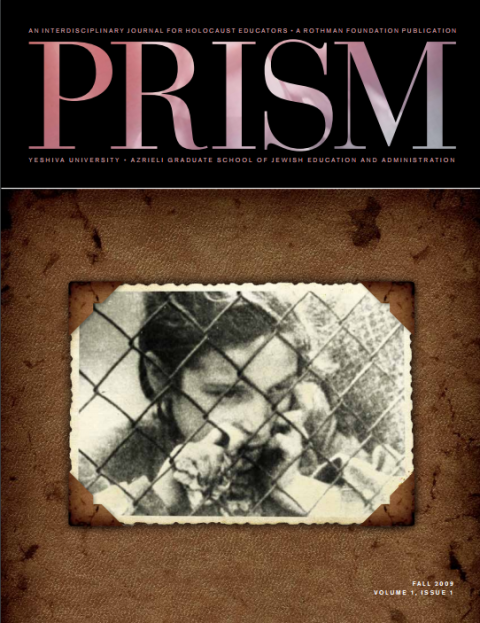 The necessity of darkness. The pedagogic imperative to teach about the death camps How much knowledge about the Holocaust is too much for students? How early is too early to begin to teach about the event? How do we find the correct balance between teaching about the atrocities and teaching about Jewish agency? The Azrieli Graduate School of Jewish Education and Administration debate these and other pedagogical questions in these pages. (By the publisher)
  The duty to remember: Holocaust remembrance and education in contemporary France Though the decades following the liberation of France in 1944 were characterized by myths and repressions, since the 1970s historians, filmmakers, educators, the general public, and government officials have made considerable efforts to reconcile the dark aspects of France's history and to integrate them into French memory and national history. As Vichy's involvement in the perpetration of the Holocaust moved from the periphery into the mainstream of French consciousness, so did Holocaust remembrance and education. Though for several decades these initiatives appear to have provided a symbolic protection against anti-Semitic acts, the 21st century has been marked by a resurgence of anti-Semitic incidents in France. This paper explores the evolution of France's memory of Vichy's anti-Semitism, the measures taken to incorporate Holocaust remembrance and education into national memory and history, and the reasons why these measures no longer appear to have the same effect in contemporary France. (By the author) Complicating Issues in Holocaust Education Confronting the Holocaust in a classroom setting involves a complex undertaking that demands careful planning as educators develop and present curricula on the subject to their students. This article explores another problematic factor involved in teaching the Shoah, that is, several issues that exist outside the content/pedagogical framework but that nonetheless may exert a major influence on the teaching of the subject. These issues affect the environment that surrounds Holocaust education and, therefore, can have a considerable impact on the teaching of the subject. (By the author)
  Recommendations for Teaching and Learning about the Holocaust 발행 연도: 2019 단체 저자: International Holocaust Remembrance Alliance (IHRA) These recommendations, written by a group of international experts, are crafted to help educators with fact-based and educationally sound techniques for teaching the complex and nuanced history of the Holocaust. These recommendations will allow you to: Explain why teaching and learning about the Holocaust matters. The guidelines provide compelling reasons for covering the Holocaust in classroom curricula, so that students have a deeper understanding of the past and how it shapes the present. Find appropriate sources for the classroom. Covering this subject in a way which is both sensitive and accurate can be difficult; these recommendations include practical guidance on how to make your choices. Bring curricula up to date with latest research. There’s a huge range of recent research in this field; we’ve made it easy to incorporate these findings into your classroom.
 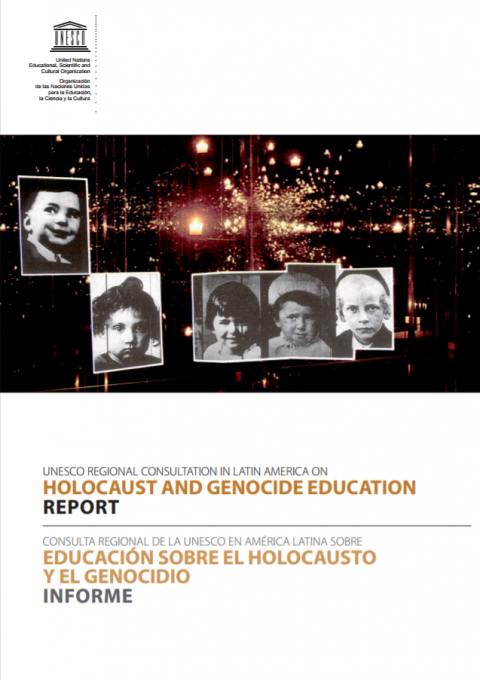 Consulta regional de la UNESCO en América Latina sobre educación sobre el Holocausto y el genocidio: informe 발행 연도: 2014 단체 저자: UNESCO Santiago This consultation with Latin American Member States sought to raise awareness amongst policymakers and education specialists of the region about the history of the Holocaust, as it can contribute to the prevention of genocide, following United Nations General Assembly resolution 60/7 on Holocaust remembrance. The meeting also aimed at fostering concrete cooperation between UNESCO and Member States on education about the history of genocide and mass atrocities, notably the Holocaust, with a view of introducing the subject in the curriculum and of developing relevant educational programmes in the region. The overall objectives of the project were as follows:▶ Strengthen educational leaders’ awareness and support for Holocaust remembrance and education about the history of genocide and mass atrocities, in line with regional efforts to foster education for peace and human rights.▶ Increase the implementation of education programmes about the history of the Holocaust and other genocides, and support interested Ministries of Education to introduce these subjects in the curriculum.▶ Foster regional exchanges about this topic and facilitate access to good practices regarding Holocaust and genocide related issues and peace education.
  Address by Irina Bokova, Director-General of UNESCO, on the Role of UNESCO in Countering Anti-Semitism and Preserving the Legacy of the Holocaust on the occasion of the launch of UNESCO's guide on Holocaust Education and Genocide Prevention, 15th Plenary Assembly of the World Jewish Congress, New York, 24 April 2017 발행 연도: 2017 단체 저자: UNESCO. Director-General, 2009-2017 (Bokova, I.G.) This address was given by Irina Bokova, Director-General of UNESCO, on the role of UNESCO in countering anti-semitism and preserving the legacy of the holocaust on the occasion of the launch of UNESCO's guide on Holocaust Education and Genocide Prevention, 15th Plenary Assembly of the World Jewish Congress. UNESCO regional consultation in Latin America on Holocaust and genocide education: report 발행 연도: 2014 단체 저자: UNESCO Santiago This consultation with Latin American Member States sought to raise awareness amongst policymakers and education specialists of the region about the history of the Holocaust, as it can contribute to the prevention of genocide, following United Nations General Assembly resolution 60/7 on Holocaust remembrance. The meeting also aimed at fostering concrete cooperation between UNESCO and Member States on education about the history of genocide and mass atrocities, notably the Holocaust, with a view of introducing the subject in the curriculum and of developing relevant educational programmes in the region. The overall objectives of the project were as follows:▶ Strengthen educational leaders’ awareness and support for Holocaust remembrance and education about the history of genocide and mass atrocities, in line with regional efforts to foster education for peace and human rights.▶ Increase the implementation of education programmes about the history of the Holocaust and other genocides, and support interested Ministries of Education to introduce these subjects in the curriculum.▶ Foster regional exchanges about this topic and facilitate access to good practices regarding Holocaust and genocide related issues and peace education. Teaching about the Holocaust in English Secondary Schools : An empirical study of national trends, perspectives and practice 발행 연도: 2009 저자: Alice Pettigrew | Stuart Foster | Jonathan Howson | Paul Salmons | Ruth Anne Lenga | Kay Andrews The aims were to examine when, where, how and why the Holocaust is taught in state-maintained secondary schools in England, and to inform the design and delivery of a continuing professional development (CPD) programme for teachers who teach about the Holocaust. A two-phase mixed methodology was employed. This comprised an online survey which was completed by 2,108 respondents and follow-up interviews with 68 teachers in 24 different schools throughout England. The research reveals that teachers adopt a diverse set of approaches to this challenging and complex subject. In the report, teachers’ perceptions, perspectives and practice are presented and a range of challenges and issues encountered by teachers across the country are explicitly identified. The research shows that, although most teachers believe that it is important to teach about the Holocaust, very few have received specialist professional development in this area. It also shows that many teachers find it a difficult and complicated subject to teach, and that they both want and need support to better equip them to teach about the Holocaust effectively.(By the author) National Socialism and the Holocaust in West German school books The author differentiates five phases of representation of the Holocaust in West German history books and lessons. Attempts to deal with the subject in a serious and comprehensive way in some post-war school textbooks were repressed in the 1950s. The students' movement, intensive research work and increased political attention on right-wing tendencies brought a change in the 1960s. New didactic methods such as source work and regional historical approaches were adopted, intended to give pupils greater insight into the individual areas of dictatorship and enable them to form their own opinion of the activities at that time. In the meantime, National Socialism is usually the area of German 20th century history dealt with in the most detail. The increasing distance in time to the period in question, the dissolution of the Socialist bloc, reunification and the multicultural nature of school classes have produced new teaching conditions, which on the one hand create a greater distance from the subject but on the other hand call for comparison of genocide, war and exile in the present time or from the history of other peoples. (By the author)
  Understanding Matters: Holocaust Curricula and the Social Studies Classroom Over the past two decades, interest in Holocaust education has grown substantially as individual states, starting in the 1980s, began to mandate and/or recommend Holocaust studies as part of the social studies curriculum. As a result, these mandates and/or interest in the Holocaust have spawned any number of curriculum products, some of which seek less to help the student of history acquire an understanding of this historical event, and more in terms of dictating to the social studies student what he or she should understand. Hence, the purpose of this paper is to critique Holocaust curricula that have been developed under the auspices of a state department of education (SDE) or endorsed by a SDE, as we believe that teachers unfamiliar with the Holocaust will turn to these products as sources of authority. We base this critique on what we refer to as three approaches or considerations to understanding history—the body of work on historical thinking which we view as the underpinning of historical empathy and positionality, historical empathy as articulated by Elizabeth Yeager, O.L. Davis, Jr., and Stuart Foster, and the guidelines on teaching the Holocaust developed for the U.S. Holocaust Memorial Museum by William Parsons and Samuel Totten. These three elements, each in their own way, help us to understand the challenge for teachers and students whose foundation for understanding the Holocaust may solely rest upon curriculum products whose curricular aims and/or design often obstruct the quest to “understand,” e.g., lack of historical accuracy, lack of depth, and historical gaps. (By the author)