
자료
세계시민교육에 대한 이해를 넓히고 연구, 옹호 활동, 교수, 학습 등을 향상시킬 수 있는 다양하고 유용한 자료를 찾아보세요.
123 건의 결과가 검색되었습니다
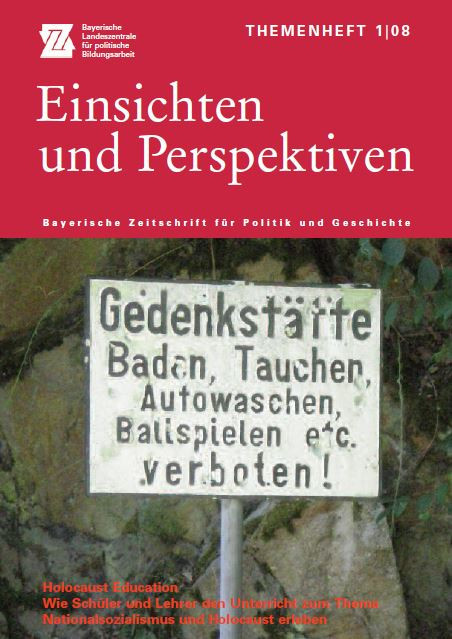 Holocaust Education: How Students and Teachers Experience Teaching and Learning about National Socialism and the Holocaust 발행 연도: 2008 단체 저자: Bayerische Landeszentrale fürpolitische Bildungsarbeit The original title: Holocaust Education: Wie Schüler und Lehrer den Unterricht zum Thema Nationalsozialismus und Holocaust Erleben(Bayerische Zeitschrift für Politik und Geschichte, 1(8) [Themenheft Einsichten und Perspektiven]) Special issue of a Journal presenting several articles of a pilot study carried out in Bayern, focusing on the subjective experiences and representations of teachers and students when dealing with the Holocaust and with National Socialism. The above abstract is taken from the International Holocaust Remembrance Alliance Education Research Project. Please also consult the full list of abstracts in 15 languages and the accompanying publication Research in Teaching and Learning about the Holocaust: A Dialogue Beyond Borders. Ed: IHRA, Monique Eckmann, Doyle Stevick, Jolanta Ambrosewicz-Jacobs, 2017, Metropol Verlag at www.holocaustremembrance.com/resources/publications.
  Early Historical Learning about National Socialism and the Persecution of Jews: Family Conditions, Interests and Acquisition of Knowledge among Fourth Graders 발행 연도: 2012 저자: Christina Klätte The original title: Frühes Historisches Lernen über Nationalsozialismus und Judenverfolgung: Familiäre Bedingungen, Interessen und Wissenserwerb bei Viertklässlern(Kinder und Zeitgeschichte: Jüdische Geschichte und Gegenwart, Nationalsozialismus und Antisemitismus Supplement 8, pp. 85–99) This is a quantitative study of German primary school children’s knowledge about the Holocaust. It demonstrates the importance of family background, family discussion and a general interest in history. It also displays how teachers’ willingness to bring up the Nazi period at a comparatively early age, among other things, depends upon the socio-economic status of the school children’s parents. The above abstract is taken from the International Holocaust Remembrance Alliance Education Research Project. Please also consult the full list of abstracts in 15 languages and the accompanying publication Research in Teaching and Learning about the Holocaust: A Dialogue Beyond Borders. Ed: IHRA, Monique Eckmann, Doyle Stevick, Jolanta Ambrosewicz-Jacobs, 2017, Metropol Verlag at www.holocaustremembrance.com/resources/publications.
 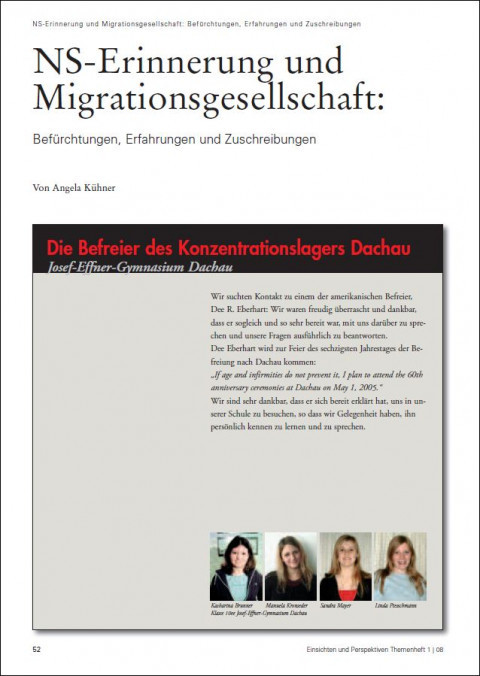 The Memory of Nazism and the Migration Society: Fears, Experiences and Attributions. Intergenerational Historical Consciousness 발행 연도: 2008 저자: Angela Kühner The original title: NS-Erinnerung und Migrationsgesellschaft: Befüchtungen, Erfahrungen und Zuschreibungen(Einsichten und Perspektiven, Bayerische Zeitschrift für Politik und Geschichte, 1(8), pp. 52-65) The articles deals with a specific part of the pilot-study (see Kühner et al. 2008) on teachers’ and students’ experiences and representations, i.e. with the dimension of a migration-society. The author suggests to use the idea of “a society of migration as a context,” instead of the “migrants as target group.” This approach allows the author to work out several ways in which the students and teachers position themselves towards the national-socialist past of German society, and how the attribution of guilt, shame or esponsibility to several groups of “Others” serves as an interactive pattern in a migration society. Migration can therefore offer on one hand a tool to project their own fears or feelings, but on the other hand, it can also offer an opportunity for dialog and a higher degree of reflexivity on the past and the present. The above abstract is taken from the International Holocaust Remembrance Alliance Education Research Project. Please also consult the full list of abstracts in 15 languages and the accompanying publication Research in Teaching and Learning about the Holocaust: A Dialogue Beyond Borders. Ed: IHRA, Monique Eckmann, Doyle Stevick, Jolanta Ambrosewicz-Jacobs, 2017, Metropol Verlag at www.holocaustremembrance.com/resources/publications.
  Overview of Selected Research Results 발행 연도: 2008 저자: Angela Kühner | Phil. C. Langer | Robert Sigel The original title: Ausgewählte Studienergebnisse im Überblick(Einsichten und Perspektiven, Bayerische Zeitschrift für Politik und Geschichte, 1(8), pp. 76-82)The article deals with the results of a pilot study carried out in Bayern, which focuses on the subjective experiences and representations of teachers and students from a social-psychology perspective. The research questions: How does the educational situation reflect remembrance today? How do teachers and students interpret situations of “Holocaust Education,” and what feelings do they report? The study carried out qualitative interviews with students and their teachers, and analyzes the pedagogical setting of history classes in secondary schools. Intercultural and intergenerational dimensions are also analyzed. The authors conclude that both sides, students and teachers, show a high degree of interest to the topic, but also a tendency to Selbst-Überforderung ; thus, concrete possibilities and spaces for self-reflection about their own feelings and conflicting pedagogical aims must be recognized and supported. The above abstract is taken from the International Holocaust Remembrance Alliance Education Research Project. Please also consult the full list of abstracts in 15 languages and the accompanying publication Research in Teaching and Learning about the Holocaust: A Dialogue Beyond Borders. Ed: IHRA, Monique Eckmann, Doyle Stevick, Jolanta Ambrosewicz-Jacobs, 2017, Metropol Verlag at www.holocaustremembrance.com/resources/publications.
 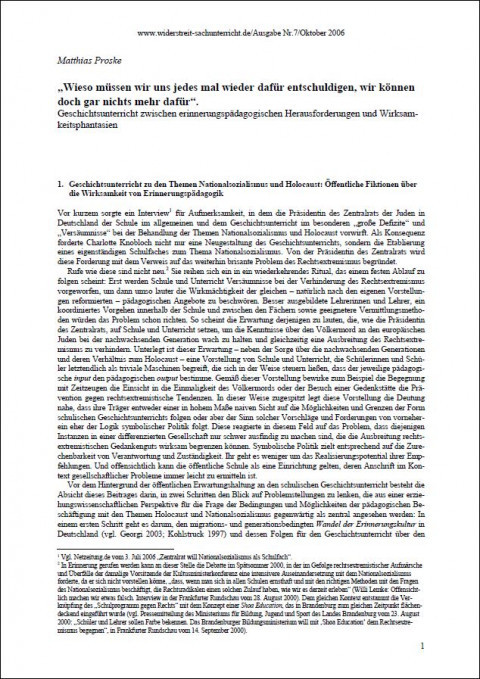 “Why Do We Have to We Apologize for It All the Time, We Can’t Help it”: History Education between Memory-Pedagogy Challenges and Fantasies about Effectiveness 발행 연도: 2006 저자: Matthias Proske The original title: “Wieso Müssen Wir Uns Jedes Mal Wieder dafür Entschuldigen, Wir Können Doch Gar Nichts Mehr Dafür”: Geschichtsunterricht zwischen Erinnerungspädagogischen Herausforderungen und Wirksamkeitsphantasien(Widerstand sachunterricht, 7, pp. 1–10)Against the background of public expectations on the schools’ history education, the article connects a theoretical analysis of the changes in the German historical culture and their consequences for history education about the Holocaust and Nazism with a discussion about how students and teachers take on these themes in educational practice. This is exemplified with a case study from a 9th grade history class. The above abstract is taken from the International Holocaust Remembrance Alliance Education Research Project. Please also consult the full list of abstracts in 15 languages and the accompanying publication Research in Teaching and Learning about the Holocaust: A Dialogue Beyond Borders. Ed: IHRA, Monique Eckmann, Doyle Stevick, Jolanta Ambrosewicz-Jacobs, 2017, Metropol Verlag at www.holocaustremembrance.com/resources/publications.
 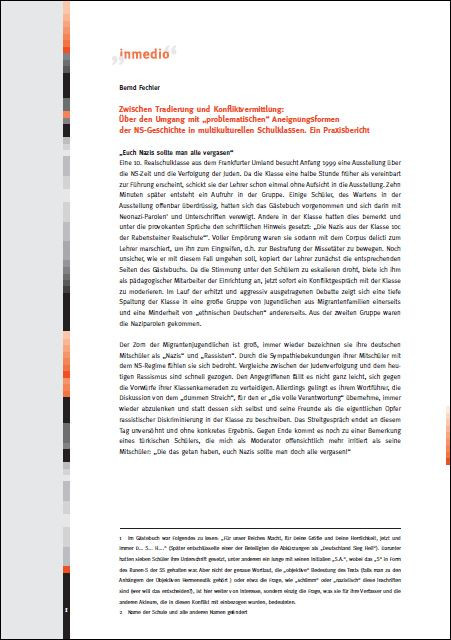 Between Transmission and Conflict Mediation: On the Handling of “Problematic” Forms of Appropriation of Nazi History in Multicultural School Classes 발행 연도: 2000 저자: Bernd Fechler The original title: Zwischen Tradierung und Konfliktvermittlung: Über den Umgang mit “Problematischen” Aneignungsformen der NS-Geschichte in Multikulturellen Schulklassen(Erziehung nach Auschwitz” in der multikulturellen Gesellschaft: Pädagogische und soziologische Annäherungen, pp.1-18) Discussion of the challenges of Holocaust education a multicultural setting, based on a case when a German 10th grade class visited an exhibition about the Nazi period, something which led to an intense conflict between “German” and “immigrant” students.The above abstract is taken from the International Holocaust Remembrance Alliance Education Research Project. Please also consult the full list of abstracts in 15 languages and the accompanying publication Research in Teaching and Learning about the Holocaust: A Dialogue Beyond Borders. Ed: IHRA, Monique Eckmann, Doyle Stevick, Jolanta Ambrosewicz-Jacobs, 2017, Metropol Verlag at www.holocaustremembrance.com/resources/publications
 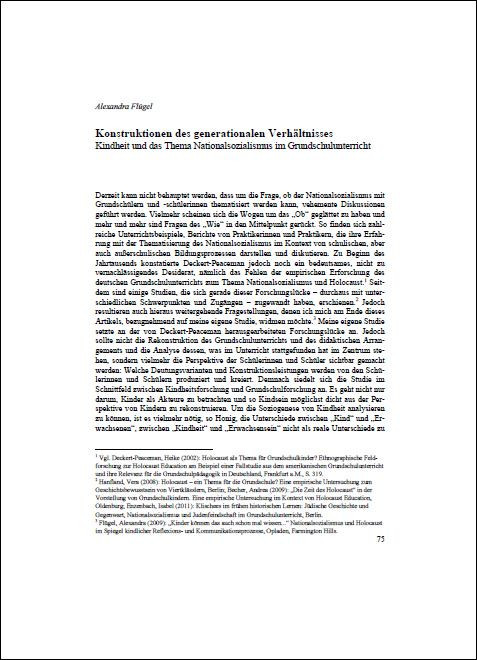 Constructions of Generational Relations: Childhood and the Theme of National Socialism in Primary-School Education 발행 연도: 2012 저자: Alexandra Flügel The original title: Konstruktionen des Generationalen Verhältnisses: Kindheit und das Thema Nationalsozialismus im Grundschulunterricht(Kinder und Zeitgeschichte: Jüdische Geschichte und Gegenwart, Nationalsozialismus und Antisemitismus, Supplement 8, pp. 75–84) This is a qualitative study, based on the results in Fügel 2009, of German primary school children’s communication about Nazism and the Holocaust. It demonstrates how interwoven these exchanges are with general German memory discourses about these topics, but also how the children already at the age of 9–10 reflect upon their need to learn about this dark side of German history.The above abstract is taken from the International Holocaust Remembrance Alliance Education Research Project. Please also consult the full list of abstracts in 15 languages and the accompanying publication Research in Teaching and Learning about the Holocaust: A Dialogue Beyond Borders. Ed: IHRA, Monique Eckmann, Doyle Stevick, Jolanta Ambrosewicz-Jacobs, 2017, Metropol Verlag at www.holocaustremembrance.com/resources/publications.
 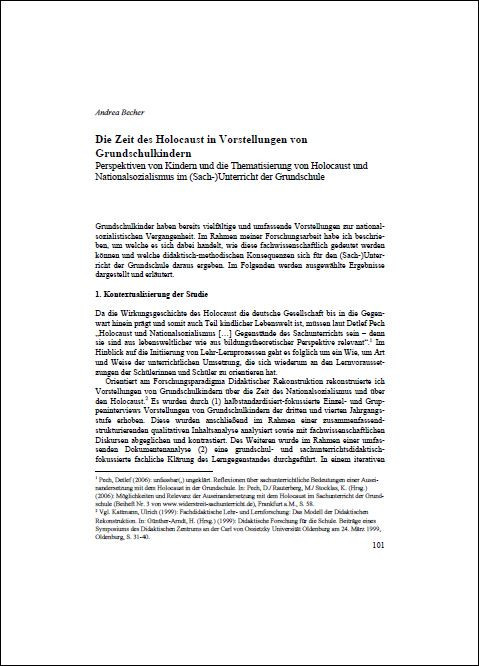 The Time Period of the Holocaust in the Beliefs of Primary School Children – Children’s Perspectives and the Thematization of the Holocaust and National Socialism in Primary-School Instruction (in General Subjects) 발행 연도: 2012 저자: Andrea Becher The original title: Die Zeit des Holocaust in Vorstellungen von Grundschulkindern – Perspektiven von Kindern und die Thematisierung von Holocaust und Nationalsozialismus im (Sach-)Unterricht der Grundschule(In I. Enzenbach, C. Klätte, & D. Pech, (Eds.). Kinder und Zeitgeschichte: Jüdische Geschichte und Gegenwart, Nationalsozialismus und Antisemitismus, Supplement, 8, pp. 101–120) This is a summary of a study of German primary school children’s beliefs about the Holocaust, based on interviews conducted in two classes in 2005. The author finds that the children almost exclusively focus on Hitler; that one can find “latent anti-Semitic fragments” in their statements; that, even without formal education, the pupils still possess knowledge about the Holocaust; and their main source of information about Nazi Germany seems to be family members. However, the family narratives mainly touch upon everyday-life and avoid the topic of the Holocaust. From these findings, the author argues that one could and should teach the Holocaust already in the German primary school. The above abstract is taken from the International Holocaust Remembrance Alliance Education Research Project. Please also consult the full list of abstracts in 15 languages and the accompanying publication Research in Teaching and Learning about the Holocaust: A Dialogue Beyond Borders. Ed: IHRA, Monique Eckmann, Doyle Stevick, Jolanta Ambrosewicz-Jacobs, 2017, Metropol Verlag.
 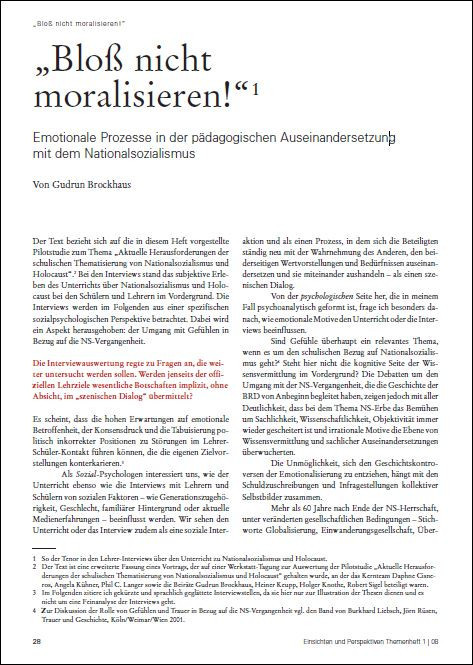 “Just Don’t Moralize!” Emotional Processes in the Pedagogical Engagement with National Socialism 발행 연도: 2008 저자: Gudrun Brockhaus The original title: “Bloß nicht moralisieren!” Emotionale Prozesse in der pädagogischen Auseinandersetzung mit dem Nationalsozialismus(Einsichten und Perspektiven, Bayerische Zeitschrift für Politik und Geschichte, 1(8), pp. 28–33.) The article is a critical reflection on the outcomes of an empirical study (Kühner 2008; Kühner et al. 2008), based on a psychological/psychoanalytical perspective: how should we deal with emotions when dealing with the Holocaust? The author highlights the teachers’ very high expectations regarding the emotional Betroffenheit, the pressure on consensus, and the tabooisation of “political incorrectness” in the classroom, tendencies that can lead to a problematic teacher-student relationship. Thus, teachers encounter specific didactical difficulties and show a certain lack of self-assertion. Brockhaus assumes that this is based on how the teacher relates, as a person and as a pedagogue, to the heritage of National Socialism. Brockhaus concludes by insisting on the necessity to reflect openly, as students and as teachers, on the emotional processes and the reluctance caused by the topic of the Holocaust in this society. The above abstract is taken from the International Holocaust Remembrance Alliance Education Research Project. Please also consult the full list of abstracts in 15 languages and the accompanying publication Research in Teaching and Learning about the Holocaust: A Dialogue Beyond Borders. Ed: IHRA, Monique Eckmann, Doyle Stevick, Jolanta Ambrosewicz-Jacobs, 2017, Metropol Verlag at www.holocaustremembrance.com/resources/publications
 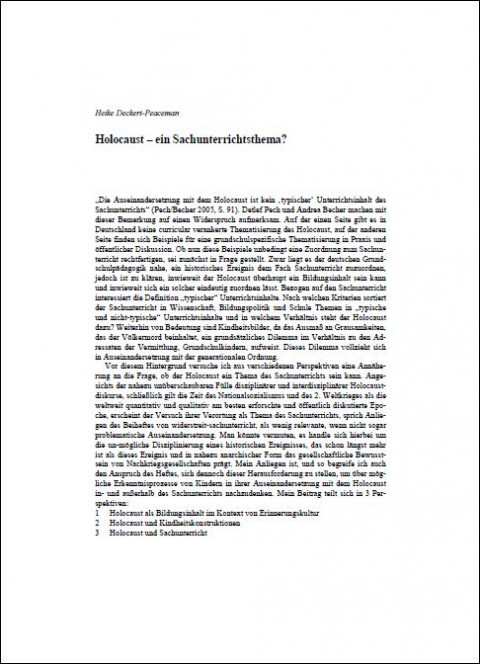 The Holocaust – A Theme for Instruction in General Subjects? 발행 연도: 2006 저자: H. Deckert-Peaceman The original title: Holocaust – ein Sachunterrichtsthema?(Möglichkeiten und Relevanz der Auseinandersetzung mit dem Holocaust im Sachunterricht der Grundschule. Supplement, 3, pp. 35–50) An interesting discussion about the Holocaust as a topic for younger children, and especially about the use of youth literature in Holocaust education, but not an empirical analysis.The above abstract is taken from the International Holocaust Remembrance Alliance Education Research Project. Please also consult the full list of abstracts in 15 languages and the accompanying publication Research in Teaching and Learning about the Holocaust: A Dialogue Beyond Borders. Ed: IHRA, Monique Eckmann, Doyle Stevick, Jolanta Ambrosewicz-Jacobs, 2017, Metropol Verlag.