
자료
세계시민교육에 대한 이해를 넓히고 연구, 옹호 활동, 교수, 학습 등을 향상시킬 수 있는 다양하고 유용한 자료를 찾아보세요.
124 건의 결과가 검색되었습니다
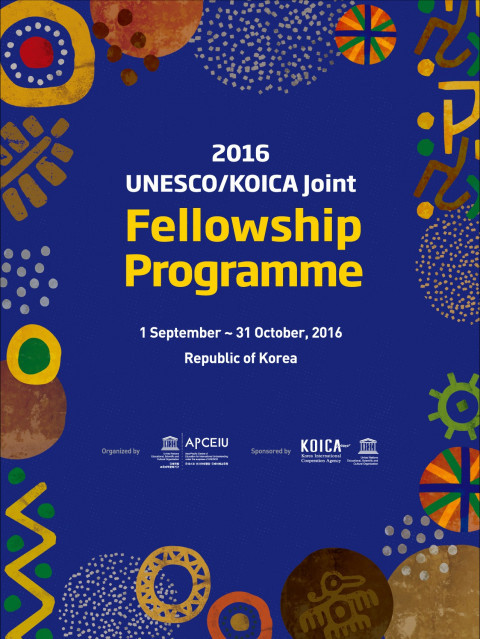 Final Report: 2016 UNESCO/KOICA Joint Fellowship Programme 발행 연도: 2016 단체 저자: APCEIU This report provides an overview of the activities carried out during the 2016 UNESCO/KOICA Joint Fellowship Programme held in Republic of Korea from 1 September - 31 October, 2016.In its 10th year of implementation, UNESCO/KOICA Joint Fellowship Programme 2016 invited 25 educators from 17 countries in Africa and the Asia-Pacific region for two months; from September 1st to October 31st. The overarching goal of the Programme was to enhance the capacities of participating educators under the themes of “Teacher Training for Basic Education,” “Use of ICT for Education (or e-Learning),” “Leadership in Global Education” and “Girls’ Education.” Composed of various segments such as lectures, workshops, hands-on activities, and seminars, which were closely interlinked with each module, the modules were designed to enable the participants to reorient their perspectives on educational development, to gain essential knowledge and skills, and furthermore to produce meaningful and relevant outputs that could be widely applied in their local contexts.For more information, please contact APCEIU's Office of Education and Training at ent@unescoapceiu.org. 2016 한-유네스코 펠로우십 프로그램 최종보고서 발행 연도: 2016 단체 저자: APCEIU 본 보고서는 2016년 9월 1일부터 10월 31일까지 열린 ‘2016 한-유네스코 펠로우십 프로그램’에서이루어진 활동 내용과 성과물에 대한 요약을 담고 있다. 올해 10회를 맞이하는 본 프로그램에는 아시아태평양 및 아프리카 17개국 25명의 교육자들이 참가하였으며, 두 달간 기초교육, ICT교육(e-러닝), 세계시민교육 및 소녀교육의 4가지 주제영역에 대한 참가자들의 이해 증진과 역량강화를 위한 연수로 진행되었다. 이 보고서를 통해, 다양한 주제관련 강의, 워크숍, 현장학습활동, 교육자료 개발 프로젝트 등으로 이루어진 이 프로그램의 내용과 참가자들의 교육현장에서 의미 있게 적용될 수 있는 결과물과 실행계획 등 성과에 대한 내용을 살펴볼 수 있다. 문의: 유네스코 아태교육원 교육연수실(ent@unescoapceiu.org)
  Regional overview: Central and Eastern Europe and Central Asia 발행 연도: 2015 단체 저자: UNESCO Central and Eastern Europe (CEE) and Central Asia (CA) have both made significant advances towards Education for All (EFA) since 1999. However, the 2015 EFA Global Monitoring Report shows that despite progress, Education For All remains unfinished business, including in Central and Eastern Europe and in Central Asia. This must be taken into account in the post-2015 agenda.
 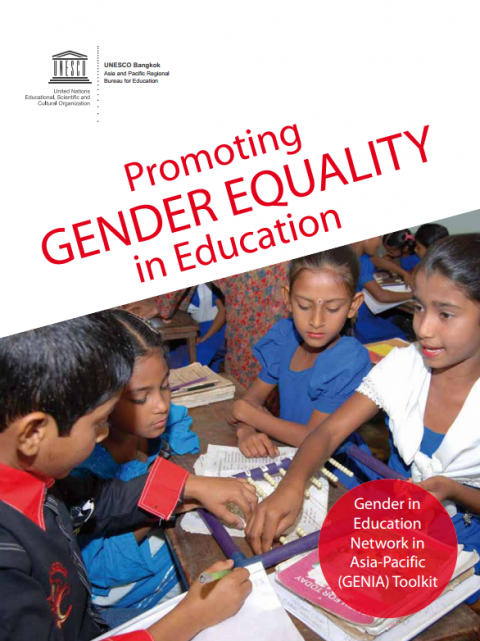 Promoting gender equality in education 발행 연도: 2009 단체 저자: UNESCO Kathmandu This publication was originally designed in 2003 when the Gender in Education Network in Asia-Pacific (GENIA) was established. Few gender in education resources were available at that time, and until the 2006 version, documents were mainly intended to be used by GENIA members, who are representatives (gender focal points) from ministries of education in the Asia-Pacific region. GENIA members have been using the Toolkit to sensitize and train their national counterparts ever since. However, the Toolkit has not only been distributed and used by gender focal points, but also by other people who have heard about GENIA, and/or who were interested in the resource materials published by UNESCO Bangkok. For this reason, the Toolkit has been accessible via the UNESCO Bangkok website1 since 2006. As a result, anyone searching the Web for information on gender equality can easily access the Toolkit. This fourth edition of the Toolkit, thus, expands the scope of the target audience. The content has likewise been adapted accordingly in order to meet the needs of all who could potentially access it. The Toolkit also integrates existing information and tools designed by other national or international organizations dedicated to promoting and providing training on gender equality in education and other sectors. Further information from these sources is obtained by consulting the references section at the end of the Toolkit. The Toolkit is designed as a user-friendly resource. As such, a matrix is provided on pages 4 and 5 to indicate each tool’s potential for use, based on its relevance to each prospective user group. Still, every tool will have relevance to many contexts or situations and, therefore, we encourage you to make use of all the materials by adapting them to your country context.
 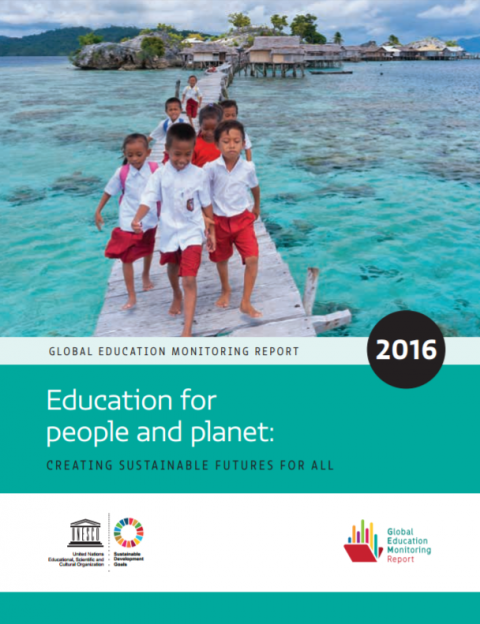 L'Education pour les peuples et la planète: créer des avenirs durables pour tous; Rapport mondial de suivi sur l'éducation, 2016 발행 연도: 2016 단체 저자: UNESCO | Global Education Monitoring Report Team The GEM Report provides an authoritative account of how education is the most vital input for every dimension of sustainable development. Better education leads to greater prosperity, improved agriculture, better health outcomes, less violence, more gender equality, higher social capital and an improved natural environment. Education is key to helping people around the world understand why sustainable development is such a vital concept for our common future. Education gives us the key tools – economic, social, technological, even ethical – to take on the SDGs and to achieve them. These facts are spelled out in exquisite and unusual detail throughout the report. Yet the report also emphasizes the remarkable gaps between where the world stands today on education and where it has promised to arrive as of 2030. Образование в интересах людей и планеты: построение устойчивого будущего для всех 2016 г 발행 연도: 2016 단체 저자: UNESCO | Global Education Monitoring Report Team Всемирный доклад по мониторингу образования (ВДМО), ранее известный как Всемирный доклад по мониторингу образования для всех, является независимым по содержанию, авторитетным и основанным на фактическом материале ежегодным докладом, который публикуется ЮНЕСКО, о ходе работы по осуществлению глобальных целей и задач в сфере образования, принятых международным сообществом в 2015 г. в качестве элемента целей в области устойчивого развития (ЦУР). Его цель – отслеживать ход работы по выполнению задач в сфере образования, которые являются элементами нового комплекса целей в области устойчивого развития (ЦУР). Подготовкой содержания ВДМО и обеспечением его качества занимается опытная группа сотрудников под руководством директора ВДМО.ВДМО – это единственное в своем роде, всеобъемлющее, аналитическое и авторитетное справочное издание для мониторинга и обзора сферы образования в глобальном масштабе. За период с 2002 г., в течение которого вышло в свет 12 изданий доклада, группа по его подготовке приобрела обширный опыт в вопросах мониторинга и стратегического анализа, а также снискала высочайшую общемировую репутацию за широкий тематический охват – от проблем неравенства, гендерных отношений и преподавания до конфликтов, грамотности, ухода за детьми младшего возраста и их обучения.Цель доклада – обеспечивать информацию и оказывать влияние на уровне национальной, региональной и международной политики в области образования, в том числе в сферах финансирования и оказания помощи, посредством авторитетного фактологического обзора прогресса и сбалансированного анализа наиболее острых проблем, стоящих перед странами и другими заинтересованными сторонами. В этой публикации тщательно рассматриваются детали масштабной повестки дня для проведения реформы образования; она рассчитана прежде всего на лиц, принимающих решения: министров, политиков, парламентариев, специалистов по планированию в сфере образования.Не менее значимым является более широкий спектр групп гражданского общества, включая ассоциации преподавателей, неправительственные организации, университетские исследовательские кадры, молодежные сети и средства массовой информации. Способствуя более широкому осмыслению вопросов образования, доклад открывает возможности для обсуждения, обмена опытом и просвещения.Презентации доклада на глобальном, региональном и национальном уровнях, организуемые в течение года во всех регионах мира, активно освещаются в прессе и вызывают большой интерес на местах. Помимо этих мероприятий, ознакомление с докладом все чаще сопровождается политическими семинарами для вовлечения руководящих должностных лиц и парламентариев в дискуссии, посвященные ключевым темам и рекомендациям доклада. Ознакомление с изложенными в докладе выводами происходит также в ходе министерских совещаний, международных ученых конференций, курсов профессиональной подготовки для практических специалистов в области образования и семинаров с участием представителей правительств, доноров, НПО, исследователей и преподавателей. Кроме того, они распространяются через средства массовой информации и социальные сети.Краткое изложение докладов ВДМО издается на всех шести языках ООН (английском, арабском, испанском, китайском, русском и французском), а также на ряде других языков (включая бангла, вьетнамский, индонезийский, кхмерский, немецкий, португальский, тайский, хинди и японский). Полный текст доклада также издается на официальных языках ООН. Все версии наряду со справочными документами и статистическими данными размещаются на этом веб-сайте. Education for People and Planet: Creating Sustainable Futures for All, Global Education Monitoring Report, 2016 발행 연도: 2016 단체 저자: UNESCO | Global Education Monitoring Report Team Education for People and Planet: Creating Sustainable Futures for All explores the complex relationship between education and the new 2030 Agenda for Sustainable Development, covering six fundamental pillars – Planet, Prosperity, People, Peace, Place and Partnerships. This report shows that education will not deliver its full potential unless participation rates increase dramatically and sustainable development guides education system reform. It also warns of the destructive impact that climate change, conflict, unsustainable consumption and the increasing gap between rich and poor have on education. A huge transformation is needed if we are to create sustainable futures for all. Informe de Seguimiento de la Educación en el Mundo, 2016: La Educación al servicio de los pueblos y el planeta: creación de futuros sostenibles para todos 발행 연도: 2016 단체 저자: UNESCO | Global Education Monitoring Report Team Education for People and Planet: Creating Sustainable Futures for All explores the complex relationship between education and the new 2030 Agenda for Sustainable Development, covering six fundamental pillars – Planet, Prosperity, People, Peace, Place and Partnerships. This report shows that education will not deliver its full potential unless participation rates increase dramatically and sustainable development guides education system reform. It also warns of the destructive impact that climate change, conflict, unsustainable consumption and the increasing gap between rich and poor have on education. A huge transformation is needed if we are to create sustainable futures for all.
 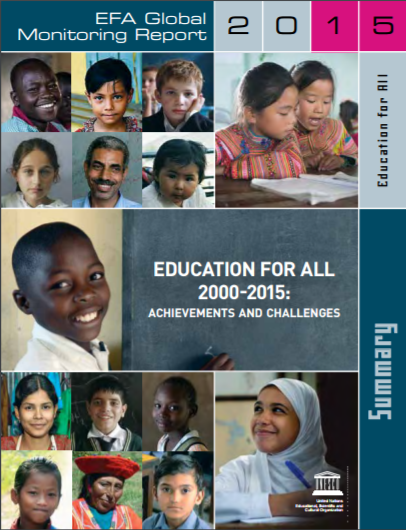 Education for All 2000-2015: Achievements and Challenges; EFA Global Monitoring Report, 2015; Summary 발행 연도: 2015 단체 저자: UNESCO At the World Education Forum in Dakar, Senegal, in 2000, governments from 164 countries, together with representatives of regional groups, international organizations, donor agencies, non-government organizations (NGOs) and civil society, adopted a Framework for Action to deliver Education for All (EFA) commitments. The Dakar Framework comprised 6 goals and their associated targets to be achieved by 2015, and 12 strategies to which all stakeholders would contribute. The EFA Global Monitoring Report (GMR) has monitored progress on an almost annual basis towards the EFA goals and the two education-related Millennium Development Goals (MDGs). The 2015 GMR provides a complete assessment of progress since 2000 towards the target date for reaching the Dakar Framework’s goals. It takes stock of whether the world achieved the EFA goals and stakeholders upheld their commitments. It explains possible determinants of the pace of progress. Finally, it identifies key lessons for shaping the post-2015 global education agenda. Other lang. title: L'Education pour tous 2000-2015: progrès et enjeux, rapport mondial de suivi sur l'EPT, 2015, résumé; La Educación para Todos, 2000-2015: logros y desafíos, informe de seguimiento de la EPT en el mundo, 2015, resumen 발행 연도: 2015 단체 저자: UNESCO At the World Education Forum in Dakar, Senegal, in 2000, governments from 164 countries, together with representatives of regional groups, international organizations, donor agencies, non-government organizations (NGOs) and civil society, adopted a Framework for Action to deliver Education for All (EFA) commitments. The Dakar Framework comprised 6 goals and their associated targets to be achieved by 2015, and 12 strategies to which all stakeholders would contribute. The EFA Global Monitoring Report (GMR) has monitored progress on an almost annual basis towards the EFA goals and the two education-related Millennium Development Goals (MDGs). The 2015 GMR provides a complete assessment of progress since 2000 towards the target date for reaching the Dakar Framework’s goals. It takes stock of whether the world achieved the EFA goals and stakeholders upheld their commitments. It explains possible determinants of the pace of progress. Finally, it identifies key lessons for shaping the post-2015 global education agenda.