
자료
세계시민교육에 대한 이해를 넓히고 연구, 옹호 활동, 교수, 학습 등을 향상시킬 수 있는 다양하고 유용한 자료를 찾아보세요.
114 건의 결과가 검색되었습니다
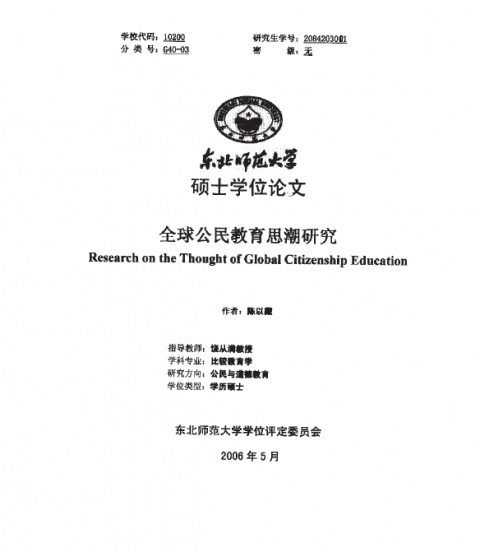 Research on the Thought of Global Citizenship Education 발행 연도: 2006 저자: Chen Yicang Based on the literature review, the thesis tries to expound the thought of global citizenship education, by ascending to the its origin and development, exploring the characteristics of the conceptions of global citizenship and education for global citizenship, and examining its influences.The paper is comprised of a preface and four parts. Part 1 mainly examines the origin and development of the thought of global citizenship education. The characteristcs of the thought in different stages are analyzed according to the threestage division of the history: pre-modern times, mordern times and post-modern times. Part2 explores into the characteristics of the conception of global citizenship after analyzing the features of modern citizenship, examining the challenges of globalization for the modern citizenship.Part3 mainly examines and analuzes the conception of education for global citizenship.Part4 provides a brief evaluation of the thought of education for citizenship on the basis of summarizing the characteristics of the thought of education for global citizenship, and examining the effect of the thought upon the educational theory and practice. 全球公民教育思潮研究 발행 연도: 2006 저자: Chen Yicang 通过教育使个体成为一个合格的公民,这是每个民族国家对成员个体发展的基本期望,也是教育最基本的目标之一。正是由于这样的背景,公民资格和公民教育理论,不断得到发展。然而自20世纪80年尤其是90年代以来,随着全球化趋势的增强以及全球化论的兴起,公民的定位、现代公民资格理论以及公民教育理论不断受到了挑战。全球公民教育教育思想就是在这样的背景形成了一股思潮。这一思潮在发达国家的教育实践中已经有所体现。我国已经加入了世界贸易组织,与国际交往日益扩大和加深。因此,在全球化的浪潮中,我国的公民教育怎样应对全球化的挑战,是一个必须面对的课题。因此,研究全球公民教育思潮,其意义是不言而喻的。本文主要基于文献研究,考察与分析全球公民教育思潮,追溯其历史渊源和发展历程,探讨全球公民资格观和全球公民教育观的特征及其影响。本文共由绪论和正文四个部分组成。第一部分主要是追溯全球公民教育思想的历史渊源和发展历程,按照前现代时期、现代时期和后现代时期这一历史分期,考察和分析了全球公民教育思想在每个阶段的特征。第二部分在分析了现代公民资格观的特征、全球化对现代公民资格观的挑战之后,探讨了全球公民资格观的内涵。第三部分主要分析和考察了全球公民教育观的主要内容。第四部分在归纳和总结了全球公民教育思潮的特征和考察了全球公民教育思潮的理论和实践性影响的基础上,对其作了简短的评价。
  Globalising the school curriculum: gender, EFA and global citizenship education (RECOUP working paper 17) 발행 연도: 2008 저자: Harriet Marshall | Madeleine Arnot 단체 저자: Research Consortium on Educational Outcomes and Poverty (RECOUP) This paper aims to bring the school curriculum into the analysis of gender, education and development. There is a marked absence of discussion both in the academic field of development studies and in the political domain of educational policy making around Education for All about what is required of the school curriculum so that it could help promote gender equality. All too often national school curricula reproduce gender inequalities in the public and private sphere and sustain hegemonic male regimes on a national and global scale (Arnot, 2002). Curriculum research, however, can challenge these social messages embedded in curricular formations as well as raise deeper questions about whose forms of knowledge should be transmitted through official forms of schooling. Critical sociological research, for example, recognises the importance of the rules governing the access and redistribution of knowledge, and also the politics behind the selection, organisation and evaluation of legitimate knowledge through formal national educational institutions within developing economies and the impact these have on indigenous social stratifications. It can also critically assess new global interventions into the school curriculum whether in the name of economic progress, human rights or social justice. These global developments are controversial not least because of the challenge they represent to what has been considered the prerogative of national governments – to transmit its own selection of educational knowledge to its citizens, using its own contextualised pedagogic style. The study of national curricula therefore offers the possibility of exploring the equity dimensions of global–national and local educational interfaces and policy agendas. The paper has limited but hopefully valuable ambitions. It aims to initiate discussion of the curriculum in relation to gender, education and development by exploring the global significance of recent interventions on gender, and in particular girls’ education. The first section briefly considers the implications of globalisation as a transformative process on the development of educational knowledge and queries whether the school curricula could address persistent worldwide gender disparities, inequalities and female subjugation. In the second section, we focus specifically on whether new global declarations around gender equality such as those analysed in the UNESCO Education for All Global Monitoring Reports imply certain roles for the school curriculum. The final section addresses the possibilities for gender equality implied by recent interest global citizenship education – a new curriculum subject and approach that promises much. We consider in a preliminary way whether these new developments represent a move towards forms of educational knowledge that are critical rather than legitimating and ‘normalising’ in relation to gender inequalities. Mondialiser le programme scolaire: le sexe, l'EPT et L'éducation à la Citoyenneté Mondiale (ECM) (papier de travail 17) 발행 연도: 2008 저자: Harriet Marshall | Madeleine Arnot 단체 저자: Research Consortium on Educational Outcomes and Poverty (RECOUP) Ce document vise à amener le programme scolaire dans l'analyse de genre, l'éducation et le développement. Il y a une absence marquée de la discussion à la fois dans le domaine académique des études de développement et dans le domaine politique de la politique en matière d'éducation autour de l'éducation pour tous à propos de ce qui est requis du programme scolaire afin qu'il puisse aider à promouvoir l'égalité des sexes. Tous les programmes scolaires nationaux trop souvent reproduisent les inégalités entre les sexes dans le domaine public et privé et de soutenir les régimes de sexe masculin hégémonique à l'échelle nationale et mondiale (Arnot, 2002). la recherche des programmes, cependant, ne peut contester ces messages sociaux intégrés dans les formations scolaires ainsi que soulever des questions plus profondes sur dont les formes de connaissances doivent être transmises par le biais des formulaires officiels de scolarité. recherche sociologique critique, par exemple, reconnaît l'importance des règles régissant l'accès et la redistribution des connaissances, ainsi que la politique derrière la sélection, l'organisation et l'évaluation des connaissances légitimes par les institutions éducatives nationales officielles dans les économies en développement et de l'impact qu'elles ont sur autochtones stratifications sociales. Il peut également évaluer de façon critique les nouvelles interventions mondiales dans le programme scolaire que ce soit au nom du progrès économique, les droits de l'homme ou de la justice sociale. Ces développements mondiaux sont controversés pas moins à cause du défi qu'ils représentent pour ce qui a été considéré comme la prérogative des gouvernements nationaux - de transmettre sa propre sélection de connaissances sur l'éducation de ses citoyens, en utilisant son propre style pédagogique contextualisée. L'étude des programmes nationaux offre donc la possibilité d'explorer les dimensions d'équité des interfaces éducatives globales nationales et locales et les agendas politiques. Le papier a des ambitions limitées mais nous espérons précieux. Il vise à engager un débat sur le programme d'études en fonction du sexe, de l'éducation et le développement en explorant l'importance mondiale des récentes interventions sur le sexe, et en particulier l'éducation des filles. La première section examine brièvement les implications de la mondialisation comme un processus de transformation sur le développement des connaissances et des requêtes si les programmes scolaires pourraient remédier aux disparités persistantes entre les sexes dans le monde, les inégalités et la subordination des femmes de l'éducation. Dans la deuxième section, nous nous concentrons particulièrement sur le fait de nouvelles déclarations globales autour de l'égalité des sexes, tels que ceux analysés dans UNESCO sur l'Education pour tous rapports globaux Suivi impliquent certains rôles pour le programme scolaire. La dernière section porte sur les possibilités d'égalité entre les sexes impliqués par l'intérêt récent L'éducation à la citoyenneté Mondiale (ECM) - un nouveau sujet de curriculum et de l'approche qui promet beaucoup. Nous considérons de façon préliminaire si ces nouveaux développements représentent une évolution vers des formes de connaissances pédagogiques qui sont essentielles plutôt que légitimant et «normalisation» par rapport aux inégalités entre les sexes. Global citizenship: abstraction or framework for action 발행 연도: 2006 저자: Lynn Davies 단체 저자: Educational Review This paper explores whether the notion of ‘global citizenship’ is too abstract to be valuable in driving curriculum policy and active citizenship for students. The paper looks firstly at three of the key aspects of an active role: a concern for social justice; rights; and culture and cultural conflict. It then examines actual curricula and programmes of study for global citizenship, and compares the conceptual frameworks, progression routes and emphases within these curricula. It moves on to review the research on teachers’ practices and orientations in teaching global citizenship, finding some variation and problems, particularly in areas such as teaching controversial issues. Factors in successful impact of global citizenship education are outlined, such as various forms of democratic decision-making and community service. Constraints are nonetheless identified of curriculum overload, resources, time and confidence. The paper then describes existing research on the needs and wishes of learners within global citizenship. The conclusion confirms the consensus on the importance of global citizenship and argues that it can be turned into a more radical and politicised curriculum area; however, more research is needed on impact of the learning, including research by students themselves. Global citizenship: abstraction or framework for action 발행 연도: 2006 저자: Lynn Davies 단체 저자: Educational Review Cet article examine si la notion de ‘citoyenneté mondiale’ est trop abstraite pour être utile dans la conduite de la politique des programmes et la citoyenneté active pour les étudiants. Le document examine tout d'abord à trois des aspects clés d'un rôle actif: un souci de justice sociale; droits; et de la culture et de conflits culturels. Il examine ensuite les programmes et les programmes d'études à la citoyenneté mondiale réelle, et compare les cadres conceptuels, des voies de progression et emphases au sein de ces programmes. Il se déplace en revue les recherches sur les pratiques et les orientations des enseignants dans l'enseignement de la citoyenneté mondiale, de trouver une certaine variation et des problèmes, en particulier dans des domaines tels que l'enseignement des questions controversées. Facteurs de succès de l 'éducation à la citoyenneté mondiale sont exposés, tels que les diverses formes de prise de décision démocratique et le service communautaire. Les contraintes sont néanmoins identifiées de la surcharge des programmes, les ressources, le temps et la confiance. Le document décrit ensuite les recherches existantes sur les besoins et les souhaits des apprenants au sein de la citoyenneté mondiale. La conclusion confirme le consensus sur l'importance de la citoyenneté mondiale et fait valoir qu'il peut être transformé en une zone de curriculum plus radicale et politisée; cependant, plus de recherche est nécessaire sur l'impact de l'apprentissage, y compris la recherche par les étudiants eux-mêmes. How can you embed global citizenship in your curriculum? 발행 연도: 2012 단체 저자: National Committee for International Cooperation and Sustainable Development (NCDO) This handbook offers tips, guidelines and inspiration for embedding global citizenship in your curriculum. It also helps your school answer the following questions: 1. What do you want to achieve? 2. Where is your school today? 3. What needs to be done? 4. Where to start? This publication is not a blueprint for embedding global citizenship in secondary education, but hopefully it will help you on your way to achieving that goal. Comment pouvez-vous intégrer la citoyenneté mondiale dans votre curriculum? 발행 연도: 2012 단체 저자: National Committee for International Cooperation and Sustainable Development (NCDO) Ce guide propose des conseils, des orientations et des idées pour intégrer la citoyenneté mondiale dans votre curriculum. Il aide également votre école de répondre aux questions suivantes: 1. Que voulez-vous atteindre? 2. Où est votre école aujourd'hui? 3. Que faut-il faire? 4. Où commencer? Cette publication ne constitue pas un plan pour intégrer la citoyenneté mondiale dans l'enseignement secondaire, mais nous espérons qu'il vous aidera sur votre chemin pour atteindre cet objectif. Quelques réflexions sur le progrès, le développement durable et la citoyenneté globale 발행 연도: 2013 저자: Georges Haddad 단체 저자: UNESCO The arguments developed in this concise presentation demonstrate that sustainable development, progress and global citizenship, efficiently embedded in the context of the Knowledge Society, undeniably participate in the development of the New Humanism promoted by the Director-General of UNESCO, and which we all agree to consider essential for the wealth and prosperity of Humanity in an agreeable, peaceful and friendly common environment.
  Strengthening the Rule of Law Through Education: A Guide for Policymakers 발행 연도: 2019 단체 저자: UN. Office on Drugs and Crime (UNODC) | UNESCO The new joint publication by UNESCO and UNODC Strengthening the Rule of Law through Education: A Guide for Policymakers explores the role that education institutions can play in promoting the rule of law and building new forms of engagement based on global citizenship, human rights and inclusion -- all of which are vital to take forward the Sustainable Development Goal 4 on education, at the heart of the 2030 Agenda for Sustainable Development. Strengthening the Rule of Law through Education: A Guide for Policymakers is intended for education policymakers and other professionals working in the formal education sector, within and outside Ministries of Education, and who are seeking to promote the rule of law and a culture of lawfulness.The guide may also be of interest to professionals working in non-formal education settings or other sectors – namely the justice, social and health sectors - in the area of crime and violence prevention, who are seeking to work more closely with the education sector. In particular, the guide offers:An explanation of key concepts, such as the rule of law and a culture of lawfulness, as well as outlining the role of education in upholding and promoting the rule of law; Guidance on how the education sector is able to strengthen and promote the rule of law, for instance, by speaking to the real learning needs of children and youth, and by ensuring that places of learning “practice what they preach”; A map of the necessary support systems needed to strengthen the rule of law at the school and classroom levels and outside formal education settings, including curricular support, classroom pedagogies, teacher training and development and school-family-community partnerships.