
자료
세계시민교육에 대한 이해를 넓히고 연구, 옹호 활동, 교수, 학습 등을 향상시킬 수 있는 다양하고 유용한 자료를 찾아보세요.
224 건의 결과가 검색되었습니다
 ASPnet strategy for 2014-2021 global network of schools addressing global challenges: building global citizenship and promoting sustainable development 발행 연도: 2014 단체 저자: UNESCO Associated Schools Project Network (ASPnet) Over the next 8 years (2014-2021), ASPnet needs to respond to the needs of education in a rapidly changing and increasingly complex world. The following strategy, therefore, has to remain flexible and requires regular re-evaluation in the light of a changing environment. Globalization and growing interconnectedness ask for increased networking and cooperation. ASPnet has proven to have a great potential for global school networking and educational innovations, which remain largely untapped. UNESCO can make much fuller use of ASPnet in its quest for and implementation of a successful Post-2015 Global Education Agenda.
 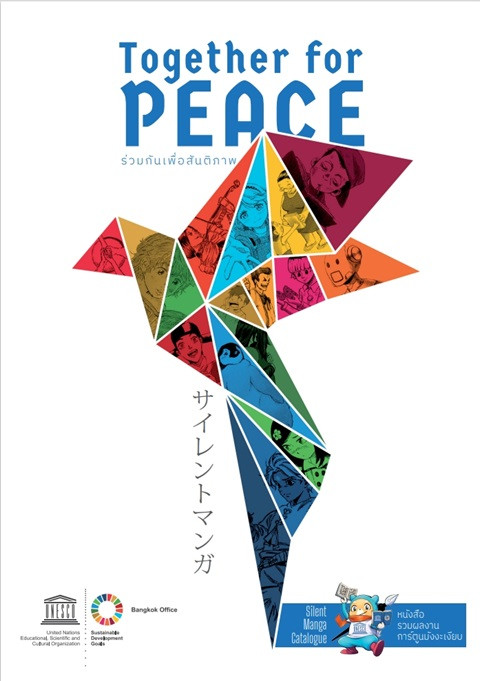 Together for Peace: Silent Manga Catalogue 발행 연도: 2020 저자: Walden Schertz | Jeremy Clay | Santibhap Ussavasodhi 단체 저자: UNESCO Bangkok | Coamix This Together for Peace Silent Manga Catalogue is a compilation of silent manga – manga stories told entirely through illustration without the use of dialogue. These works of art were selected from 274 entries submitted by artists in 117 countries worldwide to join SILENT MANGA AUDITION® Round 13 held under the theme Together for Peace, in collaboration with UNESCO Bangkok, the Asia and Pacific Regional Bureau for Education. Silent manga is a powerful medium of communication in the Asia-Pacific. Although the region is the most diverse in the world, it can be enjoyed by anyone regardless of their background. Silent manga has no language barrier. These works showcase different reflections of peace as expressed by artists around the world while conforming to the Japanese manga style.
  International Symposium on Cultivating Wisdom, Harvesting Peace: Educating for a Culture of Peace through Values, Virtues, and Spirituality of Diverse Cultures, Faiths, and Civilizations; Symposium Recommendations 발행 연도: 2005 단체 저자: Griffith University. Multi-Faith Centre On the 10-13th August 2005, over 120 delegates from 25 countries gathered at the International Symposium to share their inspirational insights and experiences on the theme of “Cultivating Wisdom, Harvesting Peace.” The Symposium was organized and hosted by the Multi-Faith Centre of Griffith University, Brisbane, Australia with the support of Pure Land Learning College, UNESCO and various UNESCO National Commissions, centres or offices, and numerous faith, interfaith, educational and civil society organizations and institutions. Reflecting a diversity of cultures, faiths and spirituality traditions, the delegates presented rich and empowering stories as well as critical analyses of how communities, institutions, civil society organizations, and international or global agencies have organized educational projects and programs to address the root causes of violence and conflicts and build a culture of peace at all levels of life. Over four intensive days of inter-faith and intra-faith dialogue, the Symposium participants engaged with humility and passion in sharing their wisdoms on ways to promote mutual understanding, solidarity, and cooperation across cultures and national boundaries. While recognizing that differences between faiths and cultures need to be understood, the dialogue also clearly showed that all faiths, cultures, and civilizations have, at their core, key values, virtues, and ethical principles that inspire and sustain peaceful relationships, communities and societies.The Symposium also highlighted the urgent need for exemplars and possibilities for transforming principles, values and visions into personal and social actions and practices in all the multiple dimensions of a culture of peace. In this first decade of the 21st century, it is clear that there are still many formidable challenges of building peace posed by prevailing realities of conflicts and violence in local, national, international and global contexts. The Symposium on “Cultivating Wisdom, Harvesting Peace” was therefore a most timely and relevant event, not only for promoting the urgent dialogue needed, but also most importantly in proposing constructive policies for educational transformation worldwide. This Summary of the Symposium Recommendations will hopefully be a very helpful document for the implementation of effective and creative strategies and practices of educating for wisdom towards a culture of peace. It is offered to government leaders, policy makers, educators, and leaders and members of diverse faith and interfaith institutions and communities in all societies and regions, in the hope that we will join our minds, hearts and spirit in solidarity to build a “one world” of peace, compassion, justice, love and diverse shared values for the well being of a common humanity and earth community
  Encountering Global Citizenship Education in Schools: Stories of School Teachers on GCED 발행 연도: 2016 단체 저자: APCEIU Titled “Encountering Global Citizenship Education in Schools: Stories of School Teachers on GCED,” the book includes stories of 11 GCED Lead Teachers focusing on the practical implementation of GCED in real educational setting. Readers will be able to learn from the experiences of those teachers, who worked to implement GCED in the field of education. Moreover, this publication provides an opportunity for educators from small primary schools in rural areas to the high schools in big cities, to think about the implications associated with GCED and how GCED can be used for students from diverse backgrounds and various ages. The stories included in the book are as follows: • GCED Starts from the Horizontal Relationships • GCED Practices in Small Schools • Doing by Learning, Learning by Doing • To View Social Issues from the Children's Perspective • Living through Communication with the People of Earth • Meeting Global Citizens in Jeju • Beginning of GCED with Students and Teachers • Starting with a Slow Change : The Story of a Candle • GCED with the views of the Children • A Path to the Future, Walking with Teachers to GCED • GCED is to Search for Values in Daily Lives
  Final Report: 2nd Youth Leadership Workshop on Global Citizenship Education 발행 연도: 2016 단체 저자: APCEIU This report provides an overview of the activities carried out during the 2nd Youth Leadership Workshop on Global Citizenship Education (GCED) held in Busan, Republic of Korea, from 11 - 16 July 2016. As an APCEIU's 2nd youth workshop, this programme gathered 49 youth activists from 38 countries around the world to exchange their ideas and identify GCED leadership strategies in order to mobilize young people for GCED in local and national contexts and advance the agenda globally. This report also aims to convey the voice of the youth on GCED: their thoughts and reflections on GCED and its priority areas. The workshop was co-organized by APCEIU and UN Secretary General’s Global Education First Initiative (GEFI); it was sponsored by Busan University of Foreign Studies and the Geum-jeong District of Busan Metropolitan City. For more information, please contact APCEIU's Office of Education and Training at ent@unescoapceiu.org.
  Final Report: 2016 UNESCO/KOICA Joint Fellowship Programme 발행 연도: 2016 단체 저자: APCEIU This report provides an overview of the activities carried out during the 2016 UNESCO/KOICA Joint Fellowship Programme held in Republic of Korea from 1 September - 31 October, 2016.In its 10th year of implementation, UNESCO/KOICA Joint Fellowship Programme 2016 invited 25 educators from 17 countries in Africa and the Asia-Pacific region for two months; from September 1st to October 31st. The overarching goal of the Programme was to enhance the capacities of participating educators under the themes of “Teacher Training for Basic Education,” “Use of ICT for Education (or e-Learning),” “Leadership in Global Education” and “Girls’ Education.” Composed of various segments such as lectures, workshops, hands-on activities, and seminars, which were closely interlinked with each module, the modules were designed to enable the participants to reorient their perspectives on educational development, to gain essential knowledge and skills, and furthermore to produce meaningful and relevant outputs that could be widely applied in their local contexts.For more information, please contact APCEIU's Office of Education and Training at ent@unescoapceiu.org.
 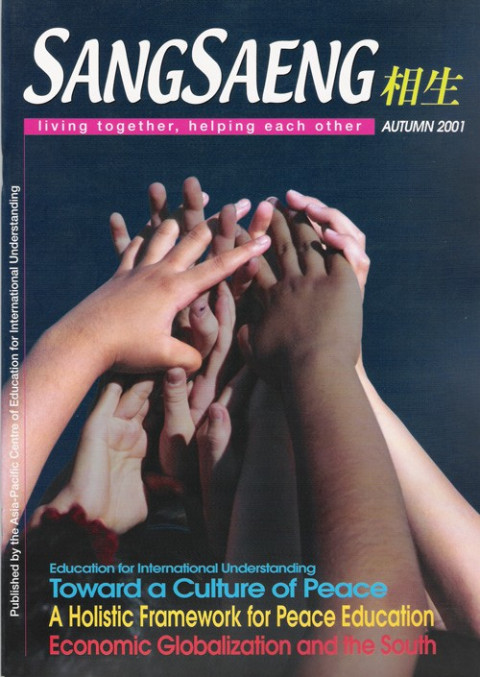 Education for international understanding: toward a culture of peace (SangSaeng vol1. autumn 2001) 발행 연도: 2001 저자: Swee-Hin Toh 단체 저자: APCEIU Over the past several decades of political, economic, social and cultural changes and developments throughout the world, the idea of education for international understanding (EIU) has evolved through the work of innumerable educators, researchers, institutions and organizations. Initially, the focus in school and tertiary programs tended to emphasize the need to increase the level of knowledge about other nations, societies and cultures as a key means to promote better, more “peaceful” international (economic and political) and intercultural relations. Especially in universities of the “North,” area studies of different regions and countries expanded and found their way into school-based curricula. In part, EIU was deemed important and helpful in the development of human resources needed to implement foreign aid programs. It was also a response to the increased internationalization of campuses due to the growing numbers of foreign/overseas students. By the 60s, however, a variety of social and political forces and movements were beginning to impact on this earlier focus of EIU. First, it was no longer viewed only in terms of understanding the relations between “nations” or “societies” across political and economic boundaries. EIU would need also to look closely at local and internal issues, and at problems of one’s own society that might significantly influence the direction and nature of international relations. Furthermore, conceptual perspectives on EIU began to reflect a spectrum of frameworks of understanding and analysis, from “conservative” and “liberal” to more “critical” paradigms. Underpinning the critical approaches was a questioning of the power inequities characterizing the international order of nation-states, and the need to overcome such gaps if the original vision of “world peace” was to be fulfilled. Third, the evolving theory and practice of EIU took on a host of societal, international and increasingly global issues deemed urgent at all levels of life.
  Video sketch: Global Youth Advocacy Workshop on GCED 발행 연도: 2015 단체 저자: APCEIU APCEIU produced a video on the Global Youth Advocacy Workshop on GCED held in Busan, Republic of Korea, from 30 March to 4 April 2015. The workshop invited 45 youth participants from 34 countries around the world, who are actively engaged with and committed to advocating and educating youth for GCED in their local contexts.This short video sketch of the workshop provides an overview of the activities carried out during the workshop and also includes the interviews of the participants, who shared their expectations, impressions, and reflections on the workshop.The workshop was co-organized by APCEIU, UN Secretary General’s Global Education First Initiative (GEFI), and the UNESCO Mahatma Gandhi Institute of Education for Peace and Sustainable Development (MGIEP); and sponsored by Educate A Child and the Geum-jeong District of Busan Metropolitan City.
 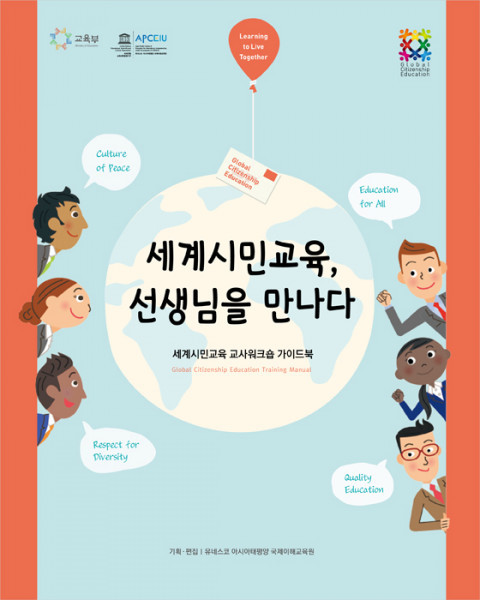 GCED Meets Teachers: GCED Teacher Workshop Guidebook 발행 연도: 2015 단체 저자: APCEIU APCEIU published the GCED teacher workshop guidebook “GCED meets teachers.” This guidebook will be used at GCED workshops for teachers of 17 metropolitan and provincial offices of education carried out by GCED Lead teachers. The contents include the concept and the background of GCED, main contents, implementing methods at school. This GCED workshop manual provides teachers with opportunities to search for the ways to implement GCED at the schools, experience learning methods, and understand the main issues and themes of GCED through workshops. This guidebook is composed of 7 workshop sessions(refer to list below). Teachers and teacher educators planning GCED workshop can use this guidebook which includes the contents of the sessions, consultation to help plan and implement workshops based on participation and communication of the participants. “Global Citizenship Education meets teachers” GuidebookSession 1. Importance of World Education Forum and Global Citizenship EducationSession 2. Concept of GCED and its backgroundSession 3. Learning the contents and the theme of GCEDSession 4. Understanding the complexity and interrelationship of the issuesSession 5. Discussion class for cooperative communicationSession 6. Implementing GCED through Project Based LearningSession 7. Setting GCED action plans
  Global youth advocacy workshop on GCED: final report 발행 연도: 2015 단체 저자: APCEIU The United Nations Secretary-General's Global Education First Initiative (GEFI) recognizes Global Citizenship Education (GCED) as one of its three priorities. UNSG GEFI has generated momentum for GCED which has since been in the target of the education goal in the Muscat Agreement 2014 and in the proposed Sustainable Development Goals (SDGs) of the Open Working Group. The proposed SDGs will provide the basis for further intergovernmental negotiations on the post 2014 development agenda.In support of UNSG GEFI, UNESCO held its Second Global Forum on Global Citizenship Education on Building Peaceful and Sustainable Societies: Preparing for Post-2015 from 28 to 30 January 2015 in Paris, France. The forum aimed to identify GCED related inputs to the emerging Framework for Action on Education for the post 2015 development agenda, as well as key dimensions of GCED in relation to peace. Furthermore, it had a concurrent session dedicated to youth on Driving the GCED Agenda Forward: Acting with and for Young People to assemble the perspectives, ideas, and priorities of youth on GCED. Against this background, the Global Youth Advocacy Workshop on GCED, co-organized by GEFI, the Asia-Pacific Centre of Education for International Understanding (APCEIU) and UNESCO's Mahatma Gandhi Institute of Education for Peace and Sustainable Development (MGIEP) aimed to build the capacity of dynamic youth leaders from countries around the world to advocate for GCED. The participants of the workshop were selected on the basis of their previous experiences, present engagement, and future commitment in educating youth at the local and national levels. The objectives of the workshop were: 1. To build a common understanding of GCED and its key priority areas by building on the dialogue initiated at the Paris GCED Forum.2. To allow the participating youth leaders to elaborate an advocacy strategy suitable for implementation at the local and national levels to advance the GCED agenda beyond 2015.3. To establish a wider network of youth advocates on GCED to advance the agenda globally.