
자료
세계시민교육에 대한 이해를 넓히고 연구, 옹호 활동, 교수, 학습 등을 향상시킬 수 있는 다양하고 유용한 자료를 찾아보세요.
224 건의 결과가 검색되었습니다
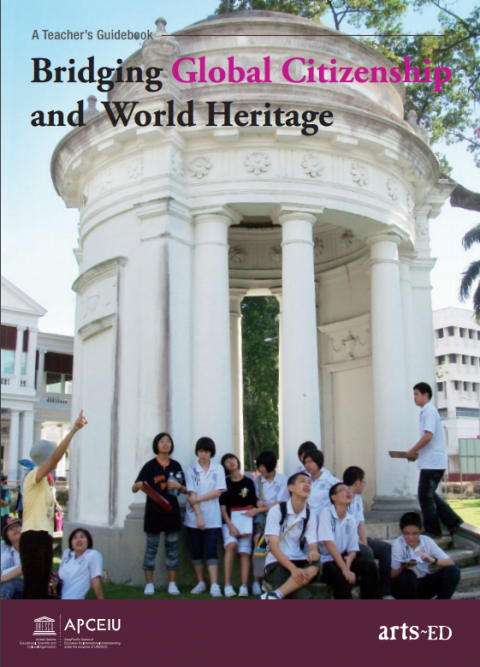 GCED Teacher's Guidebook Bridging Global Citizenship and World Heritage 발행 연도: 2016 단체 저자: APCEIU APCEIU, in collaboration with Arts-ED Penang, a non-profit organisation for art and culture education, has published a Global Citizenship Education(GCED) Teacher’s Guidebook Bridging Global Citizenship and World Heritage. This guidebook was developed as a project of GCED Material Development on World Heritage, in order to promote awareness of cultural diversity as well as mutual understanding. This Teacher’s guidebook not only provides literature on both World Heritage in Malaysia and GCED but also gives case examples and lesson plans to provide teachers with practical assistance in designing and conducting GCED class utilizing World Heritage. <Contents>ForewordList of Figures and ImagesChapter 1. Introduction to the World Heritage Site of George Town and MelakaChapter 2. Global Citizenship Education: Empowering Citizens to Create a Better World TogetherChapter 3. How to Design Lessons Using Global Citizenship Education and Heritage ResourcesChapter 4. Case Examples and Lesson PlansReferences
 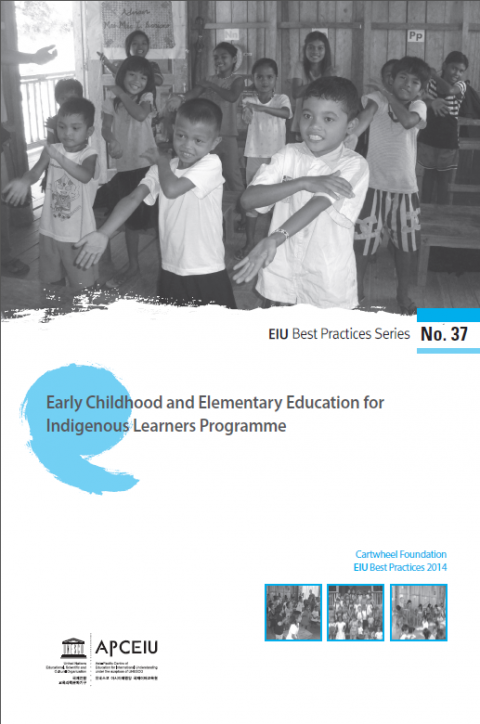 EIU Best Practices Series No.37: Early Childhood and Elementary Education for Indigenous Learners Programme 발행 연도: 2014 단체 저자: Centre Asie-Pacifique d'éducation pour la compréhension internationale (APCEIU) This monograph is one of APCEIU's EIU Best Practices Series, which aims to encourage educators, scholars, and activists to implement and share local initiatives on EIU. The Series No.37 introduces the Early Childhood and Elementary Education (ECEE) for Indigenous Learners Programme initiated in the Philippines. The indigenous peoples (IP) reside in the mountainous regions, away from basic social services and struggling with poverty, malnutrition, and lack of proper education. The aim of ECEE is to facilitate access to quality and culturally-relevant early childhood and elementary education for the Higaonon indigenous children. To achieve this, activities such as curriculum indigenization and teacher training are provided in collaboration with the community members. As the program creates learning process for all through openness, sharing, and collaboration, this is an exemplary case of EIU/GCED pedagogical approach.
 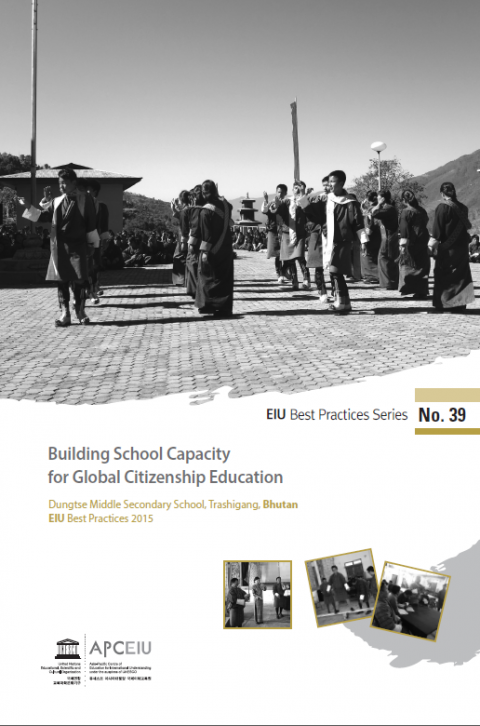 EIU Best Practices Series No.39: Building School Capacity for Global Citizenship Education: Dungtse Middle Secondary School, Trashigang, Bhutan 발행 연도: 2015 단체 저자: APCEIU This monograph is one of APCEIU's EIU Best Practices Series, which aims to encourage educators, scholars, and activists to implement and share local initiatives on EIU. The Series No.39 introduces the Training of Trainers (TOT) program, a workshop for teachers to better incorporate GCED/EIU concepts into respective curriculum and school environment. Upon participating in the APCEIU training workshop, Mr. Yeshi Dorji from Dungtse Middle Secondary School in Bhutan sought to create a forum in which teachers and school officials can learn to incorporate GCED. Such exemplary initiative not only enhances capacity building of educators in the school, but also has potential to have larger impact in the local and regional communities.
 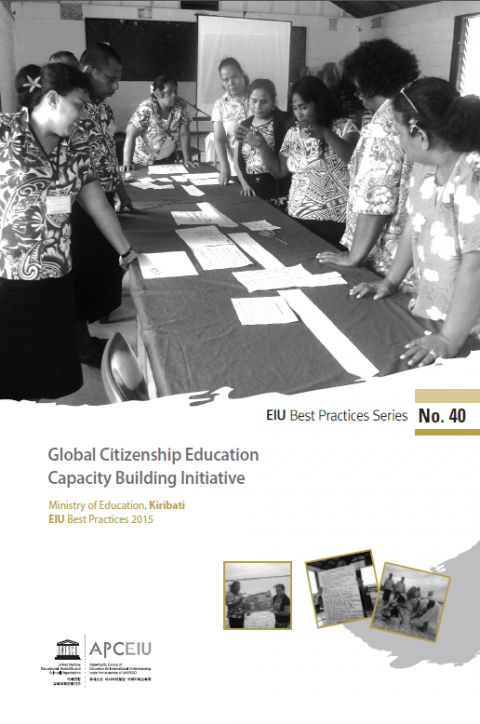 EIU Best Practices Series No.40: Global Citizenship Education Capacity Building Initiative: Misitry of Education, Kiribati 발행 연도: 2015 단체 저자: APCEIU This monograph is one of APCEIU's EIU Best Practices Series, which aims to encourage educators, scholars, and activists to implement and share local initiatives on EIU. The Series No. 40 introduces a successful hosting of workshop on GCED in Kiribati. Considered the first of its kind in Kiribati, the workshop brought together education officers and teachers to learn about emerging concept of GCED and EIU and means for implementation. The exemplary workshop involving fieldtrips and seminars has created a wave of learning opportunities for key stakeholders at all levels, paving way to put GCED into practice.
 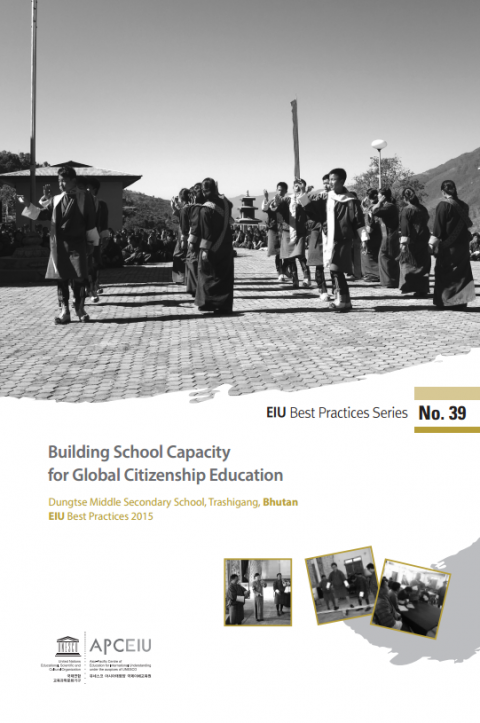 EIU Best Practices Series No. 39: Building School Capacity for Global Citizenship Education 발행 연도: 2015 단체 저자: APCEIU This monograph is one of APCEIU's EIU Best Practices Series, which aims to encourage educators, scholars, and activists to implement and share local initiatives on EIU. The Series No.39 introduces the Training of Trainers (TOT) program, a workshop for teachers to better incorporate GCED/EIU concepts into respective curriculum and school environment. Upon participating in the APCEIU training workshop, Mr. Yeshi Dorji from Dungtse Middle Secondary School in Bhutan sought to create a forum in which teachers and school officials can learn to incorporate GCED. Such exemplary initiative not only enhances capacity building of educators in the school, but also has potential to have larger impact in the local and regional communities.
  [Summary] Global Citizenship Education Forum: Sharing Stories of Empowering Citizens to Tackle Global-Local Challenges 발행 연도: 2022 단체 저자: Permanent Delegation of the Republic of Korea to UNESCO | Group of Friends for Solidarity and Inclusion with Global Citizenship Education | APCEIU This report shares the overview of the Global Citizenship Education Forum held under the theme ‘Sharing Stories of Empowering Citizens to Tackle Global-Local Challenges’ on Friday, 13 May 2022. The event was co-organized by the Permanent Delegation of the Republic of Korea to UNESCO and the Asia-Pacific Centre of Education for International Understanding (APCEIU) in collaboration with the Group of Friends for Solidarity and Inclusion with GCED (Afghanistan, Armenia, Austria, Bangladesh, Canada, Colombia, Italy, Jordan, Kenya, Kuwait, Philippines, Republic of Korea, Saudi Arabia, Senegal and Serbia). This report shares the summary of the event, particularly the presentations on GCED activities implemented by practitioners from Armenia, Austria, Colombia, Jordan, Kenya and the Philippines to influence more GCED programmes/initiatives on various contexts and backgrounds.
  2022 SSAEM Conference: Final Report 발행 연도: 2023 단체 저자: APCEIU | Korea R. Ministry of Education The 2022 SSAEM (Sharing Stories of Asia-Pacific Education Movements) Conference is a space for examining and sharing the educational outcomes of the participating teachers and schools of the programme. This conference, which has been held annually since 2014, aims to provide an excellent opportunity for the participants and stakeholders to showcase the impact of the programme and to explore methods for strengthening cooperation for further development of the programme. The main programme included the panel discussion of the Ministry representatives of the 8 countries, the presentation of 2022 programme participants, etc.
  Asia-Pacific Teacher Exchange for Global Education 2022: Final Report 발행 연도: 2022 단체 저자: APCEIU | Korea R. Ministry of Education The Asia-Pacific Teacher Exchange for Global Education (APTE), which has been in place since 2012, marks its 10th anniversary this year. APTE had been conducted according to the existing programme execution system and flow chart until 2019. However, the Office of International Teacher Exchange (ITE) focused on online exchange due to the pandemic crisis. This year’s APTE programme followed last year’s online formula and presented a new direction for utilization even post-pandemic. These efforts are expected to enhance global educational competencies for a more sustainable Global Citizenship Education.
  2022 Youth Leaders’ Mentorship & Local GCED Projects: Activity Report 발행 연도: 2022 단체 저자: APCEIU This report summarizes 15 GCED projects implemented in different parts of the world by the alumni of APCEIU’s Youth Leadership Workshop on GCED in 2022. Ranging from community advocacy for global citizenship to girls’ empowerment projects, 15 GCED initiatives have been taken by the team of 15 young leaders in their own communities in Asia, Europe, Africa, Latin America, and the Caribbean. APCEIU offers GCED training programmes targeting youth leaders around the globe to encourage them to achieve the SDGs through global citizenship and GCED. Since 2015, the Youth Leadership Workshop on GCED has been held every year in the Republic of Korea, inviting 50 young global leaders to take part in an intensive training programme where they share their actions, deepen their knowledge on global/local issues, enhance their motivation to take actions for a change, and establish the young leaders’ network on GCED. Since 2021, it has been shifted to a comprehensive training programme composed of online training workshops, mentorship, and local project implementation.
  APCEIU-MNUAC Joint Research on Establishing the Foundation for Promoting Global Citizenship Education in Higher Education Institutions in Mongolia 발행 연도: 2025 저자: Daehoon Jho | Jihyang Lee | Odsuren Dagmid | Mandukhai Baldandorj | Tumennast Dashtsenden | Amartuvshin Myagmarsuren | Delgertsetseg Choijilsuren | Punsaldulam Binderiya 단체 저자: APCEIU | Mongolia National University of Arts and Culture (MNUAC) This report reviews the integration of global citizenship education (GCED) in higher education and examines various approaches to establishing a foundation for promoting GCED in Mongolian HEIs. To this end, the study conducted a situational analysis on the current status of GCED at MNUAC. Based on this analysis, the report proposes a GCED integration roadmap for MNAUC, outlining a sequenced pathway that begins with achievable initiatives while also offering insights for other HEIs in Mongolia. The report is available in both English and Mongolian.