
자료
세계시민교육에 대한 이해를 넓히고 연구, 옹호 활동, 교수, 학습 등을 향상시킬 수 있는 다양하고 유용한 자료를 찾아보세요.
220 건의 결과가 검색되었습니다
 Localizing the 2030 Agenda and Global Citizenship Education: An Essential Dialogue 발행 연도: 2020 단체 저자: Diputació de Barcelona Diputació de Barcelona has produced a document that offers guidelines to strengthen the links between Global Citizenship Education (GCE) actions and localizing SDGs initiatives, in order to drive real changes in local policies.What we call Global Citizenship Education (GCE) brings together key elements of different educational trends, such as development education, peace education or education for sustainability, among others. Each of them has decades of experience in promoting changes in citizen’s knowledge, attitudes and behaviours through formal or informal channels. This experience can help to reinforce the 2030 Agenda’s capacity to generate real change towards a more sustainable future for the planet, connecting local and global realities and highlighting interdependencies and co-responsibility. The document points out what can be done at the local level to improve this dialogue between SDG and GCE with practical proposals such as introducing GCE perspective in the SDGs training activities or implementing joint initiatives between development cooperation departments and other areas to reach new audiences.
  International Environmental Politics and Critical Approach to Global Citizenship Education 발행 연도: 2017 저자: Zheng Fuxing The research and practice of global citizenship education have thrived since 1990s, but the effectiveness of global citizenship education is limited. The research cannot avoid the problematic premise of the possibility of global citizenship education. The identity predicament of global citizen and alienation of local implementing make probability of the global citizenship education problematic. The practial predicament of the global citizenship education maninfest5s that the nation state is the key factor of policy implementation. Environmental question, which is about global common good, attracts the attention from the government of most of nations, and becomes the good case for exploring the feasibility of global citizenship education. Environmental politics explain the inequality and injustice in the globally enviromental governance which made the global citizenship education critical. The critical ecopedagogy becomes the new form of global citizenship. The practice of the global citizenship education becomes viable by hybrid activism generated by dialectical movement between local and global in the limit of nation-state.
  Education for Global Citizenship: Promoting Democracy 발행 연도: 2019 저자: Manuela Mesa 단체 저자: Autonomous University of Madrid | Red Iberoamericana de Investigación sobre Cambio y Eficacia Escolar (RINACE) This paper makes a reflection on the role of education in the current international context, marked by profound changes and by a situation of uncertainty and instability and reverse in rights. It discusses the various interpretative frameworks that explain the current world and that are articulated around the global-local axis and ethnic-national identities and multiple identities. In a world characterized by the complexity and speed of changes, it is very important to overcome the the compartmentalization of knowledge in areas such as mathematics, social, language, etc and look for global approaches. Education as a transformative practice cannot be outside of the major challenges facing humanity at the national and multilateral. The 2030 Agenda and the Sustainable Development Goals gives opportunities for the consolidation of the Education for Global Citizenship.
  Global citizenship in primary and secondary education in the Netherlands 발행 연도: 2012 저자: Lette Hogeling 단체 저자: National Committee for International Cooperation and Sustainable Development (NCDO) NCDO has examined the opinions and methods of teachers and directors with regard to global citizenship, as well as the obstacles and opportunities they experience around global citizenship in education. More than 1,500 teachers and almost 300 directors have participated in the research. A large majority of the teachers in primary and secondary education think that global citizenship is an important subject for Dutch education. Also, the majority of the teachers are of the opinion that it is important that the lessons link up with current events. Nevertheless, only a minority of the teachers in primary and secondary education believe that global citizenship should be a compulsory part of the curriculum. It is mainly teachers of geography, economics, cultural and social subjects who are of the opinion that global citizenship is an important theme.
 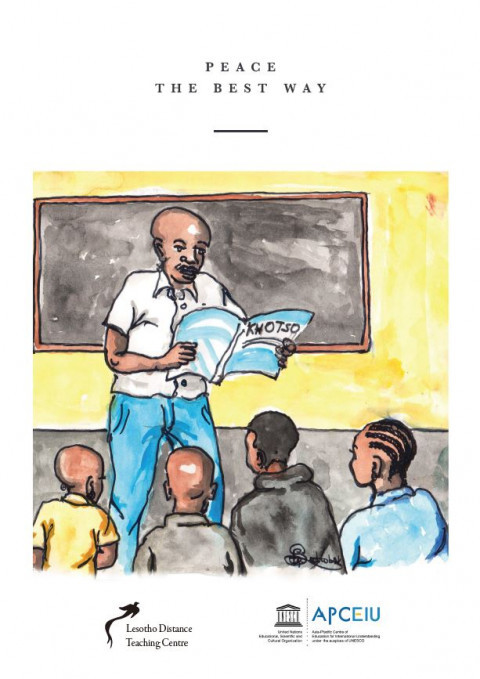 Peace the Best Way 발행 연도: 2017 단체 저자: Lesotho Distance Teaching Centre (LDTC) The storybook titled “Peace, the Best Way (Ngoan’a Khotso Ha a Lebale Tsa Khotso)” is an end-product of Workshop in Lesotho on GCED: Teacher Training on Peace Education & GCED Learning Material Development held between 12 and 14 of July 2017. During the workshop, participants created learning materials on peace and conflict transformation based on what they have learned throughout the sessions.The authors share their stories of conflicts that they encounter in their everyday lives and further identify ways of managing and resolving the conflicts in a peaceful manner to let everyone live in harmony. They hope to instill the importance of peace not only to the adults reading the book, but also to the younger generation who learn from their parents and adults of the community.The book published in English as well as Sesotho, will be used as teaching and learning resources for learners and also be disseminated to public locations including schools, community centers and libraries.For more information on the Workshop, Please click here.
 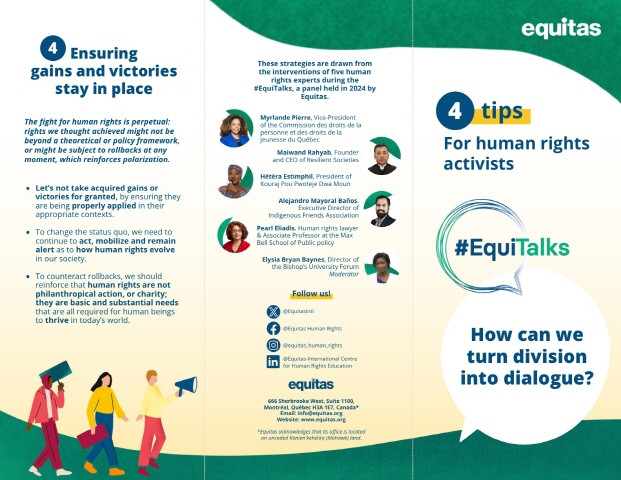 #EquiTalks: How Can We Turn Division into Dialogue? 발행 연도: 2024 단체 저자: Equitas This brochure gathers the answers of five human rights defenders during the 2024 #EquiTalks panel discussion, who attempted to answer the question: How can we turn division into dialogue? The brochure suggests potential solutions and tips to counteract the polarization of opinions on human rights.
 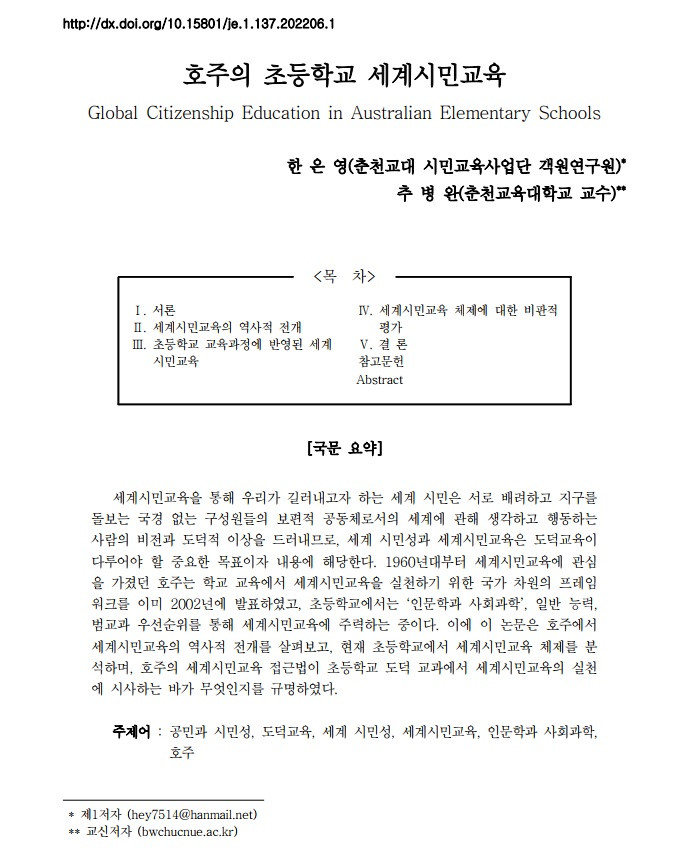 Global Citizenship Education in Australian Elementary Schools(Journal of Ethics; Vol. 137, No 1) 발행 연도: 2022 저자: 한은영 | 추병완 단체 저자: 한국윤리학회 Global citizens think and act about the world as a universal community of borderless members who care for each other and are dedicated to taking care of the earth. Considering these visions and moral ideals, global citizenship education is an important goal and content of moral education. However, at present, we do not have a framework for dealing with global citizenship education in moral education. In this regard, Australia is the country we should pay attention to. Australia declared a national statement for global citizenship education in 2002. Since 2009, it has been reflected in the Australian curriculum. This article examines the historical development of global citizenship education in Australia, analyzes the current systems of global citizenship education system in primary schools, and investigates what Australia's approach to global citizenship education suggests for elementary moral education in Korea. In conclusion, we proposed three things. First, we must develop and apply a framework for the practice of global civic education in moral education. Second, we should emphasize the aspects of knowledge and understanding, skills and processing, behavior and participation as well as values and attitudes. Third, we must seek a balance between moderate global citizenship education and critical global citizenship education.
  SDG4 이행 촉진을 위한 지표 연구 발행 연도: 2025 저자: 박근영 | 주형미 | 문무경 | 오예진 | 류기락 | 조혜승 | 변종임 | Sunmi Ji | 이슬비 | 박기웅 | 안해정 | 서무계 단체 저자: Korean National Commission for UNESCO 지속가능발전목표(SDGs) 이행의 전환점을 맞아 국내 교육의 현황과 과제를 SDG4 지표를 통해 진단하고 향후 방향을 탐색한 연구 보고서 <목차> 발간사 ‘SDG4 이행 촉진을 위한 지표 연구’ 보고서를 발간하며 서론 현 시점의 SDG4 이행 수준 점검과 개선 방향 탐색의 당위성 SDG 4.1 공평하고 양질의 초·중등 교육 이수 보장에 대한 한국 현황 및 향후 과제 SDG 4.2 영유아 교육과 보육 지표 검토와 향후 과제 SDG 4.3 고등교육의 수월성과 형평성 논의 및 향후 과제 SDG 4.4 고용을 위한 스킬: SDG 4.4의 이행 현황과 과제 SDG 4.5 교육 형평성 실현을 위한 SDG 4.5 지표 검토와 이행 현황 분석 SDG 4.6 한국의 SDG 4.6 이행 현행과 과제: 성인 문해력 SDG 4.7 더불어 살기 위한 학습을 향하여: 세계시민교육 및 지속가능발전교육 이행 현황과 모니터링 개선 방안 탐색 SDG 4.a SDG 4.a.1과 한국 디지털 교육 이행 현황: 접근성, 사용도, 스킬 SDG 4.b 공적개발원조(ODA) 장학금 확대 SDG 4.c 자격을 갖춘 교사의 공급 관련 이행 현황 및 개선 방안 결론 엄격한 현실 인식에 기반한 다음 목표로의 이행 준비
  Educational Pack: Claire Ravez, research analyst focused on monitoring and analysis, IFE 발행 연도: 2021 단체 저자: French Institute of Netherlands As a professor of history and geography, Claire Ravez joined the Monitoring and Analysis team of the French Institute of Education within the École normale supérieure de Lyon in 2017.Pedagogical file #1 is dedicated to civic education, with contributions from Claire Ravez, Dominique Schnapper, FEi, and the National Library of France.
 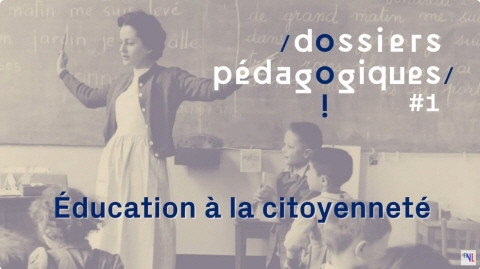 Education Pack: Dominique Schnapper, sociologue 발행 연도: 2023 단체 저자: French Institute of Netherlands Member of the Constitutional Council from 2001 to 2010, Dominique Schnapper is a French sociologist and political scientist. pedagogical file #1 is dedicated to civic education, with contributions from Claire Ravez, Dominique Schnapper, FEi and the BnF.