
자료
세계시민교육에 대한 이해를 넓히고 연구, 옹호 활동, 교수, 학습 등을 향상시킬 수 있는 다양하고 유용한 자료를 찾아보세요.
224 건의 결과가 검색되었습니다
 Address by Irina Bokova, Director-General of UNESCO on the occasion of the Plenary Session: Education for Intercultural Citizenship, AoC Third Global Forum; Brazil, 29 May 2010 발행 연도: 2010 단체 저자: UNESCO. Director-General, 2009-2017 (Bokova, I.G.) This is an address by Irina Bokova, Director-General of UNESCO on the occasion of the plenary session for Education for Intercultural Citizenship in Brazil, on 29 May 2010. She insisted the importance of education for 'Learning to Live together'. She also highlited education for inter-cultural understanding as an important theme for the 21st centry.
  A Comparative Study on Global Citizenship Education between Korea and ASEAN 발행 연도: 2015 단체 저자: Korea Institute for Curriculum and Evaluation (KICE) This research is the second-year study for a three-year project (2013-2015) focused on the global citizenship education of ASEAN (Association of Southeast Asian Nations). In the first-year study (2013), the current global citizenship education presented in the social studies curriculum of each country was analyzed based on literature research, and the global citizenship of students from each country was examined through surveys. Based on the analysis of the current global citizenship education of Korea and ASEAN overall and the characteristics of global citizenship of students from each country, this study is designed to make an in-depth analysis of global citizenship education and to seek direction for the joint global citizenship education programs between Korea and ASEAN to be employed in the third-year research.The students from the two countries, Indonesia and Thailand, among the 10 ASEAN countries are selected as participants because these two countries also participated in the previous international comparison study. The purposes of this study are as follows; (1) comparing the current global citizenship education of the national-level curriculum of Korea, Indonesia, and Thailand, (2) finding the similarities and differences by analysing the characteristics of global citizenship education of Korean, Indonesian, and Thai students, and (3) proposing the direction and themes of global citizenship education which will be mutually applied in Korea and ASEAN countries based on the research results.To conduct this study, various methods including literature study, interviews through visits to local schools, conferences for specialists, and international seminars were used. First, the meaning and goals of global citizenship education were established by reviewing literature and the concepts of ‘Humanity’, ‘Global Identity’, and ‘Global Participation’, which are the three sub-indices for global citizenship extracted from the first-year study, were used. Based on this framework, interview protocols for students, teachers, and policy makers were composed.The research team visited Indonesia and Thailand, carried out semi-structured interviews with students, teachers, and policy makers of national-level curriculum and classroom observations, and collected data related to global citizenship education. In addition, by conducting an international seminar with policy makers of curriculum of each country’s Ministry of Education and UNESCO specialists, we aimed to seek direction for joint global citizenship education in Korea and ASEAN and to reinforce educational cooperation.The major findings of this research can be suggested according to the research purposes in the following way.First, in the analysis of the national-level curriculum made for the comparison of current global citizenship education of Korea, Indonesia, and Thailand, the curriculum of each country is found to include elements of global citizenship education. However, countries show discrepancies in their actualization of curriculum, and citizenship education is still centered on national citizenship rather than global citizenship. Therefore, a more systematic attempt is needed for the advancement of citizenship education from nation-centered to globally oriented.Second, the findings from the interviews with students of each country carried out to define the characteristics of global citizenship of Korean, Indonesian, and Thai students indicate that while students’ responses showed a number of similarities in general, differences were found in specific answers as well. High school students provided more logical answers with greater depth compared to middle school students, and their responses differed based on their cultural contexts and experiences rather than their gender or religion. Therefore, while taking an approach which considers the level of students’ cognitive development as well as the cultural distinctiveness of each country, a way to expand opportunities for specific activities and experiences rather than an abstract way of teaching should be considered.Third, based on the analysis results, the directions and themes for global citizenship education to be jointly applied in Korea and ASEAN countries are proposed as follows: (1) The curriculum for global citizenship education should be focused on reinforcing the competency of citizens to participate in communities rather than that of individuals to ensure international competitiveness. (2) It is necessary to educate students to confront various conflicts and solve them by themselves rather than teaching them the abstract answers to the conflicts. (3) Global citizenship education should move beyond knowledge-based education and aim to lead bring changes in students’ behavior thereby empowering them to settle global issues. (4) For the actual implementation of curriculum, the cultural distinctiveness of each country and the differences by groups should be considered. (5) It is important to help students spread their interest to diverse countries beyond Western countries or ‘developed countries’.With these points in consideration, the objective of global citizenship education to be jointly promoted in Korea and ASEAN is suggested as the following: “Citizens are cultivated to form their identity as Asians based on their interest and knowledge of Asia and to participate in settling global issues. Through this, their qualities to participate in issues concerning all humanity are eventually cultivated.” The specific themes may include understanding Asia and ASEAN, social justice and equality, diversity, globalization and interdependence, conflict and peace, as well as sustainable development and environment. To improve effectiveness of joint global citizenship education of Korea and ASEAN and to reinforce educational cooperation, we made the following three suggestions.First, the standardization of global citizenship education across the nation is required. Having defined global citizenship education as the cultivation of the qualities of citizens based on the perception of human rights (Humanity) and with the identity as a global citizen (Global Identity) who can participate in settling the issues of global society (Participation), global citizenship education will yield the greatest efficiency when carried out together by all beyond national boundaries. Therefore, it is suggested that research for developing and expanding the joint curriculum by regions be supported and close cooperation be formed between policy makers of national curriculum and officials of International Training and Cooperation.Second, the reinforcement of global citizenship education through teacher training is required. For the effective implementation of joint global citizenship education in each country through the standardization of global citizenship education, the cultural diversity and distinctiveness of each country should be reflected. For these reasons, various practical bottom-up strategies are needed. Teacher training is a mandatory prerequisite for global citizenship education that is appropriate for the situations and contexts of each country. Therefore, it is suggested that researchers find out how to reinforce global citizenship education in teacher training based on solid research.Third, global citizenship education should be expanded by the exchange of human resources. As confirmed in this study, the exchange itself can bring a positive influence on the cultivation of global citizenship, and the sharing of the strategies for global citizenship education in each country can contribute to the development of a model for better global citizenship education. Therefore, it is suggested that the research for the joint promotion of project-based global citizenship education and the opportunities for mutual exchange of students and teachers between Korea and ASEAN countries should be expanded.
  UNESCO - UCLA Chair in Global Learning and Global Citizenship Education 발행 연도: 2016 단체 저자: HFP | global media Documentary Presentation of Dr. Carlos A. Torres as UNESCO-UCLA Chair in Global Learning and Global Citizenship Education.
 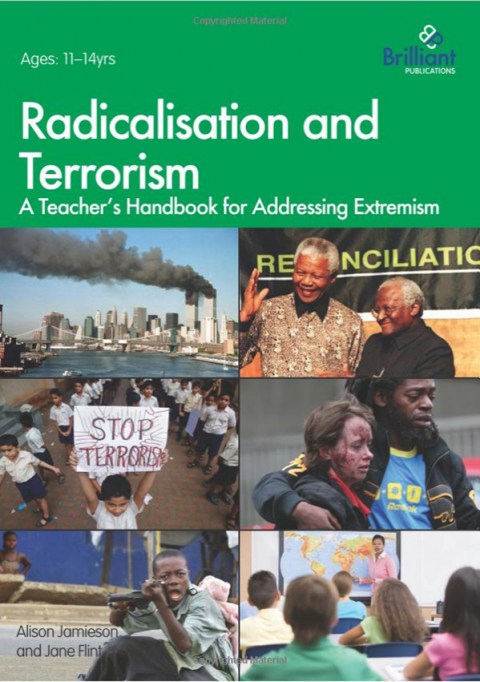 Radicalisation and Terrorism: A Teacher's Handbook for Addressing Extremism 발행 연도: 2015 저자: Alison Jamieson | Janet Flint This practical handbook provides a reliable and objective resource to enable lower secondary school teachers to tackle the complex subjects of terrorism and radicalization with confidence. The text covers issues of citizenship, human rights and respect, civil and political engagement, the nature of identity and how we identify with others. It examines different forms of violence from bullying to the most recent examples of 21st century terrorism. Historical precedent is used to illustrate a variety of contexts in which political violence has occurred, from Assassins through Suffragettes to militancy in South Africa, Europe, the Middle East and Oceania.
  Teaching Controversial Issues 발행 연도: 2006 단체 저자: Oxfam GB Young people frequently face making decisions about a wide range of issues on which there are many different views. Issues like sexuality, religion, bullying, and war can evoke complicated emotions, both in and out of the classroom.Young people need to develop skills that allow them to discuss and come to their own views about these types of issues. Having a chance to engage with controversial topics in a constructive environment will help young people to develop as global citizens, and teachers have a key role to play in enabling this.This guide explores what controversial issues are, why they should be taught, and includes classroom strategies, existing guidance and practical teaching activities.
 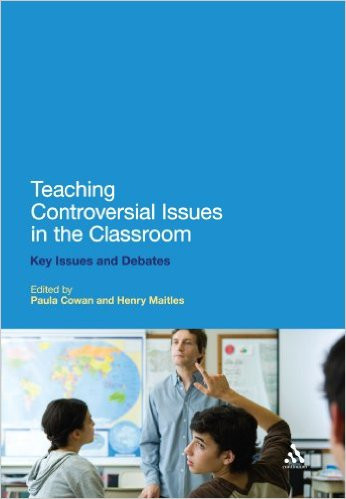 Teaching Controversial Issues in the Classroom: Key Issues and Debates 발행 연도: 2012 저자: Paula Cowan, Henry Maitles 단체 저자: Continuum The book provides an exploration of current debates and controversies relating to teaching controversial issues in primary and secondary schools. It investigates the changing nature of this type of learning experience and explore its contribution to the curriculum, particularly history and citizenship education. Topics covered include: - What is the 'right' age to discuss controversial issues? - The Citizenship Agenda - Discussing Iraq with school students - Teaching the Holocaust in the multicultural classroom – Islamophobia. International case studies provide fresh insights and valuable student and teacher feedback regarding the teaching of what many perceive as sensitive and difficult subjects.
  Educating Against Extremism: Towards a Critical Politicisation of Young People 발행 연도: 2009 저자: Lynn Davis The paper examines the nature of extremism; identity formation and radicalization; religious belief, faith schools and the myth of equal value; justice, revenge and honour; and free speech, humour and satire. It argues that religious fundamentalism, as well as state terrorism, needs to be addressed in schools. Specific forms of citizenship education are needed, which provide skills to analyse the media and political or religious messages, but also enable critical idealism to be fostered.
  Global Citizenship Education and the Crises of Multiculturalism: Comparative Perspectives 발행 연도: 2016 저자: Massimiliano Tarozzi, Carlos Alberto Torres The notion of global citizenship education (GCE) has emerged in the international education discourse in the context of the United Nations Education First Initiative that cites developing global citizens as one of its goals. In this book, the authors argue that GCE offers a new educational perspective for making sense of the existing dilemmas of multiculturalism and national citizenship deficits in diverse societies, taking into account equality, human rights and social justice.The authors explore how teaching and research may be implemented relating to the notion of global citizenship and discuss the intersections between the framework of GCE and multiculturalism. They address the three main topics which affect education in multicultural societies and in a globalized world, and which represent unsolved dilemmas: the issue of diversity in relation to creating citizens, the issue of equality and social justice in democratic societies, and the tension between the global and the local in a globalized world.Through a comparative study of the two prevailing approaches – intercultural education within the European Union and multicultural education in the United States – the authors seek what can be learned from each model. Global Citizenship Education and the Crises of Multiculturalism offers not only a unifying theoretical framework but also a set of policy recommendations aiming to link the two approaches. Preface 1. The Priority of Global Citizenship EducationPart One Defference and Citizenship 2. Theoretical Conceptualization: The Challenge of Diversity 3. Multiculturalism: The US Perspective 4. Interculturalism: The European Union Perspective 5. Comparing Intercultural and Multicultural EducationPart Two Justice in Democracies 6. Theoretical Conceptualization: The Challenge of Equlaity 7. From Multiculturalism to Global Citizenship Education 8. ConclusionBibliographyIndex
 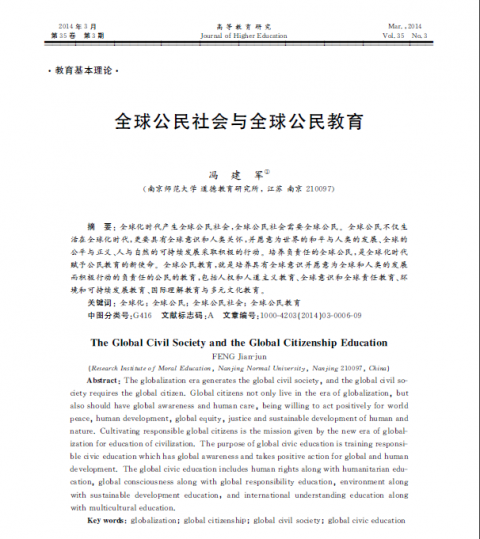 The Global Civil Society and the Global Citizenship Education 발행 연도: 2014 저자: Feng Jianjun The globalization era generates the global civil society, and the global civil society requires the global citizen. Global citizens not only live in the era of globalization, but also should have global awareness and human care, being willing to act positively for world peace, human development, global equity, justice and sustainable development of human and nature. Cultivating responsible global citizens is the mission given by the new era of globalization for education of civilization. The purpose of global civic education is training responsible civic education which has global awareness and takes positive action for global and human development. The global civic education includes human rights along with humanitarian education, global consciousness along with global responsibility education, environment along with sustainable development education, and international understanding education along with multicultural education.
 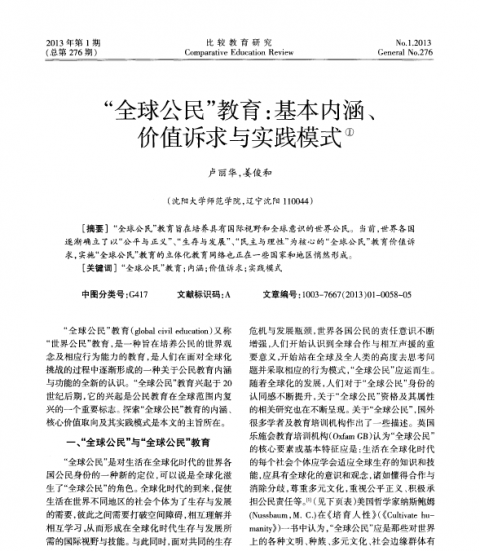 The Concept, Values and Implementation Models of GCED 발행 연도: 2013 저자: Lu Lihua, Jiang Junhe “Global Citizenship education” aims to cultivate global citizens with an international perspective and global awareness. At present, there are more and more countries focusing on developing the core education value including” equity and justice”, “survival and development” and “democracy and rationality” and builds the global citizenship education network.