
자료
세계시민교육에 대한 이해를 넓히고 연구, 옹호 활동, 교수, 학습 등을 향상시킬 수 있는 다양하고 유용한 자료를 찾아보세요.
127 건의 결과가 검색되었습니다
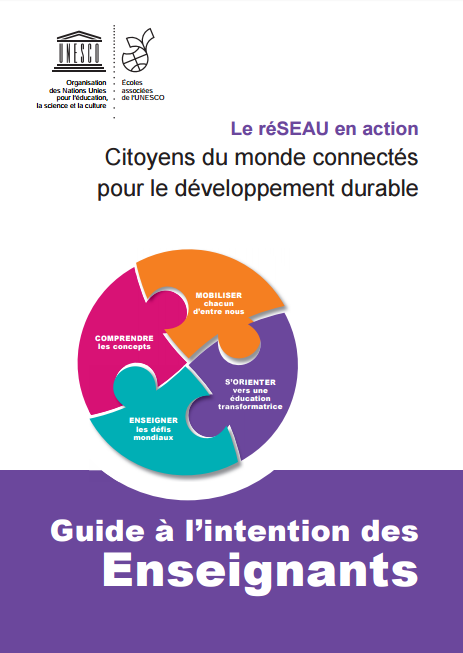 Le réSEAU en action: Citoyens du monde connectés pour le développement durable: guide à l'intention des enseignants 발행 연도: 2017 단체 저자: UNESCO Le guide à l’intention des enseignants : donne aux élèves une idée de ce que signifie pour eux « devenir des citoyens du monde » ainsi que des suggestions pour contribuer au développement durable ; propose des idées d’activités en classe pour aider les élèves du secondaire à développer des connaissances, des compétences, des valeurs, des attitudes et des comportements en faveur de l’ECM et de l’EDD ; présente une sélection d’activités sur l’ECM et l’EDD mises en œuvre par les écoles du réSEAU du monde entier.
 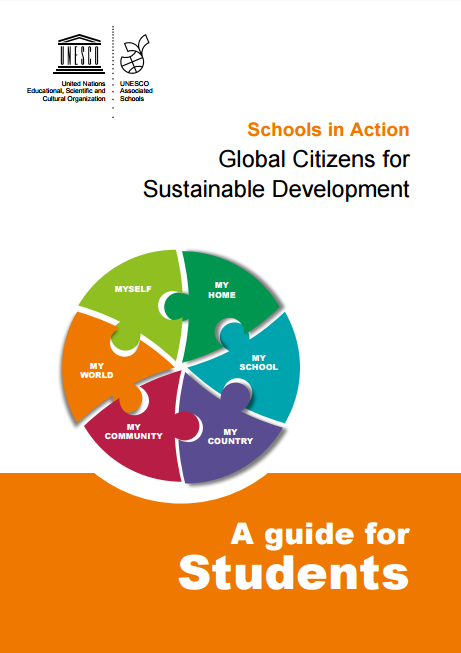 Schools in action, global citizens for sustainable development: a guide for students 발행 연도: 2016 단체 저자: UNESCO The UNESCO Associated Schools Project Network (ASPnet) in Action: Global Citizens for Sustainable Development student guide aims to introduce secondary school students to Global Citizenship Education (GCED) and Education for Sustainable Development (ESD) and provide them with ideas and activities to contribute proactively to a more peaceful and sustainable world. The guide draws on the discussions and activities of almost 1,100 participants from 104 countries, including ASPnet National Coordinators, school principals, teachers, students and experts who contributed to the ASPnet Online Collaborative Platform: Global Citizens Connected for Sustainable Development in 2014 and 2015 [http://en.unesco.org/aspnet/globalcitizens]. You will find in this student guide: An overview of what it means to be a global citizen and of how you can contribute to sustainable development. Ideas for getting active yourself, as part of your home, school, community, country and globally. Selected activities on GCED and ESD from ASPnet schools around the world. Escuelas en acción Ciudadanos del mundo para el desarrollo sostenible: guía para el alumnado 발행 연도: 2016 단체 저자: UNESCO The UNESCO Associated Schools Project Network (ASPnet) in Action: Global Citizens for Sustainable Development student guide aims to introduce secondary school students to Global Citizenship Education (GCED) and Education for Sustainable Development (ESD) and provide them with ideas and activities to contribute proactively to a more peaceful and sustainable world. The guide draws on the discussions and activities of almost 1,100 participants from 104 countries, including ASPnet National Coordinators, school principals, teachers, students and experts who contributed to the ASPnet Online Collaborative Platform: Global Citizens Connected for Sustainable Development in 2014 and 2015 [http://en.unesco.org/aspnet/globalcitizens]. You will find in this student guide: An overview of what it means to be a global citizen and of how you can contribute to sustainable development. Ideas for getting active yourself, as part of your home, school, community, country and globally. Selected activities on GCED and ESD from ASPnet schools around the world. Le réSEAU en action: Citoyens du monde connectés pour le développement durable: guide à l'intention des enseignants 발행 연도: 2016 단체 저자: UNESCO The UNESCO Associated Schools Project Network (ASPnet) in Action: Global Citizens for Sustainable Development student guide aims to introduce secondary school students to Global Citizenship Education (GCED) and Education for Sustainable Development (ESD) and provide them with ideas and activities to contribute proactively to a more peaceful and sustainable world. The guide draws on the discussions and activities of almost 1,100 participants from 104 countries, including ASPnet National Coordinators, school principals, teachers, students and experts who contributed to the ASPnet Online Collaborative Platform: Global Citizens Connected for Sustainable Development in 2014 and 2015 [http://en.unesco.org/aspnet/globalcitizens]. You will find in this student guide: An overview of what it means to be a global citizen and of how you can contribute to sustainable development. Ideas for getting active yourself, as part of your home, school, community, country and globally. Selected activities on GCED and ESD from ASPnet schools around the world.
  Coding global citizenship in the digital era (SangSaeng no. 44 winter 2015) 발행 연도: 2015 단체 저자: APCEIU Summary:The 44th issue of SangSaeng, “Coding Global Citizenship in the Digital Era,” has been released. The advancement of digital technology has connected the world, accelerating globalization. In this global digital age, Global Citizenship Education (GCED) is drawing enormous attention. Recognizing its significance, this Winter edition brings out the topic of GCED for digital citizens through the lens of education policymakers, children and youth, and corporations. In particular, the articles suggest actively participating in and contributing to the information society through ethical, safe, and responsible use of digital technology as the core competency for global citizens in the digital era.8 Striking a Balance Between Digital Opportunities & Related Risks12 Young People as Active Citizens in the Digital Age16 Empowering Children to Become Creative Digital Leaders20 Fostering Inclusive Innovation for a Better World38 Interview38 Understanding Culture through Media and Language40 Embracing Diversity to Live Together42 Peace in My MemoryTo achieve Peace, Must Understand Peace46 Understanding the Asia-Pacific RegionGlimpse into Ancient Healing Ritual of Ulik Mayang50 APCEIU in Action Codage de la citoyenneté mondiale à l'ère du numérique (SangSaeng no 44 hiver 2015) 발행 연도: 2015 단체 저자: APCEIU Le 44e numéro de SangSaeng, intitulé «Codage de la citoyenneté mondiale à l'ère numérique», a été publié. L'avancement de la technologie numérique a connecté le monde, l'accélération de la mondialisation. À l'ère numérique mondiale, l'éducation à la citoyenneté mondiale (ECM) attire l'attention. Reconnaissant son importance, cette édition d'hiver met en évidence le thème du ECM pour les citoyens numériques à travers l'optique des responsables de l'éducation, des enfants et des jeunes et des entreprises. En particulier, les articles proposent de participer activement à la société de l'information et de contribuer à celle-ci par une utilisation éthique, sûre et responsable des technologies numériques comme compétence fondamentale pour les citoyens du monde à l'ère du numérique.8 Trouver un équilibre entre les Débouchés Numériques et les Risques Connexes12 Les Jeunes en tant que Citoyens Actifs à l'ère du Numérique16 Permettre aux enfants de devenir des leaders numériques créatifs20 Favoriser l'innovation inclusive pour un monde meilleur38 Entretien38 Comprendre la Culture par le biais des Médias et de la Langue40 Adopter la Diversité pour Vivre Ensemble42 La Paix dans ma MémoirePour atteindre la paix, il faut comprendre la paix46 Comprendre la région Asie-PacifiqueDécouvrez le rituel de guérison antique d'Ulik Mayang50 APCEIU en action
  دور اليونسكو ومسؤولياتها في وضع تعليم المواطَنة العالمية موضع التطبيق وتعزيز التعليم من أجل السلام وحقوق الإنسان والتعليم من أجل التنمية المستدامة 발행 연도: 2015 단체 저자: UNESCO This document is an addendum to document 196 EX/32. This item was included in the provisional agenda of the 196th session of the Executive Board at the request of Austria and Italy
  Are we all global citizens now? Reflections on citizenship and citizenship education in a globalising world (with special reference to Singapore) 발행 연도: 2012 저자: Saravanan Gopinathan 단체 저자: Centre for Governance and Citizenship | Hong Kong Institute of Education Research into citizenship education has traditionally focused on citizenship curricula within the context of the nation-state. More recently, as a response to globalization trends, it has been suggested that citizenship research must embrace the concept of the 'global citizen.' Such perspectives draw principally on Anglo-Saxon perspectives on the evolution of the nation-state and citizen-state relations. This perspective is critiqued from the context of a post-colonial developing state, Singapore, and an argument made that a nation-centric perspective is still viable. Sommes-nous tous les citoyens du monde maintenant? Réflexions sur la citoyenneté et l'éducation à la citoyenneté dans un monde globalisé (avec référence spéciale à Singapour) 발행 연도: 2012 저자: Saravanan Gopinathan 단체 저자: Centre for Governance and Citizenship | Hong Kong Institute of Education La recherche sur l'éducation à la citoyenneté est traditionnellement concentrée sur les programmes de la citoyenneté dans le cadre de l'État-nation. Plus récemment, en réponse aux tendances de la mondialisation, il a été suggéré que la recherche sur la citoyenneté doit embrasser le concept de «citoyen du monde». Ces perspectives attirent principalement sur les perspectives anglo-saxons sur l'évolution des relations de l'État-nation et de l'Etat-citoyen. Cette perspective est critiquée dans le cadre d'un post-colonial en développement état, Singapour, et un argument fait que la perspective de la nation centrée est toujours viable.
  Education for 'Global Citizenship': A Framework for Discussion 발행 연도: 2013 저자: Sobhi Tawil 단체 저자: UNESCO The notion of ‘global citizenship’ has recently gained prominence in international development discourse with the recently-adopted United Nations Secretary-General’s Global Education First Initiative (2012). Among the three priority areas outlined in this global initiative, the third aims to ‘foster global citizenship’.The notion of ‘global citizenship’, however, remains very broad, if not contested, and consequently difficult to operationalize in education. There are two possible reasons for this. Firstly, it is unclear whether the very notion of ‘global citizenship’ is a metaphor, a contradiction of terms, or an oxymoron (Davies, 2006). Secondly, when applied to education, the notion of ‘global citizenship’ implies a certain degree of confusion. This paper discusses the following questions. What does ‘global citizenship’ possibly imply both from a legal perspective, as well as from that of collective identity, sense of belonging, and civic engagement? Is ‘global citizenship education’ (or ‘education for global citizenship’) merely an expression of a fundamental purpose of education systems? Does it also refer to a broad area of teaching and learning? If so, what are the contours of this domain? How does it relate to other often overlapping areas of learning associated with civic and political socialization?