
자료
세계시민교육에 대한 이해를 넓히고 연구, 옹호 활동, 교수, 학습 등을 향상시킬 수 있는 다양하고 유용한 자료를 찾아보세요.
169 건의 결과가 검색되었습니다
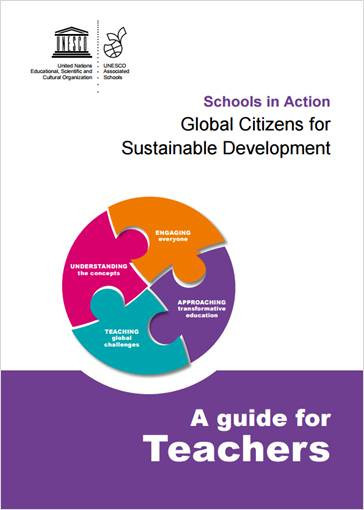 Escuelas en acción, ciudadanos del mundo para el desarrollo sostenible: guía para el profesorado 발행 연도: 2016 단체 저자: UNESCO The Global Citizens for Sustainable Development Teachers’ guide aims to introduce teachers to Global Citizenship Education (GCED) and Education for Sustainable Development (ESD). It provides secondary school teachers with ideas and activities to help students become global citizens and sustainable development actors. The Teachers’ guide draws on the discussions and activities of almost 1,100 participants from 104 countries, including ASPnet National Coordinators, school principals, teachers, students and experts who contributed to the Online Collaborative Platform ASPnet in Action: Global Citizens Connected for Sustainable Development in 2014 and 2015 [http://en.unesco. org/aspnet/globalcitizens] with associated activities and initiatives. The Teachers’ guide provides: An overview of what it means for learners to become global citizens and of how learners can contribute to sustainable development. Ideas for classroom activities that can help secondary school students to develop knowledge, skills, values, attitudes and behaviours that promote GCED and ESD. Selected activities on GCED and ESD from ASPnet schools around the world.
  Preventing Violent Extremism through Education: A guide for policy-makers 발행 연도: 2017 단체 저자: UNESCO This publication offers technical guidance for education professionals (policy-makers, teachers and various education stakeholders) on how to address the concrete challenges posed by violent extremism. The Guide particularly aims to help policy-makers within ministries of education to prioritize, plan and implement effective preventive educationrelated actions, contributing to national prevention efforts. La Prévention de l'extrémisme violent par l'éducation 발행 연도: 2017 단체 저자: Organisation des Nations Unies pour l'éducation, la science et la culture (UNESCO) Cette publication propose un guide technique pour les professionnels de l’éducation (décideurs, enseignants et autres acteurs du domaine) sur les façons d’adresser les défis posés par l’extrémisme violent. Le Guide vise particulièrement à assister les décideurs au sein des ministères de l’Éducation pour prioriser, planifier et instaurer des actions préventives en milieu scolaire complémentaires aux mesures préventives nationales. Preventing Violent Extremism through Education: A guide for policy-makers 발행 연도: 2017 단체 저자: 联合国教科文组织 (UNESCO) 该出版物在如何处理暴力极端主义带来的具体挑战的问题上为教育领域人员(政策制定者、教师以及各类教育利益相关者)提供了技术性的指导。该指导手册特别旨在帮助教育相关教育部门的政策制定者从教育方面入手优先考虑、规划并采取有效的预防性的相关行动,为国家预防工作做出贡献。
  Mainstreaming SDG4-Education 2030 in sector-wide policy and planning: technical guidelines for UNESCO field offices 발행 연도: 2016 단체 저자: UNESCO Mainstreaming SDG4-Education 2030 in sector-wide policy and planning offers technical guidelines for UNESCO field offices to ensure adequate technical support to national authorities. The guidelines take into account the different profiles of countries’ need and capacities, thus avoiding a one-size-fits-all approach. The document contains resources and pointers that can be combined and tailored to fit the particular context of each country. In all cases, UNESCO is expected to ensure that all the relevant information about SDG4-Education 2030 is properly disseminated in these guidelines. Field staff will adapt the guidelines provided here to the country they are serving to ensure that UNESCO plays its role as the leading United Nations agency in the field.
  All human beings... a manual for human rights education 발행 연도: 1998 저자: Kaisa Savolainen | Francine Best | Patrice Meyer-Bisch | Betty Reardon 단체 저자: UNESCO The World Conference on Human Rights (Vienna, 1993) took the position that human rights education, training and public information were essential in order to create and promote stable and harmonious relations among different communities and to foster mutual understanding, tolerance and peace.UNESCO has prepared this Manual for Human Rights Education as a contribution to the fiftieth anniversary of the Universal Declaration of Human Rights on 10 December 1998 and to the United Nations Decade for Human Rights Education (1995–2004). While intended mainly for educators, it may also be useful to secondary-school students and in the context of non-formal education.The Manual is the result of teamwork, with participation by numerous educators and experts from various regions of the world. A preliminary version was submitted to the delegates of UNESCO Member States at the 29th session of the Organization’s General Conference and has since been tested in several schools throughout the world.The Manual is addressed to primary- and secondary-school teachers and to instructors in non-formal education for children and adults. It is a teaching aid providing both theory and practical advice. However, parts of it can be used directly, without any teacher, by young people from the age of 14 upwards.Part 1 sets out an approach to the concepts essential if human rights education is to be rigorous, have a scientific basis, expand knowledge and promote thought. This part is to be read by teachers who wish to impart human rights education. It can be understood by secondary students aged 14 and over. It incorporates the basic components of the Declaration and Integrated Framework of Action on Education for Peace, Human Rights and Democracy (1994).Part 2 is addressed to schoolteachers and those in positions of responsibility. It is essentially a tool for teaching. It opens up avenues, makes suggestions and gives advice on how all educational disciplines can embrace the objectives inherent in human rights education. Obviously all teachers are free, in the light of their own cultures and individual pedagogical choices, to invent and create approaches and situations different from those suggested here.Part 3 presents a number of pedagogical examples that have been tried out and that provide an approach for educational work concerning a specific right. The plan follows that of the Universal Declaration of Human Rights, which is quoted and referred to at length. This part may be regarded as an educational demonstration of the features of this declaration, the fiftieth anniversary of which is being celebrated by UNESCO and the United Nations in 1998.All teachers and organizers can be guided by the experiments presented here to encourage information, training and reflection. There is no need to follow any particular order. As the need arises, a particular right (such as the right to health care or the right to live in a well-balanced environment) can be introduced before or after another right, or the focus may be on a single right.The Manual does not seek to be exhaustive but rather to propose material which can be developed and supplemented in an ongoing process. It will be for educators and learners, in their own cultural contexts, to discover how human rights can acquire meaning in their daily lives. Tous les êtres humains ... un manuel pour l'éducation aux droits de l'homme 발행 연도: 1998 저자: Kaisa Savolainen | Francine Best | Patrice Meyer-Bisch | Betty Reardon 단체 저자: UNESCO La Conférence Mondiale sur les Droits de l'Homme (Vienne, 1993) a pris la position que l'éducation aux droits de l'homme, la formation et l'information du public sont essentiels afin de créer et de promouvoir des relations stables et harmonieuses entre les différentes communautés et de favoriser la compréhension mutuelle, la tolérance et la paix. L'UNESCO a préparé ce manuel pour l'éducation aux droits de l'homme en tant que contribution au cinquantième anniversaire de la Déclaration Universelle des Droits de l'Homme, le 10 Décembre,1998 et à la Décennie des Nations Unies pour l'Éducation aux Droits Humains (1995-2004). Bien que destiné principalement aux éducateurs, il peut également être utile pour les élèves du secondaire et dans le cadre de l'éducation non formelle. Le manuel est le résultat du travail d'équipe, avec la participation de nombreux éducateurs et experts de différentes régions du monde. Une version préliminaire a été soumis aux délégués des Etats membres de l'UNESCO à la 29e session de la Conférence générale de l'Organisation et a depuis été testé dans plusieurs écoles à travers le monde. Le manuel est adressé au primaire et les enseignants du secondaire et aux instructeurs dans l'éducation non formelle pour les enfants et les adultes. Il est un outil pédagogique fournissant à la fois la théorie et des conseils pratiques. Toutefois, certaines parties peuvent être utilisées directement, sans enseignant, par les jeunes dès l'âge de 14 vers le haut. Partie 1 énonce une approche des concepts essentiels si l'éducation aux droits de l'homme est d'être rigoureux, ont une base scientifique, développer les connaissances et promouvoir la pensée. Cette partie doit être lu par les enseignants qui souhaitent donner une éducation aux droits de l'homme. Il peut être compris par les élèves du secondaire âgés de 14 ans et plus. Il intègre les composants de base de la Déclaration et Cadre d'action intégré concernant l'éducation pour la paix, droits de l'homme et la démocratie (1994). Partie 2 est adressée aux enseignants et ceux des postes de responsabilité. Il est essentiellement un outil pour l'enseignement. Il ouvre des pistes, fait des suggestions et donne des conseils sur la façon dont toutes les disciplines d'enseignement peuvent embrasser les objectifs inhérents à l'éducation des droits de l'homme. Il est évident que tous les enseignants sont libres, à la lumière de leurs propres cultures et les choix pédagogiques individuels, d'inventer et de créer des approches et des situations différentes de celles suggérées ici. Partie 3 présente un certain nombre d'exemples pédagogiques qui ont été expérimentées et qui fournissent une approche pour le travail éducatif concernant un droit spécifique. Le plan suit celle de la Déclaration universelle des droits de l'homme, qui est cité et renvoyé à la longueur. Cette partie peut être considérée comme une démonstration éducative des caractéristiques de cette déclaration, le cinquantième anniversaire de ce qui est célébrée par l'UNESCO et l'Organisation des Nations Unies en 1998. Tous les enseignants et les organisateurs peuvent être guidés par les expériences présentées ici pour encourager l'information, la formation et de réflexion. Il n'y a pas besoin de suivre un ordre particulier. Comme le besoin, un droit particulier (tel que le droit aux soins de santé ou le droit de vivre dans un environnement bien équilibré) peut être introduit avant ou après un autre droit, ou la mise au point peut être sur une seule droite. Le manuel ne cherche pas à être exhaustive, mais plutôt de proposer du matériel qui peut être développée et complétée en un processus continu. Ce sera pour les éducateurs et les apprenants, dans leurs propres contextes culturels, de découvrir comment les droits humains peuvent acquérir un sens dans leur vie quotidienne.
  التربية من أجل التنمية المستدامة: كتاب مرجعي 발행 연도: 2013 단체 저자: UNESCO The target audiences for the Education for Sustainable Development Sourcebook are primary and secondary teachers and mid-level decision-makers, who have responsibility for primary and secondary education. Another primary audience is teacher educators who work with pre-service and in-service primary and secondary school teachers. The purpose of the publication is to describe ways in which education for sustainable development (ESD) can be integrated into primary and secondary schooling. This collection of briefs is designed to complement other ESD materials published by UNESCO. The topics for the briefs were selected in consultation with UNESCO Field Offices and Institutes. The briefs for primary and secondary teachers are specifically written for professional educators who work in formal education settings. The briefs for teachers as well as those for decision-makers address “gaps” in the UNESCO ESD literature. Educación para el desarollo sostenible: libro de consulta 발행 연도: 2012 단체 저자: UNESCO The target audiences for the Education for Sustainable Development Sourcebook are primary and secondary teachers and mid-level decision-makers, who have responsibility for primary and secondary education. Another primary audience is teacher educators who work with pre-service and in-service primary and secondary school teachers. The purpose of the publication is to describe ways in which education for sustainable development (ESD) can be integrated into primary and secondary schooling. This collection of briefs is designed to complement other ESD materials published by UNESCO. The topics for the briefs were selected in consultation with UNESCO Field Offices and Institutes. The briefs for primary and secondary teachers are specifically written for professional educators who work in formal education settings. The briefs for teachers as well as those for decision-makers address “gaps” in the UNESCO ESD literature. L'Education pour le développement durable: ouvrage de référence 발행 연도: 2012 단체 저자: UNESCO The target audiences for the Education for Sustainable Development Sourcebook are primary and secondary teachers and mid-level decision-makers, who have responsibility for primary and secondary education. Another primary audience is teacher educators who work with pre-service and in-service primary and secondary school teachers. The purpose of the publication is to describe ways in which education for sustainable development (ESD) can be integrated into primary and secondary schooling. This collection of briefs is designed to complement other ESD materials published by UNESCO. The topics for the briefs were selected in consultation with UNESCO Field Offices and Institutes. The briefs for primary and secondary teachers are specifically written for professional educators who work in formal education settings. The briefs for teachers as well as those for decision-makers address “gaps” in the UNESCO ESD literature.