
자료
세계시민교육에 대한 이해를 넓히고 연구, 옹호 활동, 교수, 학습 등을 향상시킬 수 있는 다양하고 유용한 자료를 찾아보세요.
171 건의 결과가 검색되었습니다
 Guide de mise en œuvre écoles éducation à l'environnement primaire et secondaire 발행 연도: 2005 단체 저자: China. Ministry of Environmental Protection L'ONU a proposé le développement durable et l'éducation environnementale dans l'Agenda 21 comme un objectif d'éducation pour le XXIe siècle. Dans de nombreux pays développés, l'éducation environnementale est devenue une partie importante de l'éducation qui est compatible avec le développement social. La Chine est également confrontée à de graves problèmes environnementaux qui font plus de demandes pour le mode de développement économique et le niveau de protection de l'environnement. Depuis les années 1980, bien que l'éducation environnementale a été effectuée dans les écoles primaires et secondaires, sa concentration était plus que la transmission des connaissances de l'environnement. Afin de nourrir l'idée de développement durable pour les étudiants et les encourager à prendre des mesures pour un avenir durable, le Ministère de l'éducation de la RPC a officiellement intégré l'éducation environnementale dans le cadre de la fondation des écoles primaires et secondaires. Ce guide vise à fournir des conseils concrets pour les enseignants et autres éducateurs à organiser des activités pour favoriser la compréhension globale du système environnemental des élèves et de développer leurs capacités à prendre des responsabilités pour la protection de l'environnement dans la vie sociale. Il donne également des conseils pour les services administratifs de l'école pour gérer et soutenir ces activités, d'exploiter et de développer de multiples ressources en éducation à l'environnement, et d'appliquer des méthodes et des stratégies pour l'éducation environnementale. En outre, il fournit des méthodes d'évaluation de l'éducation environnementale en tant que point de départ pour ajuster et améliorer la mise en œuvre de l'éducation environnementale. 中小学环境教育实施指南 발행 연도: 2005 단체 저자: China. Ministry of Environmental Protection The UN proposed sustainable development and environmental education in Agenda 21 as an educational goal for the twenty-first century. In many developed countries, environmental education has become an important part of education that is compatible with social development. China is also facing serious environmental problems that make more demands for mode of economic development and level of environment protection. Since the 1980s, although environmental education has been carried out in primary and secondary schools, its concentration was no more than imparting environmental knowledge. In order to nurture the idea of sustainable development for students and encourage them to take action for a sustainable future, the Ministry of Education of PRC has formally incorporated environmental education in the foundation course of primary and secondary schools. This guide aims to provide concrete advice for teachers and other educators to organize activities to foster students’ comprehensive understanding of the environmental system and develop their capacities to take responsibilities for environment protection in social life. It also gives advice for the school’s administrative departments to manage and support these activities, to exploit and develop multiple environmental education resources, and to apply different methods and strategies to environmental education. In addition, it provides methods of evaluating environmental education as a starting point to adjust and improve the implementation of environmental education. Inter-agency peace education programme: skills for constructive living; overview of the programme 발행 연도: 2005 저자: Antonella Verdiani 단체 저자: UN. Office of the United Nations High Commissioner for Refugees (UNHCR) | Inter-agency Network for Education in Emergencies (INEE) This manual is one of the components of the “Inter-Agency Peace Education Programme”. The programme is designed for education managers of ministries dealing with both formal and non-formal education and for agencies which implement education activities on behalf of the government. The implementation structure is based on the experience acquired over the eight years the programme has been in use, from 1998 to 2005. The programme has been evaluated by external experts and the new revised materials (2005) incorporate both the suggestions made in the evaluation and the feedback from the specialists who implemented it in the field. Programme Interinstitution d'éducation pour la paix: compétences pour la vie constructive; aperçu du programme 발행 연도: 2005 저자: Antonella Verdiani 단체 저자: UN. Office of the United Nations High Commissioner for Refugees (UNHCR) | Inter-agency Network for Education in Emergencies (INEE) Ce manuel est l'une des composantes du «Programme Interinstitution d'éducation pour la paix». Le programme est conçu pour les gestionnaires de l'éducation des ministères chargés de l'éducation formelle et non-formelle et pour les organismes qui mettent en œuvre des activités d'éducation au nom du gouvernement. La structure de mise en œuvre est basée sur l'expérience acquise au cours des huit années, le programme a été utilisé, de 1998 à 2005. Le programme a été évalué par des experts externes et les nouveaux matériaux révisés (2005) intègrent à la fois les suggestions formulées dans l'évaluation et les réactions des spécialistes qui œuvre dans le domaine.
 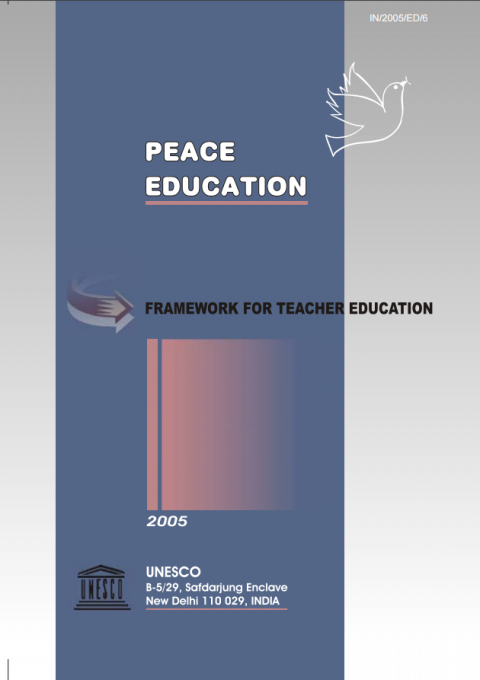 Peace education: framework for teacher education, 2005 발행 연도: 2005 단체 저자: UNESCO New Delhi UNESCO has taken a commendable initiative in promoting peace education. It has generated some important literature and educational material on peace education. ‘Learning the Way of Peace: A Teacher’s Guide to Peace Education’ is a pioneering work. It is because of UNESCO’s initiative that this material on peace education for teacher education has been developed. It would be useful to read this document in conjunction with “Learning the Way of Peace.” Éducation à la Paix: cadre pour la formation des enseignants 2005 발행 연도: 2005 단체 저자: UNESCO New Delhi L'UNESCO a pris une initiative louable dans la promotion de l'éducation de la paix. Il a généré une certaine littérature importante et du matériel éducatif sur l'éducation de la paix. «Apprendre la Voie de la Paix: Guide de l'Enseignant à l'Éducation de la Paix» est un travail de pionnier. Il est à cause de l'initiative de l'UNESCO que ce matériel sur l'éducation de la paix pour la formation des enseignants a été mis au point. Il serait utile de lire ce document en collaboration avec «Apprendre le Chemin de la Paix. » Educación para la ciudadanía y la convivencia: jóvenes por el empoderamiento y la transformación; ciclo cinco (décimo, undécimo, duodécimo) 발행 연도: 2014 단체 저자: Secretaría de Educación del Distrito (SED) | Fe y Alegría These twelve modules make reference to a series of activities that focus on how children from all the educative grades understand and live citizenship, strengthening and facilitating the learning processes based on autonomy. This educative materials, which are aimed at being implemented inside the classrooms, attempt to serve as input resources for educators and other agents that work on or are interested in working with citizenship education and coexistence. The overall objective is to provide quality education. Peace education in formal schools of West Africa: an implementation guide 발행 연도: 2012 단체 저자: West Africa Network for Peacebuilding (WANEP) This guide, first and foremost, seeks to bring hope and provide opportunity for practitioners to use tried and tested techniques to develop capacities of young people to build requisite knowledge and skills to become credible and responsible leaders. It provides both a conceptual and practical framework of peace education and confirms the potential benefits of Peace Education, particularly in the formal sector. It has been developed based on the extensive experience of WANEP’s Peace Education programme across West Africa and this experience has been outlined in great detail throughout the manual. The guide lays emphasis on entry points for developing and initiating Peace Education programmes in schools and provides practical tools for engaging various stakeholders and the wide range of potential roles they can play. In terms of the content of a peace education programme, guidelines are provided on developing a comprehensive programme that integrates effectively key concepts such as Gender and Human Rights. Critical issues of sustainability, resource mobilisation and monitoring and evaluation are covered using practical case studies based on the WANEP experience. The concluding chapter is devoted to addressing some Frequently Asked Questions. This laudable initiative and recommend this guide for adoption by West African states and institutions especially the educational sector as a tool for inculcating a culture of peace and nonviolence amongst children.The guide is divided into six chapters.Chapter 1 consists of introduction and the conceptual definition of basic philosophy that influenced the peace education program of WANEP. It also examines the role of peace education on the psycho social behaviour of youths in West Africa.Chapter 2 highlights WANEP’s guiding principles to the development of its peace education in the sub region and also the basic steps it took to implement its program in the seven (7) pilot states.Chapter 3 looks at how to mobilise resources to sustain the peace education program especially within the context of West Africa.Chapter 4 highlights the challenges that WANEP encountered in implementing the program.Chapter 5 emphasises the importance of monitoring and evaluation for impact and success of a peace education program.Chapter 6 deals with frequently asked questions by interested stakeholders. L’éducation à la paix dans les écoles formelles de l'Afrique de l'Ouest: un guide de mise en œuvre 발행 연도: 2012 단체 저자: West Africa Network for Peacebuilding (WANEP) Ce guide, d'abord et avant tout, cherche à apporter l'espoir et offrir la possibilité pour les praticiens à utiliser essayé et testé des techniques pour développer les capacités des jeunes à acquérir des connaissances et des compétences nécessaires pour devenir des leaders crédibles et responsables. Il fournit à la fois un cadre conceptuel et pratique de l'éducation de la paix et confirme les avantages potentiels de l'éducation pour la paix, en particulier dans le secteur formel. Il a été développé sur la base de la longue expérience du programme Education à la Paix de WANEP à travers l'Afrique de l'Ouest et cette expérience a été décrite en détail dans le manuel. Le guide met l'aCECnt sur les points d'entrée pour le développement et le lancement de programmes d'éducation de la paix dans les écoles et fournit des outils pratiques pour engager divers intervenants et le large éventail de rôles potentiels qu'ils peuvent jouer. En termes de contenu d'un programme d'éducation à la paix, les lignes directrices sont prévues sur l'élaboration d'un programme complet qui intègre les concepts efficacement clés tels que le genre et droits de l'homme. Les questions critiques de la durabilité, la mobilisation des ressources et de Suivi et de l'évaluation sont couverts au moyen d'études de cas pratiques fondées sur l'expérience WANEP. Le chapitre final est consacré à aborder quelques questions fréquemment posées. Cette initiative louable et recommande ce guide pour adoption par les Etats et les institutions ouest-africaines en particulier le secteur de l'éducation comme un outil pour inculquer une culture de la paix et de la non-violence chez les enfants. Le guide est divisé en six chapitres. Chapitre 1 est constitué d'introduction et la définition conceptuelle de la philosophie de base qui a influencé le programme d'éducation à la paix de WANEP. Il examine également le rôle de l'éducation de la paix sur le comportement social psycho des jeunes en Afrique de l'Ouest. Le chapitre 2 met en évidence les principes directeurs de WANEP au développement de son éducation à la paix dans la sous-région et aussi les étapes de base qu'il a fallu pour mettre en œuvre son programme dans les sept (7) Etats pilotes. Le chapitre 3 examine comment mobiliser des ressources pour soutenir le programme d'éducation à la paix en particulier dans le contexte de l'Afrique de l'Ouest. Le chapitre 4 met en évidence les défis que WANEP rencontrés dans la mise en œuvre du programme. Le chapitre 5 met l'aCECnt sur l'importance de Suivi et de l'évaluation de l'impact et le succès d'un programme d'éducation à la paix. Chapitre 6 traite des questions fréquemment posées par les parties intéressées. Kit de Plaidoyer pour la promotion de l'éducation multilingue: y compris les exclus 발행 연도: 2007 단체 저자: UNESCO Bangkok